What Is AI Search? Engines, How It Works, What It Changes
What is AI search?
AI search is search that answers instead of listing. You ask a question in plain language; the system retrieves relevant pages, reads them, and writes a direct answer, usually naming a handful of sources and brands along the way. The ten blue links become one synthesized response, and everything downstream of that difference, from user behavior to how brands compete, changes with it.
How AI search works
Under every AI search product runs the same loop. Retrieval: your question, often rewritten into several sub-queries, goes to a search index that returns candidate pages. Reading: the best passages are fed into a language model's context. Generation: the LLM writes the answer against those passages, ideally attaching citations. The architecture's name is RAG; Google's product word for it is grounding.
The loop matters practically: the retrieval half is classic search, which means classic search visibility still decides which pages ever reach the model.
The AI search engines in 2026
ChatGPT: the largest habit base; searches the web when its search tool fires, which makes its answers the most variable to measure. Gemini: Google's assistant, grounded in Google Search, tightly wired into Workspace and Android. Google AI Overviews: generated answers inside the classic results page; what they are and how to appear in them are their own disciplines. Google AI Mode: the fully conversational Google search surface (who shows up there). Perplexity: search as the entire product, every answer cited by design (what Perplexity is). Claude and Grok: the quieter engines, each with search-enabled modes and distinct source diets.
They share the loop and disagree on everything else: indexes, citation habits, source preferences. The same question routinely produces different brand lists on different engines.
AI search vs traditional search
Three shifts carry most of the weight. The unit of competition: a ranking slot becomes a mention inside an answer. You are one of the two or three names written, or absent. The click: a large share of AI search sessions end without a website visit, the zero-click pattern completed. The query itself: typed keywords become conversational questions with follow-ups, which moves targeting from keywords to questions.
What does not shift: the engines still crawl, index and rank to feed retrieval. Traditional search is not the opposite of AI search; it is the layer underneath it.
What AI search changes for brands
Discovery starts moving into answers you cannot see in analytics. A buyer asks an engine for options, hears three names, and shortlists before ever visiting a site. If you are not among the names, the funnel ended without a trace. That is why AI search created its own measurement discipline: AI visibility, tracked question by question and engine by engine, and its own optimization discipline, GEO.
Is there a best AI search engine?
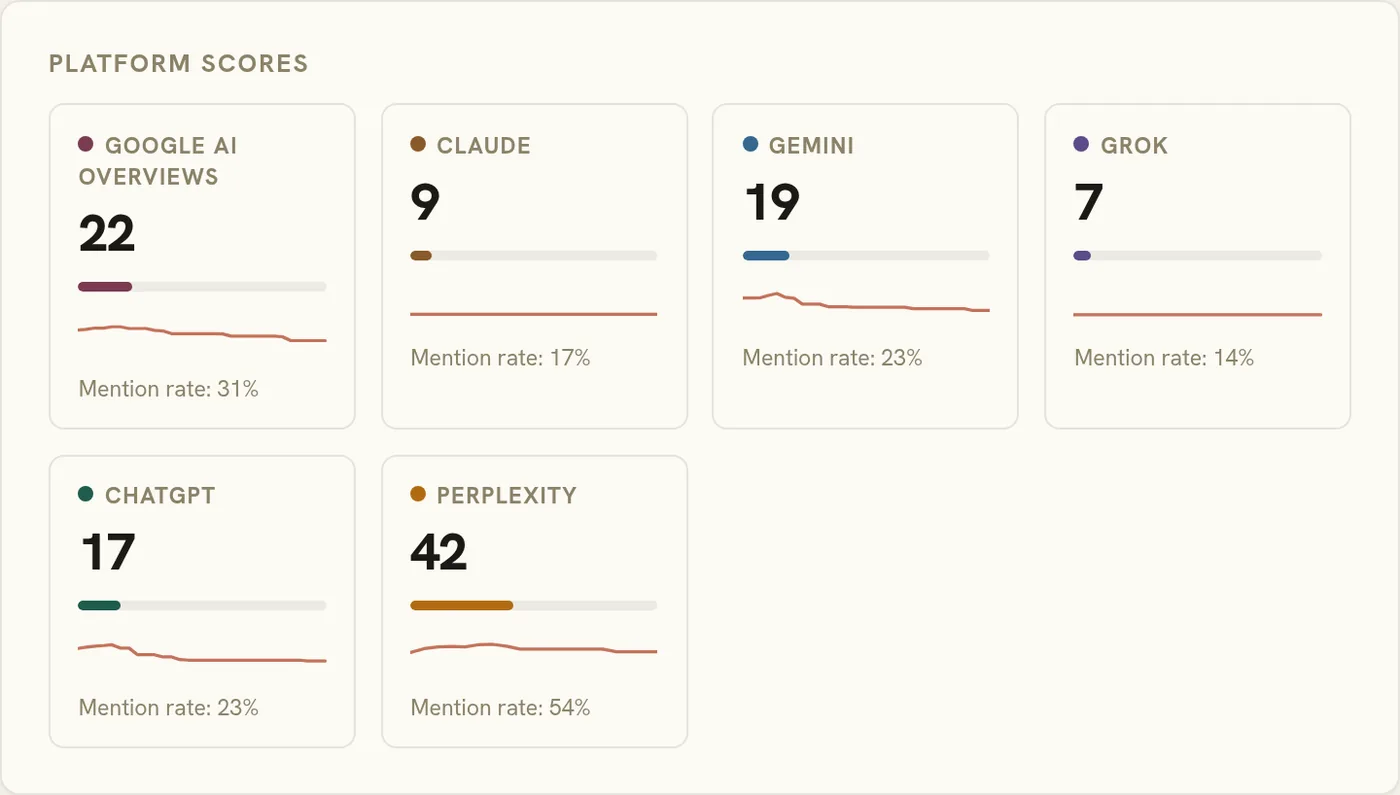
For users, it depends on the job: cited research favors Perplexity, everyday assistance favors ChatGPT or Gemini, staying inside Google favors AI Overviews and AI Mode. For brands the question inverts: the best engine is the one your buyers use, and in our panel most brands score similarly across engines, while roughly one in ten shows a 15+ point visibility gap on the same questions. The widest we have measured is 57 points. Whichever engine you optimize for first, measure all of them.
How people actually use AI search
Google's own published usage data for AI Mode sketches the behavior shift: AI queries run about three times longer than classic searches, follow-up questions grow month over month, and a meaningful share of queries now arrives as voice, image or video. People are not typing keywords at an answer engine: they are holding short interviews with it, and each follow-up re-runs retrieval with more context.
Two practical consequences. Targeting moves from keywords to questions: the unit worth tracking is "what should I look for when choosing X?", not "best X". And the conversation depth changes who wins: the brand that survives the follow-up ("which of these is cheapest?", "which works for small teams?") collects the user, which is why designing the question set you track around real dialogue, not single queries, separates useful measurement from vanity measurement.