GEO vs AEO vs LLMO: One Discipline, Too Many Names
Marketing has never met a practice it couldn't rename. The work of getting your brand into AI-generated answers is barely three years old and already carries at least four labels: GEO, AEO, LLMO, and the occasional AIO for people who felt the other three weren't confusing enough. Agencies pick one, build a services page around it, and quietly imply the other acronyms are doing something slightly different and slightly worse.
They're not. It's one discipline. Here's where each name came from, what the supposed differences are, and why you can stop worrying about picking the wrong one.
Where the GEO, AEO, and LLMO acronyms came from
Each term has a genuinely different origin story, which is the most interesting thing about the debate.
AEO (answer engine optimization) is the oldest. It predates ChatGPT by years. Around 2017 to 2019, when featured snippets, voice assistants, and "position zero" were the obsession, AEO meant structuring content so Google, Alexa, or Siri could read out a single direct answer. The term was sitting around mostly unused when generative AI arrived, and practitioners dusted it off because "answer engine" happens to describe ChatGPT pretty well. It's a repurposed term, not a new one.
GEO (generative engine optimization) has the most respectable birth certificate. It was coined in a 2023 academic paper by researchers from Princeton, Georgia Tech, the Allen Institute, and IIT Delhi, later presented at KDD 2024. The paper defined "generative engines," tested which content changes made sources more likely to be cited in AI answers, and put numbers on it. Whatever you think of the findings, GEO is the only term in this fight with a citation.
LLMO (large language model optimization) showed up around 2024, mostly in vendor blog posts. The pitch is that it targets the model itself (what an LLM "knows" and says about your brand from training data) rather than what an answer engine retrieves at query time. It's the newest term and the one working hardest to justify its existence.
If you want the full grounding on the core practice before the naming argument, start with what is GEO.
The claimed difference between GEO and AEO
When people argue GEO and AEO are distinct, the argument usually goes like this: AEO is about earning the answer (being the source an engine quotes directly, the modern descendant of the featured snippet). GEO is about influencing the synthesis: being mentioned, recommended, and cited inside a longer generated response that blends many sources.
There's a sliver of truth here. A Google AI Overview citation and a ChatGPT product recommendation are different surfaces, and we've written about how the answer-engine shift changes day-to-day work in AEO vs SEO. But notice what the distinction is actually describing: two output formats of the same underlying systems. The engine retrieves web content, weighs sources, and generates an answer. Whether that answer is a two-sentence extraction or a five-paragraph synthesis doesn't change what you'd do to appear in it.
Ask a GEO practitioner and an AEO practitioner for their checklists and you'll get the same document with different headers. Clear direct answers near the top of the page. Crawlable site, no robots.txt accidents. Structured data. Third-party mentions on sites the engines trust. Consistent entity information. Nobody has ever shown me an AEO tactic that a GEO practitioner would refuse to do, or vice versa.
What is LLMO, and does it add anything?
LLMO's claimed territory is the model's parametric memory: the stuff an LLM says about you with retrieval switched off, baked in from training data. The argument: GEO and AEO optimize retrieval, LLMO optimizes what the model learned.
It's the most defensible distinction on paper and the least useful one in practice, for one simple reason: you can't optimize training data directly. There's no console where you submit content to a training run. The only lever you have is publishing and earning content on the open web (authoritative pages, Wikipedia presence, press coverage, forum discussions) and hoping it's in the next crawl. Which is, letter for letter, the same work GEO prescribes for earning citations. The training corpus and the retrieval index are drawn from the same web. Feed one, feed the other.
So LLMO describes a real phenomenon (models have baked-in brand knowledge) but not a separate practice. It's a different accounting category for the same invoice.
Why the actual work is identical
Strip the labels and look at what anyone in this field actually does in a week:
- Publish content that answers real questions plainly, with the answer up top
- Keep the site technically clean and open to AI crawlers
- Add schema so machines can parse entities and claims
- Earn mentions, reviews, and citations on third-party sources
- Keep brand facts consistent everywhere so models don't improvise
- Track whether AI assistants actually mention you, and fix where they don't
That list is the job. Call it GEO and you're describing the engines. Call it AEO and you're describing the output. Call it LLMO and you're describing the model. The Tuesday-afternoon tasks don't move an inch.
Here's a hypothetical that plays out weekly: a SaaS founder asks three agencies why ChatGPT never mentions her product. Agency one sells a "GEO audit." Agency two pitches an "AEO content program." Agency three offers "LLMO brand entity optimization," which costs 20 percent more because it has the newest acronym. She buys all three out of curiosity. The deliverables arrive: the same crawlability check, the same schema recommendations, the same "get listed on comparison sites" advice, the same content restructuring. Three invoices, one discipline. The only genuine difference was the font on the cover page.
Which name will stick
Opinionated prediction time: GEO wins, and it mostly already has.
The evidence isn't subtle. Search interest for "generative engine optimization" appears to have outpaced the alternatives since mid-2024 (an observation from public trend tools, not a measured fact). The academic literature standardized on it. Most of the tooling ecosystem, including us, put it in their positioning. AEO survives as a secondary keyword (worth targeting because people search it, which is why this article exists), and LLMO is on track to join "web 2.0 consultant" in the museum of terms that described a moment rather than a job.
There's precedent for how this ends. Nobody won the "SEO vs search engine marketing vs findability" war of 2004 by being technically correct; one term hit critical mass and the rest became synonyms in its shadow. GEO has the mass.
The honest closing advice: pick GEO for your vocabulary, keep AEO and LLMO in your keyword list, and spend exactly zero additional minutes on the taxonomy. Every hour spent debating what to call the discipline is an hour your competitor spent actually doing it: publishing the comparison page, earning the Reddit mention, fixing the robots.txt file. The engines don't care what you call the work. They only see whether you did it.
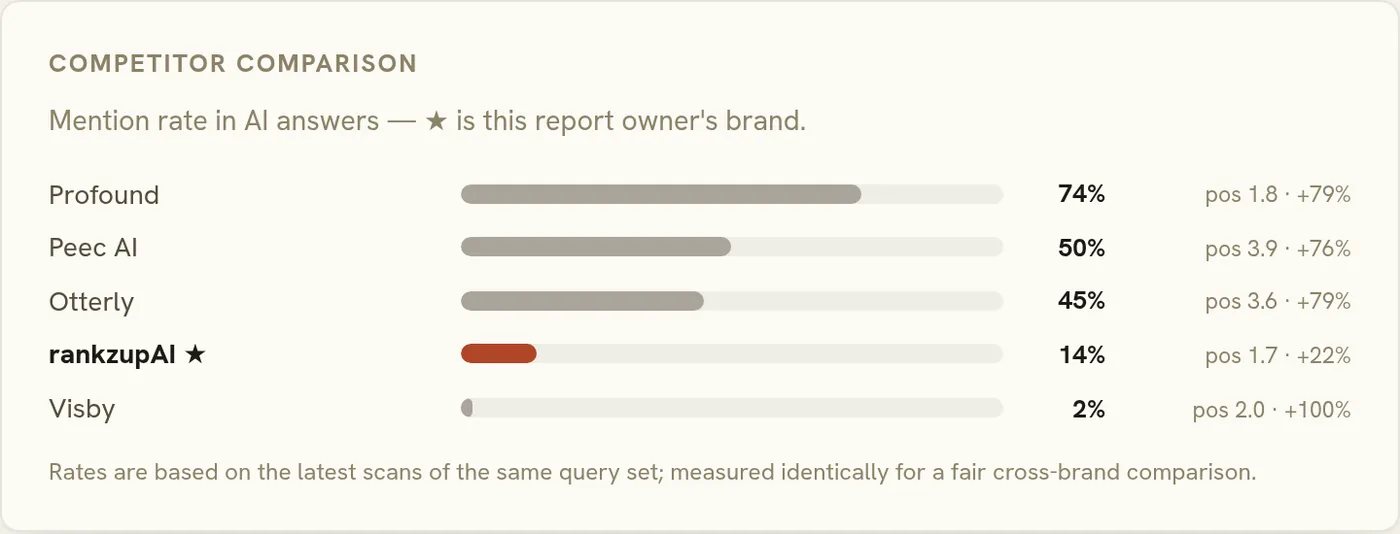
If you're choosing a tool for the actual work, see how rankzupAI compares to Visby, Peec AI and Otterly.
Want the single-term definitions? What is AEO? and what is GEO? cover each on its own.
The practical advice at the end of this argument is short: pick one name, then start measuring. That part begins with how AI visibility is measured.