Best AI Visibility Tools (2026): Ranked & Compared
The best AI visibility tools in 2026 at a glance
Short answer first. rankzupAI leads if you want tracking you can trust. Profound wins on enterprise depth. Peec AI suits agencies. Otterly.AI fits smaller teams that want something simple. The full list is below, with the case each tool actually serves.
One disclosure up front. We build rankzupAI. We put it at number one and then show our work. The reasoning sits right here so you can judge it yourself. Where a rival does the job better for your situation we say so plainly, and we end each entry with who it is not for.
Here is the shortlist in one line each.
- rankzupAI: honest multi-engine tracking with a confidence band and a GA4 conversion tie-in. Best when you want a number you can defend.
- Profound: deep enterprise coverage and analytics for large teams with the budget to match.
- Peec AI: fast agency-friendly tracking across the main answer engines.
- Otterly.AI: lightweight monitoring for small teams that want a simple read.
- Scrunch AI: an enterprise platform leaning toward content and optimization work.
- AthenaHQ: GEO-first analytics for brands going deep on generative search.
- Knowatoa: budget checks for solo operators and small sites.
- Trakkr: approachable tracking with a low entry price.
- Semrush AI toolkit: an add-on for teams already living inside Semrush.
How we ranked these tools
Five things set the order. We wanted the method visible rather than hidden behind a star rating.
Engine coverage came first. A tool that watches only ChatGPT misses where half your buyers now ask. The strong ones cover ChatGPT · Gemini · Perplexity and Google AI Overviews. That last surface trips up most of the field, so it earns its own column in the table below.
Honest scoring came second. AI answers are stochastic. Ask the same question twice and the result shifts. A score without a confidence band pretends to a precision the data never had. We rate a tool higher when it shows the range instead of a lone number.
Pricing transparency came third. A vendor that hides its price usually hides it for a reason. Clear public pricing earned points. An enterprise-only contact form counted against the tool here.
The conversion tie-in came fourth. Visibility that never connects to revenue stays a vanity metric. A GA4 link that ties AI mentions to real sessions and sign-ups is rare, and it is the difference between a dashboard and a decision.
Update cadence came last. This category moves monthly. New engines appear. A tool that ships often stays useful longer than one that shipped once and stalled.
One honest caveat on the method. Two of these tests (the confidence band and the conversion tie-in) are things we built rankzupAI around, so read our number-one placement with that bias in mind.
These are the GEO tools worth your shortlist. The ranking below runs each one through the same five tests.
The best AI visibility tools reviewed
rankzupAI, best for honest multi-engine tracking with conversions
We built rankzupAI, so treat this section as an argument rather than a verdict. The rest of the list is here so you can check it against us.
rankzupAI tracks your brand across ChatGPT · Gemini · Perplexity and Google AI Overviews, then rolls the signals into one score with a our scoring methodology around it. The band is the whole point. We run the same prompts on a schedule and show you how settled the reading is, so you stop celebrating or panicking over a swing that was really just variance. A GA4 tie-in connects those mentions back to real sessions and sign-ups, which is the part most tools skip.
The confidence band came from a real problem we hit. We ran the same prompt twice in our own panel and got two different brand orders back. A bare number would have hidden that. The range shows it, and now you can tell a true move from noise.
Standout features: coverage of all four major surfaces, a published methodology, a confidence band on every score, and the GA4 conversion link. We also dogfood the product on our own visibility, so the screenshots you see are our real data. We ship against this list too. When a new engine shows up we add it, because a tracker that stalls stops being useful.
Pricing is on the table and not behind a sales call. There is a free AI visibility check on the home page, and paid plans start at $32 a month. The full tiers sit on the pricing page.
Who it is for: teams that want measurement they can defend to a boss or a client, across every major engine, with the number tied back to revenue.
Who it is not for: if you run a giant enterprise procurement process and need a dedicated account pod, a heavier platform may suit you better. And if you genuinely only care about one engine, a cheaper single-engine checker will do the job for less. We would rather tell you that than oversell.
Profound, best for enterprise depth
Profound is built for large teams. The coverage is broad and the analytics run deep, which is why bigger brands and agencies with real budget tend to land here.
Pros: enterprise-grade breadth, mature reporting, and the kind of account support large organizations expect. Its dashboards handle large prompt sets without slowing down, which is where smaller tools start to strain. Cons: the weight and the cost are more than a small team needs, and public pricing is not clearly listed. It tends toward the enterprise end, so treat any figure you see as unverified and confirm on their site (August 2026). On our two measurement axes (a confidence band and a conversion tie-in), we did not find either documented publicly, so we mark those columns as none public rather than confirmed.
Who it is for: enterprise marketing teams and larger agencies. Who it is not for: solo founders and small sites. The head-to-head lives on our Profound alternative page.
Peec AI, best for agencies that want speed
Peec AI is clean and quick. It reads well for agencies juggling several clients across the main engines, and the interface stays out of your way.
Pros: fast, tidy, and built for multi-client work. The reporting exports cleanly for client decks, which is often the real agency need. Cons: the scoring depth is lighter than the enterprise options, and it does not carry a confidence band. Public pricing starts around the low three figures a month based on public information. Verify current tiers on their site before you commit.
Who it is for: agencies that value speed and a clean read. Who it is not for: teams that need the deepest analytics or a conversion tie-in. The full comparison is on our Peec alternative page.
Otterly.AI, best for lightweight monitoring
Otterly.AI keeps things simple. For a small team that wants a straightforward read on whether it shows up in AI answers this is an easy way in.
Pros: low friction, quick to set up, and gentle on the budget. Cons: you trade depth and engine breadth for that simplicity, and there is no confidence band or conversion link. Entry pricing sits at the low end based on public information. Check their current plans directly.
Who it is for: small teams and early experiments. Who it is not for: enterprises or anyone reporting numbers upstream. Our Otterly alternative page has the side-by-side.
Scrunch AI, best for enterprise content workflows
Scrunch AI leans toward the content and optimization side of the problem, with an enterprise footprint. Teams that want visibility data feeding straight into a content operation look at it seriously.
Pros: content-workflow focus and enterprise reach. Cons: it is heavier than a small operator needs, and public pricing is not listed. It appears to sit at the enterprise tier, so confirm directly.
Who it is for: larger content teams that want visibility wired into production. Who it is not for: small sites after a quick check.
AthenaHQ, best for GEO-first analytics
AthenaHQ aims squarely at generative search, so brands going deep on GEO find its framing familiar. The analytics are the draw.
Pros: a focused, GEO-native view and strong analytical depth. Cons: it is a focused tool rather than a broad suite, and public pricing is not clearly published. Verify on their site before you budget.
Who it is for: brands that live and breathe generative search. Who it is not for: teams that want one broad suite for everything.
Knowatoa, best for solo operators on a budget
Knowatoa is the budget-friendly pick. For a solo operator or a small site that wants to check AI presence without a big outlay it does the core job.
Pros: low cost and a simple path to a first read. Cons: do not expect enterprise-grade analytics or a conversion tie-in at this level. Entry pricing is low based on public information. Confirm current plans directly.
Who it is for: solo operators and small sites. Who it is not for: teams that need depth or revenue attribution.
Trakkr, best for a low-cost start
Trakkr is approachable and priced to let you start small. It covers the basics of tracking your brand in AI answers without much setup.
Pros: cheap to start and easy to get going. Cons: as with the other lightweight tools you trade depth for the low price. Public pricing sits at the low end based on public information. Check their site for current tiers.
Who it is for: people testing the water on a tight budget. Who it is not for: teams that need a confidence band or a GA4 link.
Semrush AI toolkit, best if you already use Semrush
If your team already lives inside Semrush the AI toolkit is the path of least resistance. It bolts AI visibility onto a stack you already know.
Pros: no new tool to learn, and it sits next to the SEO data you already track. Cons: as a native GEO specialist it is less focused than the tools built only for this, and it prices as an add-on to a Semrush subscription rather than a standalone figure based on public information. Confirm on their site.
Who it is for: existing Semrush customers. Who it is not for: teams wanting a purpose-built AI visibility platform. See our Semrush AI visibility alternative page for the detail.
AI visibility tools compared
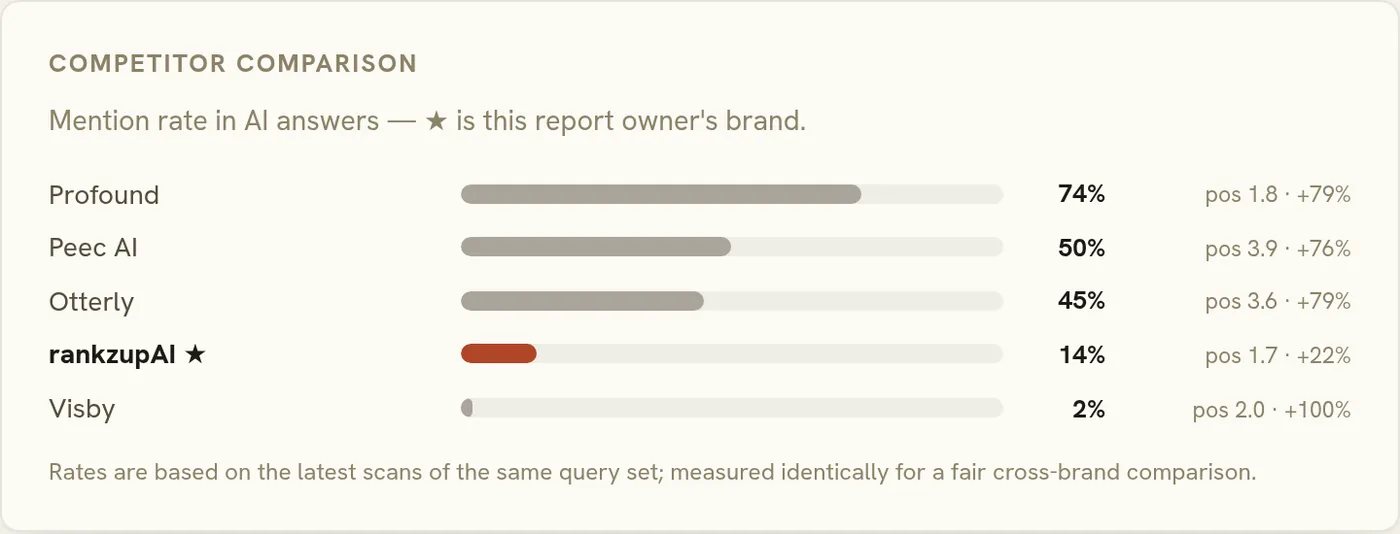
Here is the shortlist against the five tests. These AI brand monitoring tools differ most on Google AI Overviews coverage and on whether the score arrives with a confidence band. Treat prices and the competitor feature marks as public-information estimates to verify.
| Tool | Engine coverage | Google AI Overviews | Confidence band | Conversion tie-in | Starting price |
|---|---|---|---|---|---|
| rankzupAI | ChatGPT · Gemini · Perplexity · AI Overviews | Yes | Yes | Yes · GA4 | $32/mo · free check |
| Profound | Broad · multi-engine | Yes | None public | None public | Enterprise · not listed |
| Peec AI | Main engines | Partial | None public | None public | ~low 3-figure/mo* |
| Otterly.AI | Main engines | Partial | None public | None public | Low-end* |
| Scrunch AI | Multi-engine | Partial | None public | None public | Enterprise · not listed |
| AthenaHQ | Multi-engine | Partial | None public | None public | Not listed* |
| Knowatoa | Main engines | Limited | None public | None public | Low-end* |
| Trakkr | Main engines | Limited | None public | None public | Low-end* |
| Semrush AI toolkit | Within Semrush | Partial | None public | Via Semrush | Add-on* |
*Competitor prices and feature marks are based on public information and not independently verified. "None public" means we did not find it publicly documented, not that it definitely does not exist. Confirm on the vendor site.
How to choose the right AI visibility tool
Start with the engines. If your buyers ask across ChatGPT · Gemini · Perplexity and Google, a single-engine tracker will leave blind spots. If they only live in one place, you can pay less and stay focused.
Then weigh measurement honesty. If you report these numbers to a boss or a client, a confidence band is not a nicety. It stops you defending a number that was really just noise. This is the axis most lists ignore, and the one we care about most.
Match the tool to your size next. Enterprise platforms bring depth and a price to match. Lightweight tools cost little and stay shallow. An agency wants multi-client handling. A solo founder wants a cheap honest check.
A worked example helps. Say you run marketing for a mid-size SaaS. Your buyers ask ChatGPT and Perplexity for recommendations, and your CEO wants proof the effort moves sign-ups. That points at a multi-engine tool with a confidence band and a GA4 link, not a single-engine checker. A solo founder selling one course has the opposite need. One engine, a low price, a quick monthly glance is plenty.
One more question decides it. Is visibility alone enough, or do you need it tied to revenue? A GA4 conversion link answers the thing a boss actually asks. Did any of this sell anything?
Still deciding? The AI visibility tool page covers what the category is and does, and our comparisons run the head-to-heads in depth. When you want to see where you stand today, run a free AI visibility check on the home page. It takes a minute and no card.