Agentic Commerce: Is Your Store Ready for AI Checkout?
What is agentic commerce?
Agentic commerce is what happens when the AI assistant doesn't just recommend a product but helps buy it. ChatGPT's Instant Checkout and agent modes like Operator can increasingly move a user from "what's the best X" all the way to a completed purchase (browsing options, comparing them, and in some cases checking out) without the person ever landing on a search results page or typing your URL. The buyer talks to an agent; the agent does the shopping.
Picture the old path: someone searches, scans a few results, clicks two or three stores, compares, and buys. Now compress that into one conversation where an agent does the scanning and the comparing and, at the frontier, the transacting on the person's behalf. The human sees a recommendation and a checkout, not ten links. Your store is either in that flow or it isn't.
That shifts the question a store has to answer. Classic ecommerce SEO asks "will a human find and click my product?" Agentic commerce asks "can an AI agent find, understand, trust, and transact with my store on a human's behalf?" Those are different bars, and clearing the first doesn't guarantee the second.
How AI shopping agents reach your store
Before an agent can recommend or buy from you, it has to fetch and parse your pages, and shopping agents are stricter than casual browsers.
They arrive as specific bots. The same OpenAI crawlers that power answers (ChatGPT-User for live fetches, OAI-SearchBot for the search index) are what an agent uses to reach a product page. Block them in robots.txt and you're invisible to the agent before the conversation even starts. It's worth checking what these bots can actually retrieve from a given URL; our crawler simulator does exactly that.
They need machine-readable product data. Agents lean on structured product markup (price, availability, variants, shipping) far more than a human shopper who can just read the page. If your price only appears after JavaScript runs, or your product schema is missing or contradicts the visible page, the agent is working blind and will favor a competitor whose data it can trust. A human forgives a messy page; an agent quietly drops it from the shortlist.
The agentic-readiness signals we measure
We built an agentic-readiness check into the product, and it looks at the same things an agent does. In plain terms, it inspects whether your store is:
- Reachable: are the shopping-agent crawlers allowed, and does the key content exist in raw HTML rather than behind client-side rendering that a bot won't execute?
- Fast: agents time out. A slow product page isn't a lower-ranked candidate; it's a dropped one.
- Structured: is there valid, complete product schema (price, availability, variants) an agent can parse without guessing at it?
- Priced in the open: is the price visible to a bot, or hidden behind a click, a login, or an "add to cart to see price" pattern?
- Feed-ready: is there a clean product feed the agent ecosystem can ingest directly, without scraping each page?
None of these are exotic. They're the unglamorous plumbing of being transactable by a machine, and most stores fail at least one without realizing it, because a human browser papers over the gaps an agent can't. The value of measuring them is that "we think we're fine" becomes a specific, fixable list.
A checklist for preparing your store
If you sell online and want to be ready, work through these in order.
First, confirm the shopping-agent bots aren't blocked in robots.txt, and that your product pages render their key facts (name, price, availability) in the raw HTML rather than only after a script runs.
Second, audit your product schema. Every product page should carry valid structured data with price and availability, and it should match what's actually on the page. Stale or contradictory markup erodes exactly the trust an agent needs to transact.
Third, keep pages fast and prices visible without interaction. An agent won't click "reveal price" or wait out a slow render; both quietly cost you the recommendation.
Fourth, maintain a clean product feed. The agent ecosystem increasingly ingests feeds directly, and a well-formed one is the difference between being a candidate and being skipped.
If you run a Shopify store specifically, our Shopify AI search visibility guide covers the platform details, and the broader ecommerce AI visibility guide puts agentic readiness in the context of getting recommended in the first place, because an agent can't buy from a store it never surfaces.
How stores get into ChatGPT Instant Checkout
Instant Checkout launched in late 2025 with Etsy sellers and then Shopify merchants, built on the Agentic Commerce Protocol (ACP), an open standard OpenAI developed with Stripe. Participation is merchant-side: you or your platform expose a product feed and checkout capability over ACP and apply through OpenAI's merchant program; US buyers came first, with coverage expanding since. Practical readiness today: on Shopify, keep product data immaculate, because the feed inherits it; standalone stores should track ACP (implementing it is an engineering task comparable to adding a payment provider). The prerequisite stands regardless: an agent must be able to read your store before it can buy from it.
Measure it, don't guess
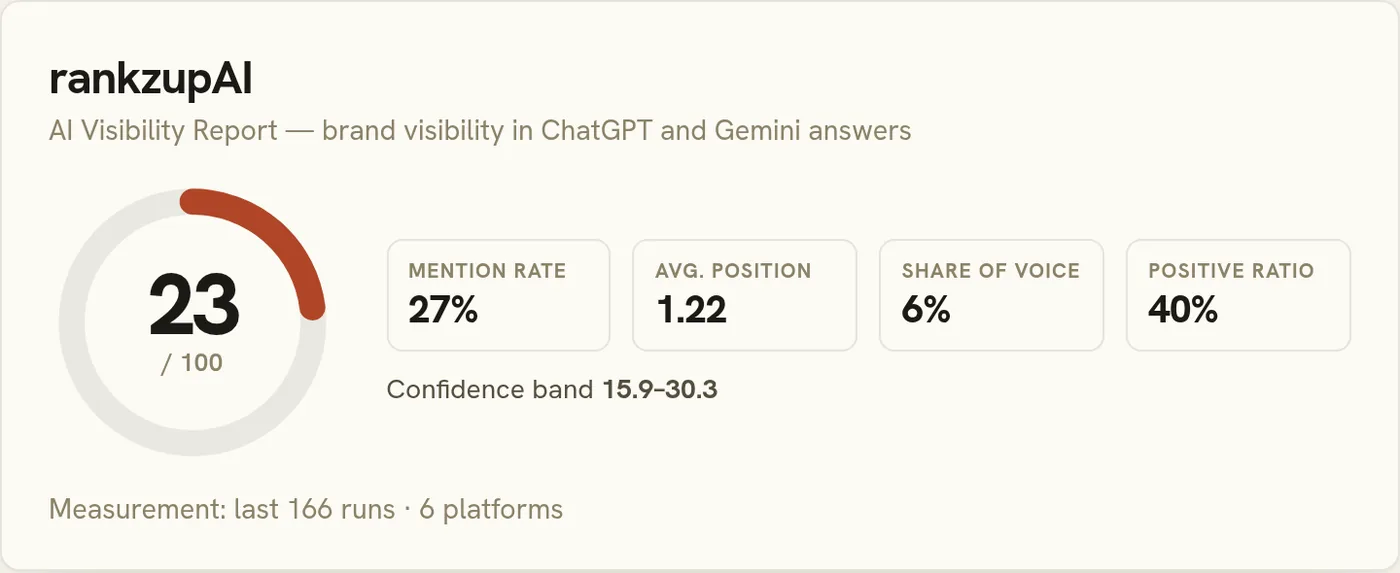
Readiness isn't a one-time audit. Schemas drift when you re-platform, a theme update can start hiding prices behind JavaScript, and a robots.txt change can silently lock out a crawler. The honest way to stay ready is to check these signals on a schedule and watch for regressions, the same way you'd monitor uptime. A green check today is not a promise about next month.
Why this matters now
Agentic checkout is early, and it's tempting to wait. The catch is that the readiness work (crawlable pages, clean schema, visible prices, a good feed) takes weeks to months and can't be switched on the day agents start sending real volume. The stores that win the first wave of agent-driven purchases are the ones already transactable when the agents arrive. Being ready early costs little; being caught out late costs the sale.
Readiness work is slow, so set a baseline before you start. How AI visibility is measured covers the sampling that makes a before-and-after comparison readable.