GEO Services for Agencies: Pricing, Reporting, Pitfalls
Why clients are asking agencies for GEO services
The question lands in your inbox in some version of the same sentence: "We asked ChatGPT for companies like ours and we're not in the answer. Can you fix that?" If you run an agency, you've either had this email already or you'll get it this quarter. Clients have noticed that their buyers ask assistants instead of search boxes, and they're turning to whoever already owns their search budget for an answer.
That makes agencies the natural home for GEO services. You already have the client relationship, the technical access, the content workflow, and half the required skills. What you don't automatically have is the other half, and this is where I've watched agencies get into trouble. GEO is not SEO with the labels swapped. It's a different medium with different economics, and the promises that were merely aggressive in SEO become indefensible here. The agencies building durable GEO practices treat it as a new service line with its own pricing, its own reporting language, and its own contracts. The ones relabeling last year's deliverables are signing up for renewal conversations they will lose.
This guide covers the three things that decide whether the service line works: how to price it, how to report it without overselling, and the pitfalls that keep showing up.
Pricing GEO services, project versus retainer
Two models fit this work, and they map onto two different jobs.
Project pricing fits the audit. A GEO audit is a bounded, concrete deliverable: can AI crawlers reach and render the client's site, is the schema in place, how does the brand's entity look across the sources engines actually cite, where does the client appear today across a designed prompt set, and who's eating their share of the answers. Priced like a serious technical SEO audit, it's an easy first sale because the client gets a document full of findings whether or not they continue. It's also your qualification filter: an audit tells you whether this client can plausibly improve in six months or whether you'd be taking money to fight a category leader's decade of accumulated citations.
Retainer pricing fits everything after, and it's where the real business is. AI visibility moves on a quarterly clock: the work involves other people's publishing schedules, engine recrawl cycles, and slow accumulation of third-party mentions. It also requires continuous measurement, because a single snapshot of a stochastic medium is close to worthless. A monthly retainer covering prompt-set maintenance, sampling across engines, citation analysis, off-site placement work, content recommendations, and reporting matches how the value actually accrues.
Price the retainer on scope (number of prompt sets, engines tracked, markets, competitors monitored), never on outcomes. Which brings up the model to refuse: performance-based pricing. "Pay per mention gained" sounds client-friendly and is actually a coin flip wearing a contract. Answer variance means mention counts wobble month to month for reasons unrelated to anyone's work. You'd be billing on noise in good months and eating the noise in bad ones, and the client relationship corrodes either way.
Reporting that doesn't oversell means confidence bands or nothing
Reporting is the biggest trust risk in the whole offering, so it deserves its own discipline.
The core fact to build around: AI answers are stochastic. The same prompt, on the same engine, on the same day, produces different answers across runs: different brands, different orderings, different citations. If your monthly report says "mention rate improved from 40% to 46%" and that's based on ten samples per prompt, you have reported noise as progress. Do that for three months, then watch the number "decline" for equally random reasons, and you'll be explaining a regression that never happened to a client who no longer believes your improvements either.
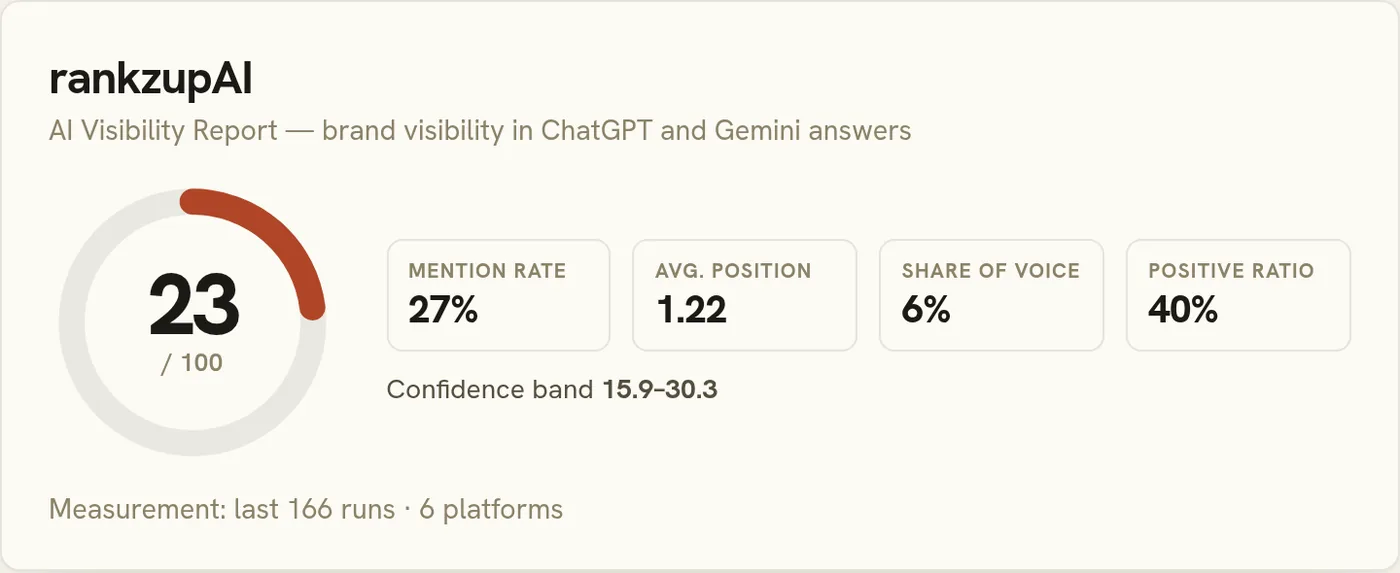
The fix is to report ranges, not points. A mention rate is an estimate from a sample; give it a confidence band and show the band on every chart. When the bands for two months overlap, say plainly that the change isn't distinguishable from variance. Track trends over four to eight weeks before calling direction. Watch citations as the leading indicator: the sources engines cite shift before the mention rates do, so "the client got added to two of the five most-cited roundups" is real, bankable progress you can report months before the headline number moves. The mechanics of computing share of voice defensibly are covered in AI share of voice, and the scoring approach we use (including how confidence is handled) is public on the methodology page. Publish your own methodology or point at one; a report whose numbers can't be traced to a method is a liability with page numbers.
Here's the part that surprises agencies: honest error bars sell. Plenty of clients have been burned by vendors reporting AI visibility as if it were a rankings table. Walking into a pitch and explaining variance before showing your first chart marks you as the vendor who won't need excuses later. The uncertainty isn't a weakness in your report: it's a property of the medium, and naming it is what expertise looks like.
Pitfalls that sink agency GEO offerings
The failure patterns are consistent enough to list.
Promising rankings in a stochastic medium. There is no position one in a generated answer, and no state you can reach where the client appears every time. Contract language matters here: sell "increase presence and share of voice across a defined prompt set," never "get you ranked in ChatGPT." The first is achievable and measurable; the second is a term sheet for a dispute.
Overfitted prompt sets. It's tempting to design prompts the client already wins so the baseline looks respectable and early reports look great. This destroys the only thing the prompt set is for. Build it from how buyers actually ask, including the phrasings where the client is invisible, and let the baseline be ugly. An ugly honest baseline is the foundation of every good renewal conversation you'll ever have.
One blended number across engines. ChatGPT, Gemini, Perplexity, and AI Overviews retrieve differently and cite different source ecosystems. Averaging them hides the story: a client can be strong in Perplexity and absent from AI Overviews, and the fix for each is different work. Report per engine.
Monthly expectations on a quarterly channel. If the client expects movement in the first thirty days, the sale created a problem the delivery can't solve. Set 90-day checkpoints, and fill the early reports with the leading indicators: fixes shipped, placements earned, citations shifting.
Relabeled SEO deliverables. The overlap with SEO is real but partial. A retainer that's actually just technical SEO plus a monthly screenshot of ChatGPT will get found out: most of GEO's leverage is off-site, in review platforms, communities, and third-party pages you don't control and can't relabel your way into.
A white-label GEO workflow that scales
A workflow that has held up across client types. Onboarding: run a prompt-design session with the client, because they know their buyers' language better than you do and the prompt set is the contract's real scope. Fix the competitor list. Then sample for a full baseline month before making a single promise: variance means one week of data isn't a baseline, it's an anecdote.
Monthly cycle: sample the prompt set on a steady cadence, read the citations behind the answers, and let the citations set the month's work (placement outreach where competitors are cited and the client isn't, content where retrieval keeps missing, technical fixes as the audit dictates). Report with bands. Quarterly: revisit the prompt set as the client's market shifts, and re-cut strategy against what the citation data says now.
The part not to hand-build is the measurement layer. Sampling across engines with repetition, storing runs, scoring mentions and citations consistently: that's infrastructure, and every hour your team spends maintaining scripts is an hour not spent on the work clients pay for. This is exactly what the agency plan exists for: multi-client tracking with white-label reports that go out under your brand, on your methodology story.
A hypothetical ten-person shop sells its first retainer
An invented example to make the shape concrete. Say a ten-person SEO agency (call it Wrenfield Digital) closes its first GEO retainer with a B2B payroll software client. In the pitch, a well-meaning account lead promises the client will "show up in ChatGPT within 60 days." The baseline month then shows the client mentioned in one of twenty-five prompts, while two competitors dominate on the strength of review-platform presence and three listicles Wrenfield doesn't control.
Day 60 arrives, the headline number hasn't moved, and the promise is now a problem. The save: Wrenfield resets to a 90-day plan, shows the citation analysis explaining exactly where the competitors' visibility comes from, and switches reporting to banded trends with citation movement up front. Week nine, the client gets added to the most-cited payroll software roundup after a pitch built on data the client had never seen from any vendor. The headline mention rate doesn't clearly move until month five, but the client renews at month six anyway, because the reporting predicted that shape from the corrected start. The lesson isn't that the work is slow, though it is. It's that the reporting, not the results, carried the relationship through the gap.
Start with the audit, price the retainer on scope, put the variance language in the contract before the client asks, and let honest numbers be the thing you're known for. In a service line this young, the agencies with credible reporting are going to collect the clients of the agencies without it.