Best AEO Tools (2026): What They Do and How to Choose
The best AEO tools in 2026 at a glance
Short answer first, list right after. An AEO tool measures whether answer engines name your brand, and the right one depends on how many engines you need plus whether you have to tie the result to revenue. rankzupAI leads for honest multi-engine tracking. Profound wins on enterprise depth. Peec AI suits agencies, Otterly.AI suits small teams. The one-line shortlist:
- rankzupAI: multi-engine AEO tracking with a confidence band and a GA4 conversion tie-in
- Profound: enterprise-grade coverage and analytics for large teams
- Peec AI: fast, agency-friendly tracking across the main answer engines
- Otterly.AI: lightweight monitoring for small teams
- Scrunch AI: enterprise platform leaning toward content and optimization work
- AthenaHQ: GEO-first analytics for brands going deep on generative search
- Knowatoa: budget checks for solo operators and small sites
- Trakkr: approachable tracking with a low entry price
- Semrush AI toolkit: an add-on for teams already living inside Semrush
Disclosure up front: we build rankzupAI, we put it first, and we show the reasoning so you can judge it. Where a rival fits your case better, we say so.
What counts as an AEO tool
An AEO tool measures your presence in answer engines: it runs your category's buyer questions across ChatGPT, Gemini, Google AI Overviews and Perplexity on a schedule and records mentions, positions, citing sources and sentiment. The label comes from answer engine optimization; the same products are sold as GEO tools and AI visibility trackers: one category, several names.
The AEO tools, reviewed
rankzupAI, best for honest tracking with a revenue tie-in
Tracks all four major surfaces and rolls the signals into one score with a our scoring methodology, because AI answers are stochastic and a bare number pretends to precision the data never had. A GA4 tie-in connects mentions to sessions and sign-ups. Free check on the home page; paid plans from $32 a month on public pricing. Not for you if you run enterprise procurement and need an account pod.
Profound, best for enterprise depth
Broad coverage, deep analytics, built for large teams and agencies with budget. No public pricing; we found no published confidence band or conversion tie-in. Not for solo founders. Head-to-head on our Profound alternative page.
Peec AI, best for agencies
Clean, quick, multi-client friendly, exports that survive client decks. Lighter scoring depth, no confidence band; public entry pricing around the low three figures monthly (verify current tiers). Comparison on the Peec alternative page.
Otterly.AI, the best lightweight option
Low friction, quick setup, gentle pricing. You trade engine breadth and depth for simplicity; no band, no conversion link. Side-by-side on the Otterly alternative page.
Scrunch AI, AthenaHQ, Knowatoa, Trakkr, Semrush AI toolkit
Scrunch leans enterprise-content; AthenaHQ goes deep on GEO analytics; Knowatoa and Trakkr serve the budget end honestly; the Semrush AI toolkit makes sense only if your team already lives in Semrush. Each entry, with pros, cons and current caveats, is reviewed in depth in the full tools guide: same category, fuller table.
How to choose between them
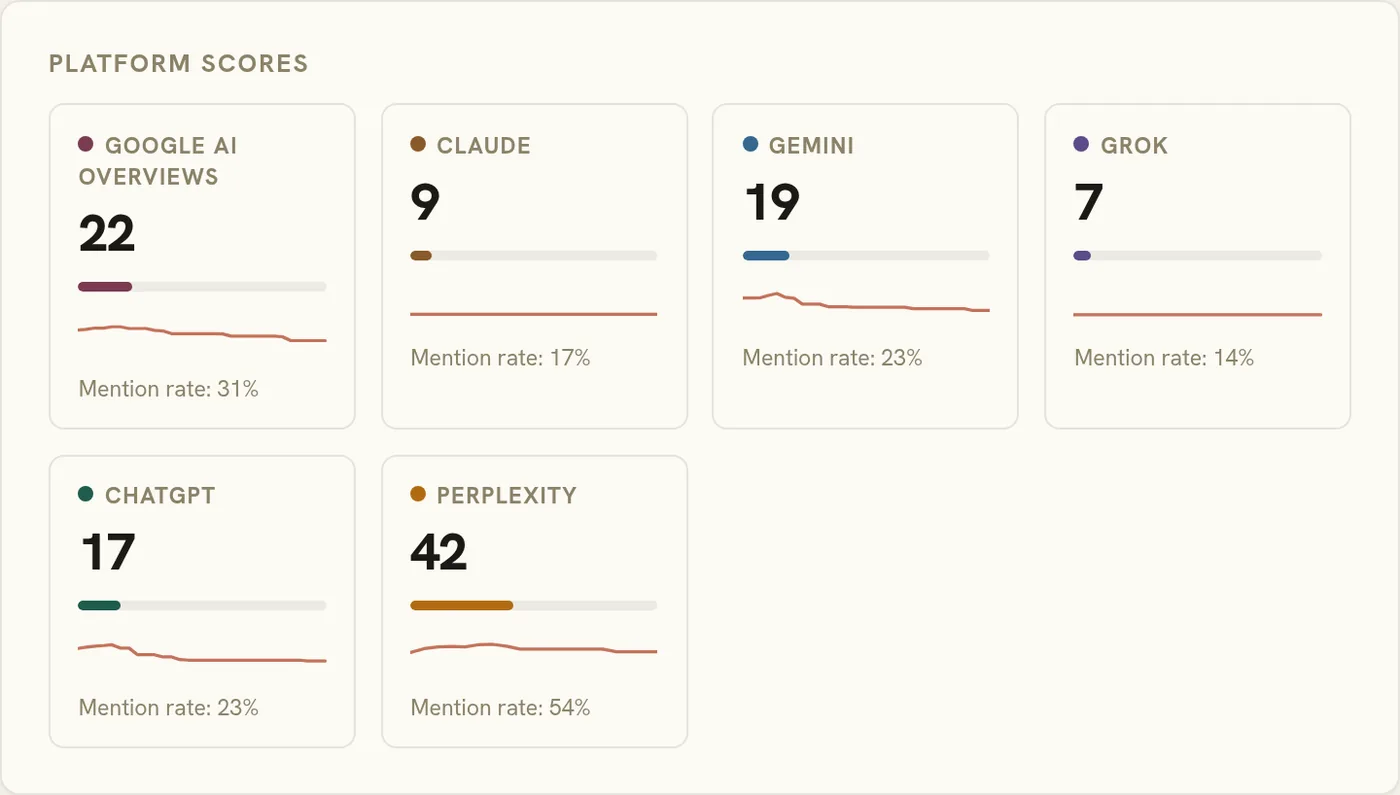
Five criteria beat any star rating. Engine coverage (all four surfaces, not just ChatGPT). Honest scoring (repeated sampling with a confidence band, not single-run screenshots). Pricing transparency (a hidden price usually hides for a reason). A conversion tie-in (visibility that never touches revenue stays vanity). Update cadence (this category moves monthly). Two of those five are things we built rankzupAI around. Read our self-placement with that bias in mind.
Fitting an AEO tool into your existing SEO stack
An AEO tool does not replace your rank tracker; it covers the surface your rank tracker cannot see. The practical wiring: keep classic SEO tooling for crawl health and rankings, point the AEO tool at a frozen prompt set, and join the two in reporting. Rankings describe the click path, mention and citation data describe the answer path. The one integration worth demanding from any tool on this list is a GA4 join, so AI-referred sessions land next to the visibility numbers that explain them.
Free vs paid AEO tooling
Free tiers answer one question well: "how do the answers treat us today?" (a real baseline in ten minutes). Paid earns itself when someone acts on the data monthly: lost questions becoming PR briefs, share-of-voice reaching a leadership dashboard. If nobody owns the follow-through yet, keep the free baseline, do the source work first, and buy the sensor when there is a process to feed.