What Is a Confidence Band in AI Visibility Scoring?
Why a single number isn't enough
If a tool hands you one number ("your AI visibility is 63") and nothing else, it's quietly overstating how much it knows. A confidence band is the range that number actually sits in, calculated from how much the measurement moves between runs. Without it you cannot tell a real change from ordinary variance.
AI answers are stochastic. Ask ChatGPT or Gemini the same question twice and you can get different brands, in a different order, with different framing. A visibility score built on top of that variation is an estimate, not a fact. Reporting it as a single clean number implies a precision the underlying data doesn't have, and that false precision is exactly what leads teams to celebrate or panic over movement that's really just noise.
A confidence band fixes this by showing the number and how sure you can be about it.
What a confidence band actually is
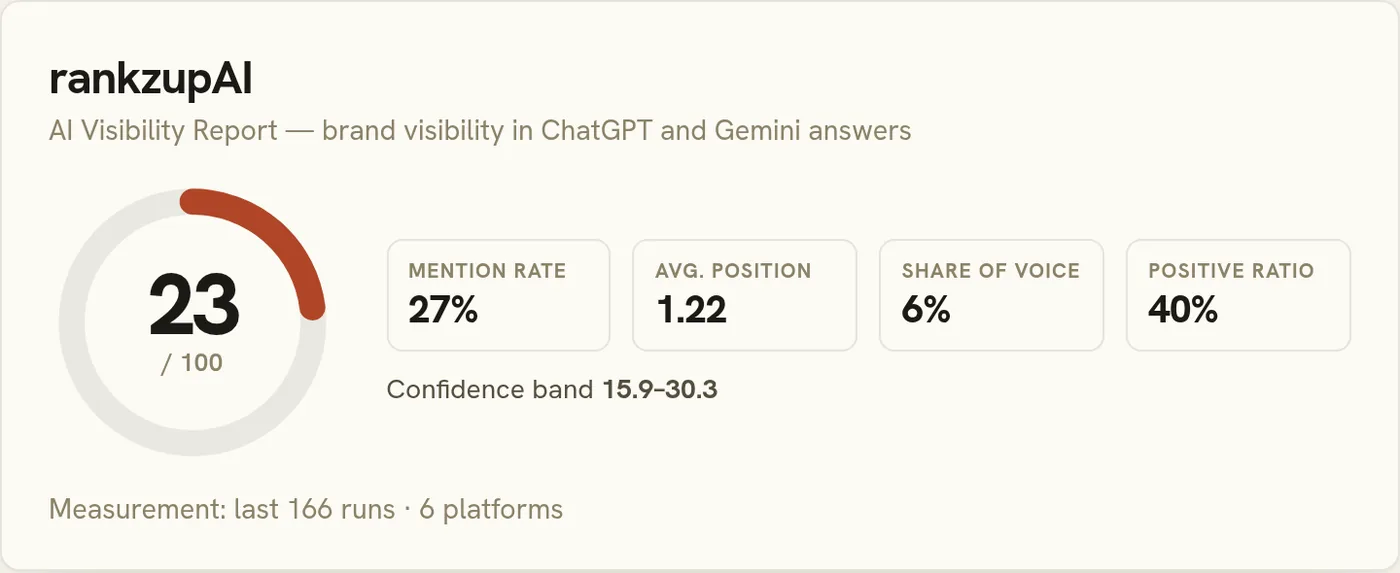
A confidence band is a range (a lower and upper bound around the headline score) that tells you how settled the measurement is. A score of 63 with a tight band of 61-65 means "we've sampled enough that this is a reliable read." The same 63 with a wide band of 52-74 means "the answers are bouncing around; treat this as provisional and gather more data before acting."
The band isn't decoration. It's the honest part of the score. It answers the question every dashboard number should answer but usually doesn't: how much should I trust this?
How rankzupAI calculates confidence bands
We don't score a brand from a single day or a single answer. For each question and engine we keep a sliding window of recent measurements and derive the band from them using statistical resampling, repeatedly re-estimating the score from the samples we have to see how much it moves. A stable underlying signal produces a narrow band; a noisy one produces a wide band that only tightens as more measurements accumulate.
Two honest caveats we state openly. First, the band reflects how settled the current measurement is; it is not a forecast that guarantees tomorrow's score. Second, the band doesn't capture every source of day-to-day randomness on its own. We reduce that separately by accumulating more samples in the window. The full mechanics, including the exact percentiles and how the window is weighted, are laid out in our scoring methodology.
Why most competitors don't publish this
Showing a confidence band is slightly uncomfortable. It admits, on the face of the product, that the measurement carries uncertainty, and a single bold number always looks more authoritative in a sales demo than a number with a range attached.
But the single number is the less honest choice, and in a discipline built on a probabilistic medium, honesty is the differentiator. When you're deciding whether a dip is a real problem or just this week's variance, the band is the thing that tells you, and a tool that hides it is hiding the one signal you most need. It's the same principle behind everything in generative engine optimization: the medium is noisy, so the measurement has to be honest about it.
How to read a confidence band in practice
Three quick rules make the band useful day to day.
If the band is narrow, trust the number and act on its movement: a real change in a tight band is a real change. If the band is wide, hold off; the honest read is "not enough data yet," and the fix is more sampling, not a strategy pivot. And when you compare yourself to a competitor, check whether the bands overlap: two scores of 61 and 66 whose bands both span the mid-50s to low-70s aren't meaningfully different yet, no matter what the headline gap suggests.
Read this way, the band stops being a technical footnote and becomes the part of the score you actually make decisions with.
A worked example of reading a 13-25 band
Your score says 19, band 13-25. Next scan: 16, band 12-24. Did you drop? No: 16 sits comfortably inside the previous band; this is the variance the band exists to absorb. A month later: 9, band 7-12. Now the bands no longer overlap, and that is the honest definition of "something changed": time to open the per-question breakdown, not before. Teams that internalize this one reading habit stop burning mornings on phantom drops.
Band width is itself a signal
A narrow band says the measurement has settled: enough runs, consistent answers. A wide band says one of two things: few runs so far (wait), or genuinely unstable answers for your questions (interesting!). Some categories are inherently volatile: engines rotate brands in "best X" answers weekly. A stubbornly wide band on stable questions is worth investigating; it often means two engines disagree hard, and the per-engine split shows which.
When to act despite a wide band
The band disciplines score-reading; it does not excuse inaction. Three things warrant moves regardless of overlap: a rival entering answers for a question that matters (SOV divergence), negative framing appearing anywhere (fix negative AI sentiment), and any access regression from the technical audit. Statistical caution applies to the score; source facts are actionable the day you see them.