Gemini vs ChatGPT (2026): An Honest Comparison
The quick answer on Gemini versus ChatGPT
They are the two default assistants of the moment, and the honest comparison is about fit, not victory. Gemini is the stronger choice when your work lives inside Google (Search, Workspace, Android) and when you want answers grounded in live search results.
ChatGPT is the stronger choice for breadth: the largest habit base, the deepest third-party ecosystem, and the most flexible general assistant. Below the marketing, they differ most in one place that gets little attention: how they behave as search engines.
Where Gemini is genuinely strong
Integration and grounding (the full Gemini brand visibility guide goes deeper). Gemini sits inside the Google stack, which means answers can draw on live Search through grounding, and the assistant reaches into Gmail, Docs and Drive where you allow it. For questions where freshness and sources matter (prices, comparisons, anything that changed recently), a grounded Gemini answer with links is structurally more checkable than a memory answer. The same wiring powers Google's AI Overviews and AI Mode, so time spent understanding Gemini's retrieval pays across all three surfaces.
Where ChatGPT is genuinely strong
Habit and ecosystem. ChatGPT remains the assistant most people reach for first, with the widest range of connected tools and custom workflows built on top of it. As a general reasoning and writing partner it is at least the equal of anything else. Its search behavior is the caveat: web search fires only when the model decides it should, so answers mix live retrieval with training memory more unpredictably than Gemini's grounded mode, which is flexibility in daily use and noise in measurement.
As search engines, they diverge
This is the practical difference buyers and brands actually feel. Gemini's search-grounded answers behave like search: retrieved, sourced, comparatively stable. ChatGPT's answers oscillate between retrieval and memory, which makes them fresher some days than others, and makes tracking your presence there inherently noisier. Neither is "more correct"; they are differently wired, and they read different slices of the web.
They disagree about your brand
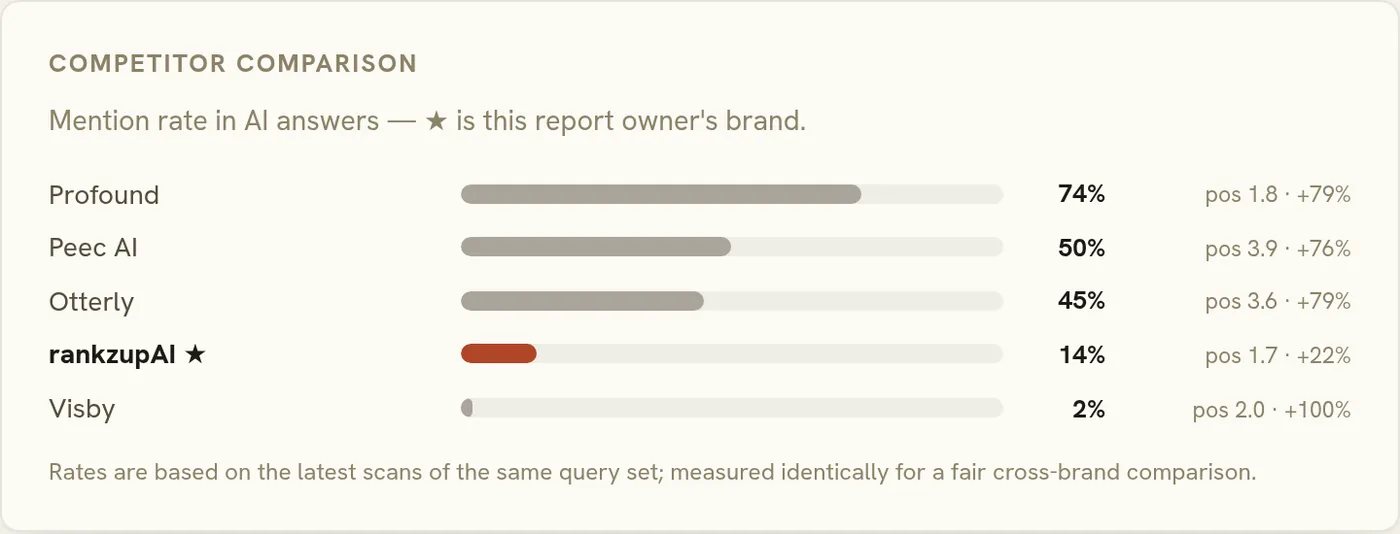
The part almost no comparison mentions: ask both the same buyer question about a category and you will regularly get different brand lists. In rankzupAI's panel most brands score within a few points across engines, but roughly one in ten shows a visibility gap of 15+ points on identical questions, and the widest gap we have measured is 57 points. So "are we in AI answers?" has no single answer: a brand can be winning Gemini and losing ChatGPT without anyone noticing until it is measured per engine.
Which should you use?
As a user: both are free to try, and the honest advice is to run your own real week of tasks through each. Ecosystem fit will decide long before benchmark charts do. As a brand: the question is not which to use but which your buyers use, and the answer is both, in proportions you cannot see from inside your analytics. That is an argument for measuring Gemini and ChatGPT side by side rather than betting the category on either.
Pricing will not decide it either: both sell consumer tiers at similar price points, both keep capable free tiers, and the capability gaps people argue about (coding, file handling, image work) shift with every model release. Test both on your own real tasks for a week; that beats any comparison table, including ours.
Gemini vs ChatGPT at a glance
| Dimension | Gemini | ChatGPT |
|---|---|---|
| Search behavior | Grounded in live Google results | Search fires when the model decides |
| Sourcing | Links attached in grounded mode | Citations only in search mode |
| Ecosystem | Google Workspace, Android, Search | Largest third-party tool ecosystem |
| Answer stability | Comparatively steady | More variable run to run |
| For brand measurement | Steadier signal | Bigger audience, noisier signal |
| Related surfaces | AI Overviews, AI Mode | Operator-style agents, custom GPTs |
The table understates one asymmetry: Gemini's behavior transfers. Understanding how it retrieves and cites pays again on AI Overviews and AI Mode, because the same grounding wiring drives all three Google surfaces. ChatGPT's behavior transfers to nothing but itself, which is exactly why it needs its own tracking line.