Google AI Mode SEO: Who Shows Up and What to Do Now
Google now runs two AI surfaces inside search, and people mix them up constantly, including people selling "AI SEO" services, which should worry you. AI Overviews is the summary box that sometimes appears above classic results. AI Mode is something bigger: a full conversational mode of Google Search, a separate tab where the entire experience is an AI answer you can keep talking to.
If your customers are in the US or another English-first market, a slice of your Google demand is already flowing through AI Mode. Here's what it actually is, how it decides who to show, and what's worth doing about it, as opposed to the panic-driven busywork currently being sold.
What Google AI Mode actually is
AI Mode is a dedicated tab in Google Search (and the Google app) where, instead of a results page, you get a synthesized answer built by a Gemini model (with links woven in) and a chat box to ask follow-ups. Google introduced it in 2025, first as a Labs experiment, then rolled it out broadly in the US and expanded to more countries and languages through 2025 and into 2026.
Under the hood, the defining mechanic is query fan-out explained: AI Mode takes your question, breaks it into multiple related searches, runs them against Google's index in parallel, and composes one answer from the results. Google has described this technique openly. It means AI Mode isn't a different index or a separate crawler you need to court. It's Google's existing index, queried differently and presented conversationally.
Two properties follow from that. First, you can't opt into AI Mode separately: if you're indexed and eligible for snippets, you're eligible for AI Mode. Second, you can't measure it separately either: as of August 2026, Google folds AI Mode clicks and impressions into regular Search performance data in Search Console rather than breaking them out. That opacity is a genuine problem, and pretending otherwise would be dishonest: nobody outside Google knows exactly how much traffic AI Mode drives or takes.
The difference that matters between AI Mode and AI Overviews
Same company, same index, related plumbing, but different products, and the difference changes how you think about each. Our AI Overviews guide covers the overview box in depth; here's the contrast in brief.
AI Overviews is an addition to the classic results page. It appears for some queries, sits above the blue links, and the rest of the page still exists below it. The user didn't choose it. AI Mode is a replacement experience the user actively switches into. There is no results page underneath: the answer, its embedded links, and the follow-up conversation are the whole product.
That "user chose it" detail matters more than it looks. AI Mode users are self-selected for wanting synthesized answers and multi-turn digging: longer questions, follow-ups, comparisons, "which one should I pick given my situation" conversations. These are exactly the high-intent research sessions that used to produce a dozen classic searches. When that session happens in AI Mode, you either exist inside the conversation or you were never considered.
The follow-up dynamic is the other real difference. In AI Overviews, you're cited once or you're not. In AI Mode, the conversation keeps fanning out with each turn ("compare those two," "which is cheaper for a small team," "any downsides?"), and each turn is a fresh retrieval where you can enter or drop out of the answer. Visibility becomes something you hold across a conversation, not a slot you win once.
Who shows up in Google AI Mode answers
Since AI Mode fans your question out across Google's index, the honest baseline answer is: mostly, pages that already do well in Google. Ranking still carries most of the weight. Google says it, and observation backs it: the links AI Mode cites are overwhelmingly pages that rank well for one of the fanned-out sub-queries. There is no secret AI Mode ranking system to optimize, and anyone selling access to one is selling air.
But "rank well" hides a twist: rank well for what? Not for the question the user typed, but for the machine-generated sub-queries it decomposes into. A hypothetical to make it concrete: someone asks AI Mode, "we're a 15-person startup, is a PEO or a payroll provider better for us?" AI Mode might fan that into four searches:
- PEO vs payroll comparisons
- PEO pricing
- Payroll providers for startups
- PEO drawbacks A mid-authority HR blog with a genuinely thorough "PEO disadvantages" page can get cited in that answer alongside giants: it won a sub-query the giants never bothered to cover. Meanwhile a bigger competitor ranking #3 for the head term "payroll software" might not appear at all, because the head term wasn't one of the searches.
So here is the profile of who shows up. Sites with solid classic rankings, yes, but weighted toward pages that answer specific sub-questions completely and toward sources that cover the comparison and pricing and drawback angles a synthesizer needs. Well-structured, extractable content wins for the same reason it wins in AI Overviews: the model has to lift and recombine passages, and clean passages get lifted.
The English-first rollout, honestly
AI Mode launched in English, in the US, and expanded outward from there: more countries quickly, more languages gradually. As of August 2026, coverage is broad in English-speaking markets while many other languages and markets are somewhere between partial and absent. If you sell primarily in, say, the Turkish or German market, AI Mode is likely a smaller slice of your Google reality today than US-focused coverage implies.
That's not a reason to ignore it. It's a preview window. Rollout direction has been one-way (features tested on US English users have consistently spread), and the fan-out retrieval pattern is the same one ChatGPT and Perplexity already run in every language. Non-English markets get the unusual luxury of watching the disruption arrive in slow motion: you can see which content shapes win in English AI Mode now, and build the local-language equivalents before the tab shows up for your customers. Few will. That's the opportunity.
What to do now about Google AI Mode SEO
Everything here is work that pays off across AI surfaces, which is precisely why it's the right list: AI-Mode-only tactics don't really exist.
- Keep winning classic Google. AI Mode retrieves from the index via rankings. Your existing SEO is your AI Mode foundation, full stop.
- Build pages for sub-questions, not just head terms. Cover the comparison, pricing, alternatives, and drawback angles of your category as complete standalone pages. That's what fan-out retrieves.
- Make passages extractable. Direct answers high on the page, real headings, tables for anything tabular, numbers and dates stated plainly. The synthesizer cites what it can cleanly lift.
- Don't block what you don't mean to block. AI Mode eligibility rides on normal indexing and snippet settings. Check that aggressive nosnippet or max-snippet rules aren't quietly excluding you from every AI surface at once.
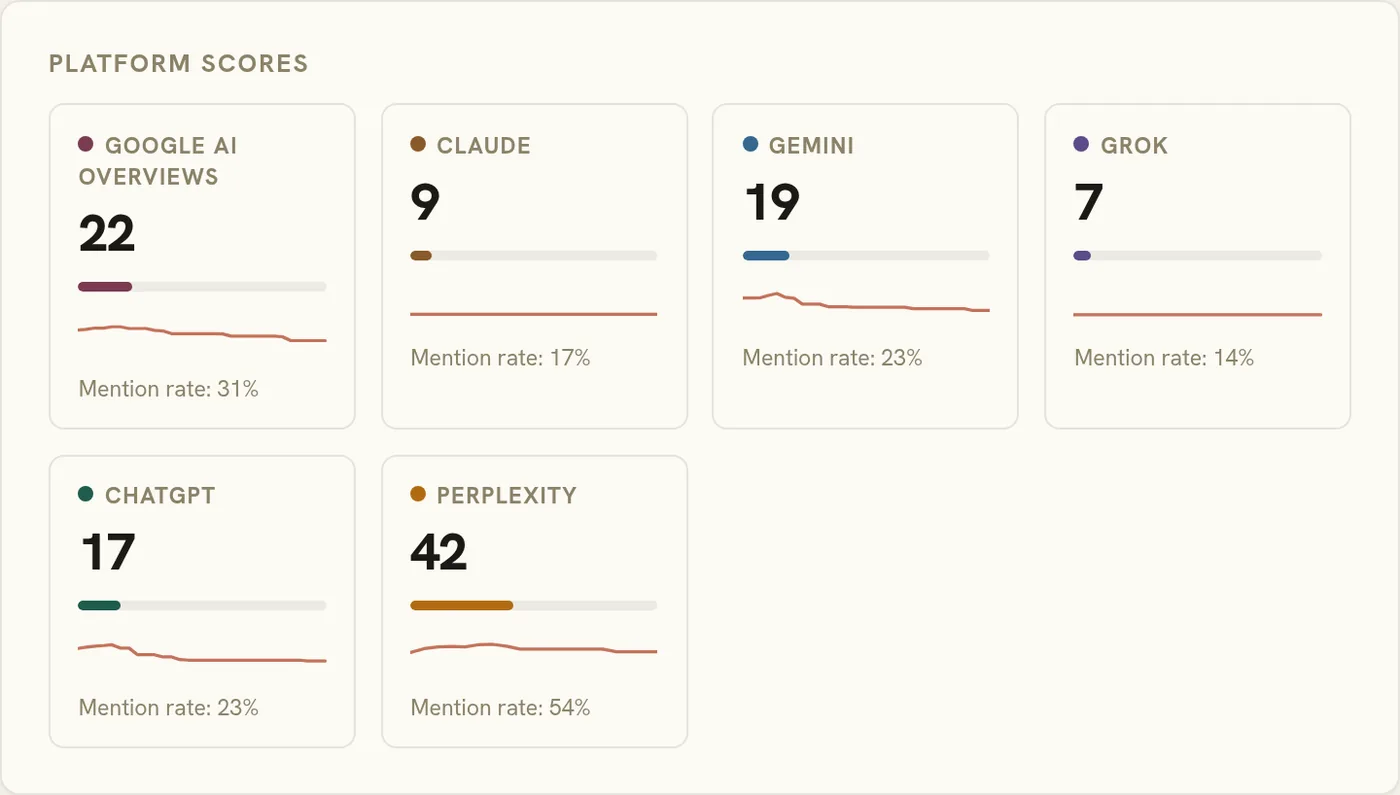
- Measure your presence directly. Since Search Console won't isolate AI Mode, the only way to know if you appear is to run your money questions through it (and its siblings) and track who gets named over time. That's the measurement gap rankzup exists to fill.
- Mind the Google ecosystem beyond the tab. The same Gemini models power the standalone Gemini assistant, where brand visibility follows related but distinct rules. Our Gemini guide covers that side.
The strategic summary: AI Mode doesn't introduce a new game, it raises the stakes of the existing one. Rankings get you into the room; complete, extractable, angle-covering content decides whether you're in the answer. The brands treating those as one project are the ones showing up.
Compare the sourcing with how ChatGPT recommends brands.
AI Mode moves fast, so judge changes against a baseline instead of a single check. The method is in measuring AI visibility.