Wikipedia and Wikidata: An Entity Strategy for Brands
Somewhere on your GEO to-do list, someone has written "get a Wikipedia page." I want to talk you out of half of that plan and into a better version of the other half, because Wikipedia and Wikidata get lumped together in SEO advice, and they're wildly different in both difficulty and payoff.
Short version: a Wikidata item is achievable for most legitimate companies this quarter. A Wikipedia article is not achievable for most SaaS companies, period, and trying to force one can actively hurt you. Here's the full picture.
Why Knowledge Graphs Feed AI Answers
When an AI assistant states a fact about your company (founding year, category, headquarters, who owns you), that fact came from somewhere. A lot of "somewheres" flow through knowledge graphs: structured databases of entities and relationships that search engines and, increasingly, retrieval systems use as ground truth.
Wikidata sits near the center of this. It's the structured sibling of Wikipedia: machine-readable statements like "Ledgerly (Q-something): instance of software company, founded 2023, country: Germany." Google's Knowledge Graph draws on it. Countless datasets and APIs mirror it. Its content is in every major training corpus because it's openly licensed and heavily crawled. When your company exists as a well-formed entity there, machines stop guessing who you are. Your name, your category, and your sameAs connections (official site, LinkedIn, Crunchbase) become resolvable facts rather than string matches.
That's the mechanism. An entity that exists in structured sources gets described accurately and disambiguated correctly. An entity that doesn't gets confused with the yacht company that shares your name, or omitted entirely because the model can't confidently say what you are.
Wikidata for Brands Is the Achievable Half
Wikidata's inclusion bar is much lower than Wikipedia's. An item needs to be a real, identifiable entity that's referenced in at least some serious external sources. It does not need press coverage in major outlets. Most operating companies with any footprint (Crunchbase profile, funding announcement, product listings, a few independent mentions) can clear it.
Practical notes from having done this:
- Check whether you already exist. Search Wikidata first. A duplicate item is worse than none.
- Create the item with sourced statements. Instance of, official website, industry, founding date, founders (if they're identifiable), headquarters location. Every statement should carry a reference to an independent source where possible.
- Don't stuff it. Wikidata editors delete promotional items. Ten well-sourced statements beat forty flimsy ones. No marketing language exists in Wikidata's data model anyway. That's rather the point.
- Link it back. Add the Wikidata URL to the
sameAsarray in your Organization schema. Now your site and the knowledge graph confirm each other.
Cost: a few hours. Risk: near zero if you keep it factual. This is one of the rare GEO tasks that's genuinely just execution.
The Honest Part About Wikipedia Notability
Now the uncomfortable half. Wikipedia's notability standard for companies (the guideline is WP:NCORP) requires significant coverage in multiple independent, reliable sources. Every word of that is load-bearing:
- Significant means articles substantially about your company. Passing mentions, funding-round briefs, and inclusion in listicles don't count.
- Independent means not press releases, not interviews with your founder, not sponsored content, not coverage that rewrites your announcement. Editors are good at spotting churnalism and discount it.
- Reliable means established publications with editorial oversight. Your industry's blog ecosystem mostly doesn't qualify.
Be honest with yourself against that bar: most SaaS companies (including funded ones, including ones doing eight figures) don't clear it. TechCrunch covering your Series A is not notability. Notability looks like the Wall Street Journal writing a feature about you, twice, without your PR firm arranging it.
And forcing it backfires specifically. Paid Wikipedia editing without disclosure violates the Terms of Use. Articles created by undisclosed paid editors or obvious COI accounts get flagged, taken to deletion discussions, and removed. And that deletion discussion is public and permanent. There's a small industry of "Wikipedia page creation services," and their work product is disproportionately represented in the deletion logs. Worse for our purposes: a deleted article and a hostile deletion debate are exactly the kind of content that gets crawled. You can end up with the machines knowing your brand primarily from a page titled "Articles for deletion: YourCompany."
If you genuinely believe you're close to the bar, the legitimate path is slow: accumulate real independent coverage over years, then let an unaffiliated editor decide it's worth writing about. You can't schedule that, and you shouldn't pay someone who claims they can.
Alternatives That Actually Move the Needle
The good news: Wikipedia is one node in the entity graph, not the whole graph. For a hypothetical fintech startup called Ledgerly that's three years old with solid trade-press mentions but no WSJ feature, I'd build this stack instead:
- Wikidata item, done properly, as above.
- Crunchbase profile, complete and current. It's heavily crawled, feeds countless downstream datasets, and AI search tools cite it for company facts constantly.
- Industry-specific databases and wikis: G2 and Capterra for software, GitHub org for dev tools, national company registers, whatever structured directories your vertical treats as canonical.
- Consistent NAP-style facts everywhere. Same founding year, same description, same category on your site, LinkedIn, and every profile. Contradictions between sources are how models end up hedging or hallucinating about you.
- Organization schema on your site tying all of it together via
sameAs.
Ledgerly with that stack gets its facts stated correctly by AI assistants (category, pricing model, founding year) even with zero Wikipedia presence. That's most of the practical value, minus the vanity.
Realistic Expectations and Next Steps
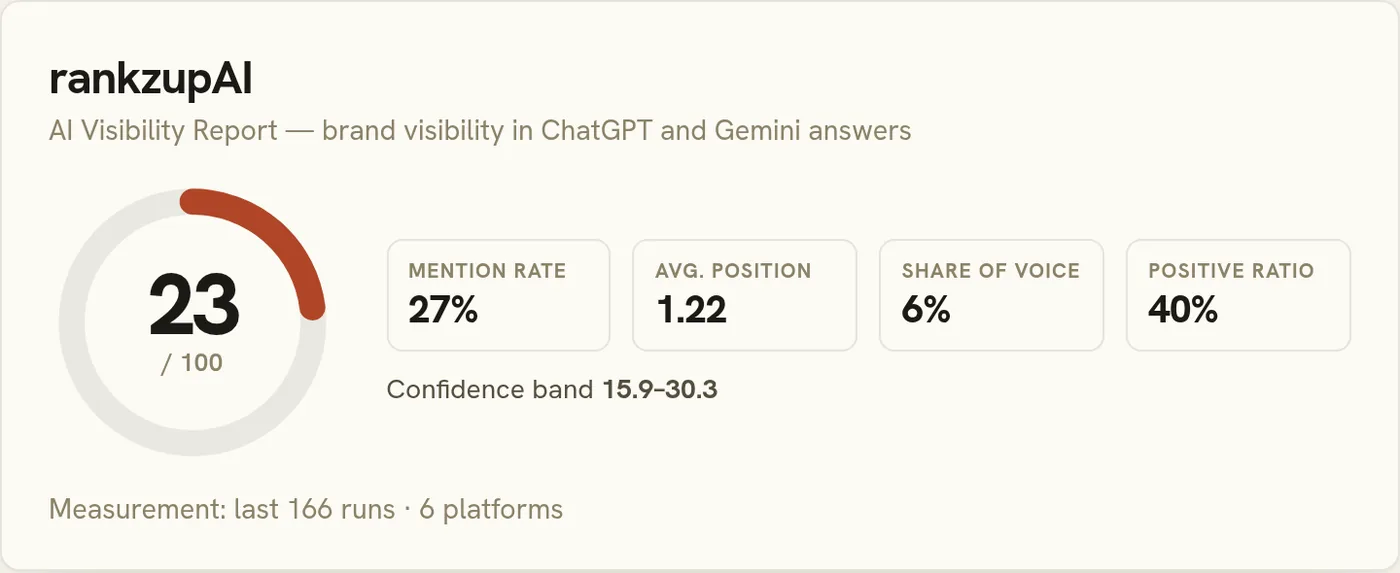
Entity work is slow-release. Retrieval-based tools can pick up Crunchbase and Wikidata facts within weeks; training-data effects take model cycles, so think in quarters. And entity presence gets you described accurately. It doesn't get you recommended. Recommendations come from reviews, comparisons, and community mentions, which is a different workstream (the AEO vs SEO breakdown covers where each fits).
Start by auditing where you stand: search Wikidata, Google your brand plus "site:crunchbase.com," and ask three AI assistants basic factual questions about your company. Or let a free GEO audit map your entity footprint and flag the gaps in one pass. Fix the achievable layer first. Leave Wikipedia to the editors: if you ever truly qualify, someone else will write it, and it'll stick precisely because you didn't.
This is one piece of the broader technical GEO checklist.
Entity work is slow by nature, and so is the result: category positions move slowly at the top. Expect quarters rather than weeks.