AEO vs SEO: What Actually Changes (and What Doesn't)
AEO vs SEO in short
Answer engine optimization (AEO) is the work of getting your content retrieved, trusted, and quoted by AI answer engines (ChatGPT, Perplexity, Gemini, Google's AI Overviews) instead of merely ranked on a results page. It is not a replacement for SEO, and it is not "just SEO with a new name" either.
The GEO vs AEO vs LLMO naming debate is its own story. Both takes are wrong, and both are loudly held by people trying to sell you something. The honest picture: maybe 60% of the work carries over directly, a meaningful chunk is genuinely new, and a few beloved SEO habits are now actively wasted effort.
Anyone who has done SEO for a decade spent the last two years relearning a job they thought they knew. Here's our current map of what transferred and what didn't, in one table before we go deeper:
| Signal | Role in SEO | Role in AEO |
|---|---|---|
| Crawlability | Table stakes | Still table stakes, plus AI-bot access checks |
| Entities and schema | Helpful for rich results | Core: the model must place you in a category |
| Links and authority | Central ranking factor | Indirect: feeds the indexes retrieval leans on |
| Quotable passages | Nice-to-have (featured snippets) | Decisive: only liftable passages survive extraction |
| Third-party mentions | Valued mostly as links | Central: cross-source consensus picks the brands |
| Rank tracking | Stable positions, daily checks | Replaced by sampled share of voice over time |
What carries over from SEO
Crawlability still comes first. ChatGPT's search mode leans on OpenAI's own index and crawlers (with third-party providers historically in the mix), Perplexity runs PerplexityBot, Google's AI Overviews sit on top of ordinary Google indexing. If a bot can't fetch and render your content, nothing downstream matters. Same rule as 2010. The one twist: check your CDN and robots.txt for AI crawlers specifically, because plenty of sites blocked GPTBot in a 2023 panic and forgot, and some bot-protection vendors block OAI-SearchBot and PerplexityBot by default.
Entities still matter, arguably more. Search engines spent a decade moving from strings to things, and language models took that idea to its logical end. A model needs to know your brand exists, what category it belongs to, and what it's associated with. Consistent naming, a clear about page, schema markup, a sane Wikipedia-and-directories footprint: the classic entity hygiene work pays off in both channels.
Authority transferred too, though the mechanism shifted. Links still matter because retrieval still leans on search indexes that count them. But the bigger authority signal now is being talked about in text the models trust and retrieve: industry publications, comparison articles, community threads. Digital PR people are quietly having a great time.
What's genuinely new in answer engine optimization
You have to be quotable
Search rewarded pages that earned a click. Answer engines reward passages that survive extraction. Those are different skills. A 2,000-word post that builds an argument gradually might rank fine in classic search and contribute nothing to an AI answer, because no single passage in it states a complete, liftable claim.
The practical shift: put the direct answer high, in plain declarative sentences, with the entity named in the sentence rather than referred to as "it." Then elaborate. I resisted this for a while because it felt like writing for robots, but it's really just the old journalism inverted pyramid, and readers don't mind it either.
Source diversity is the game
In classic SEO you could win a query with one great page. Answer engines synthesize across sources, and they visibly favor consensus. If five independent sources describe your product as the go-to option for X, you'll surface for X. If only your own site says it, you mostly won't: the model treats a self-description very differently from a third-party one.
This means AEO budgets skew away from "more blog posts on our domain" toward getting into other people's content: comparison posts, industry roundups, podcast transcripts, analyst mentions. Your own site becomes one voice in a chorus you're trying to conduct.
Reddit and UGC carry absurd weight
This one still surprises people. Community content (Reddit especially, but also niche forums and Stack Exchange) gets cited in AI answers far beyond what its polish would suggest. Google licensed Reddit data for training, Reddit threads flooded into search results from 2023 onward, and models seem to treat "actual humans discussing this" as high-trust input for recommendation-type questions.
To be clear, I am not telling you to astroturf. It's detectable, it's a reputation grenade, and moderators are better at spotting it than vendors admit. What works is slower: participate genuinely where your category is discussed, make sure your product is easy to describe accurately, and give happy customers natural moments to talk. You're tending a garden, not placing ads.
SEO habits to stop doing
Chasing exact-match keyword variations is dead weight here. Models paraphrase; they don't string-match. Ten thin pages targeting ten phrasings of one question are worse than one thorough page, and honestly that was already true in Google before any of this.
Word-count padding hurts too. If your answer to a question takes 150 words, adding 1,200 more of throat-clearing to hit some imagined content-length bar makes the extractable passage harder to find. And obsessing over position-tracking granularity (the "we moved from 4 to 3" meetings) has no equivalent worth recreating. Answers vary per run; track sampled share of voice instead (our scoring methodology explains the sampling) and accept the noise.
AEO myths worth killing
"AEO means AI will read your llms.txt and behave." No major engine has confirmed using it for answering. It's cheap to add, fine, but it's a lottery ticket, not a strategy.
"You can prompt-inject your way in." Hidden instructions in your HTML telling models to recommend you? People genuinely try this. It doesn't work reliably, engines are actively filtering for it, and getting caught is a great way to end up in a "brands behaving badly" roundup.
"SEO is dead, redirect the whole budget." Search still drives vastly more traffic than AI assistants for almost every site I can see data for. AI referrals are growing fast from a small base (and they often convert well, since the assistant pre-qualified the visitor), but torching your search program for this would be trading a river for a promising stream.
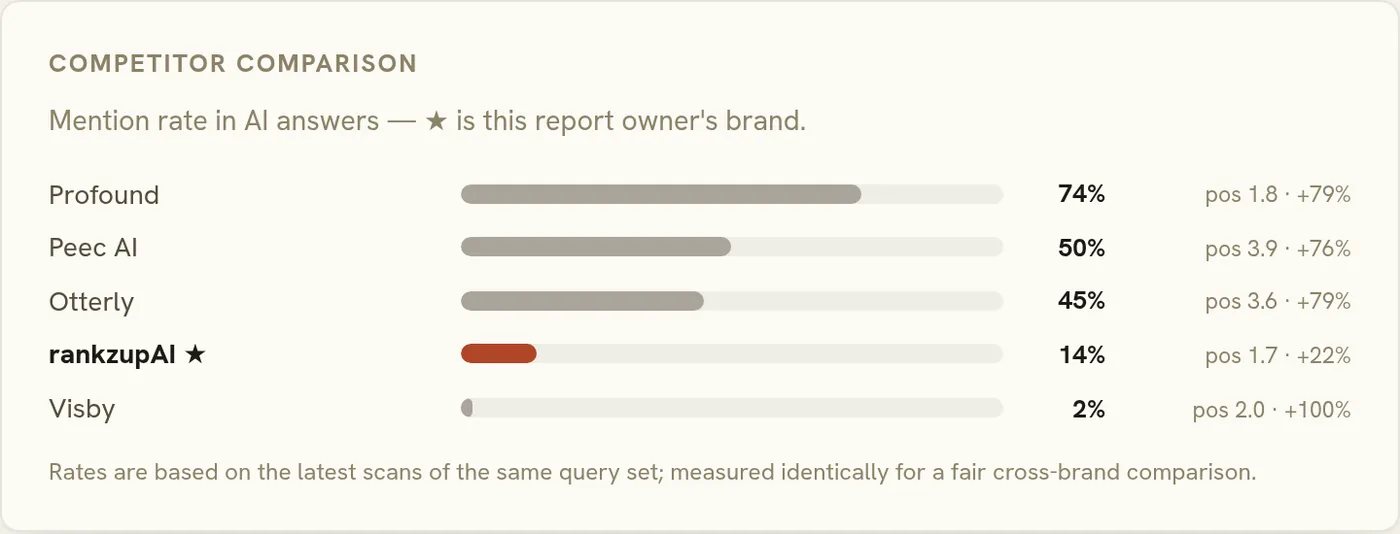
Here's a hypothetical that shows the overlap in practice. Picture a project management tool that ranks page one for "project management software" but never appears in ChatGPT's recommendations. Digging in, they find the model's favorite sources for that query are three listicles, and they're absent from all three. Six months of outreach later they're in two of them, and their mention rate climbs from roughly nothing to appearing in about a third of sampled runs. Notice the fix was outreach, a thing SEO people have done forever. The target changed; the muscle didn't.
That's the whole story of AEO vs SEO, really: same fundamentals, redistributed weights, a few new moves. If you want to see how the weights fall for your own site, pull a free AEO report and start from evidence rather than vibes.
New to the term itself? What is AEO? gives the two-minute definition before this deep dive.