Gemini SEO: Brand Visibility in Google's Assistant
Gemini is the AI engine everyone forgets to optimize for. ChatGPT gets the headlines and Perplexity gets the SEO blog posts. Gemini meanwhile sits quietly inside the Google app and Android and Workspace and Chrome, in front of an absurd number of people. If your buyers live in the Google ecosystem, Gemini visibility probably matters more for you than the louder platforms.
The good news: it's the AI engine most connected to work you've already done.
How Gemini grounds answers with Google Search
Gemini isn't answering from model memory alone. For anything factual or current or commercial it uses grounding with Google Search. It fires off searches behind the scenes, pulls the results and uses them to write and support the answer. Google exposes this same mechanism to developers through the Gemini API, which is how we know roughly what the pipeline looks like: query goes in, related searches run, retrieved results shape the response, and sources may be linked.
Not every response is grounded. Ask Gemini to draft an email and no search happens. Ask it "what's the best CRM for a small law firm" and you're almost certainly getting search-informed output. The model decides when it needs fresh information, and that decision itself is opaque, one of several places where I have to say "we observe the pattern, we don't see the mechanism."
The strategic point is simple though: when Gemini reaches for external information, it reaches into Google's index. There is no separate "Gemini index" to optimize for.
Why your classic rankings still decide Gemini brand visibility
This follows directly from grounding, but it's worth stating hard: if you rank well in Google Search for a topic, you've done most of the work for Gemini visibility on that topic. The retrieval layer is the search engine you've been optimizing for since forever.
That's not the same as saying positions map one-to-one to mentions. They don't. Gemini synthesizes across multiple results, and the searches it runs are often reformulations of the user's question, so you might rank #3 for the user's literal phrasing but nowhere for the variant Gemini actually searched. Broad topical coverage beats a single perfectly-optimized page here, because you can't predict the reformulation.
There's a second layer: the model's own knowledge of your brand. Gemini blends what retrieval returns with what it already "believes" about you from training data. A brand with a consistent public footprint (same positioning across your site, review platforms, directories, press) gets described accurately. A brand with a messy footprint gets a muddled or outdated description, even when the retrieved page says otherwise. I've seen the second situation more often than the first, frankly.
The Shopping Graph is Gemini's commerce brain
If you sell physical products, there's a piece of infrastructure most SEO advice ignores: the Google Shopping Graph. It is Google's structured dataset of billions of listings, refreshed constantly:
- Products
- Sellers
- Prices
- Availability
- Reviews
Gemini draws on it for shopping-type queries. Ask Gemini to find running shoes under $120 with good arch support, and the products it surfaces come through that graph, not through your blog content.
Which means the optimization work is unglamorous: a complete, accurate Google Merchant Center feed. Product schema on your pages. Prices and availability that match reality. GTINs filled in. Reviews flowing. None of this is new advice. It's the same feed hygiene that Shopping ads and free listings have wanted for years, but it now also determines whether an AI assistant recommends your product or your competitor's.
Hypothetical example, clearly invented: imagine a small cookware brand, Copperline, whose carbon-steel pans rank decently in organic search. A shopper asks Gemini for "a carbon steel pan that works on induction, under $80." Copperline's Merchant Center feed is half-filled: no induction-compatibility attribute, stale pricing. Gemini's shopping results surface three competitors whose feeds carry the attribute. Copperline's blog rankings never entered the conversation, because for this query type, the Shopping Graph is the conversation. Fixing a feed attribute did more than any content rewrite could have.
Why Gemini and AI Overviews behave differently
People conflate these two constantly, and I get why: both are Google, both are AI, both cite web pages. But they behave differently in ways that matter:
- Where they live. AI Overviews sit at the top of a search results page you navigated to. Gemini is a destination: an app, a chat, an assistant woven into Android and Workspace.
- Session shape. AIO is one query, one summary, links below. Gemini is conversational: follow-ups, refinements, "compare those two," memory of context. A brand mention can compound across a session or get eliminated in turn three.
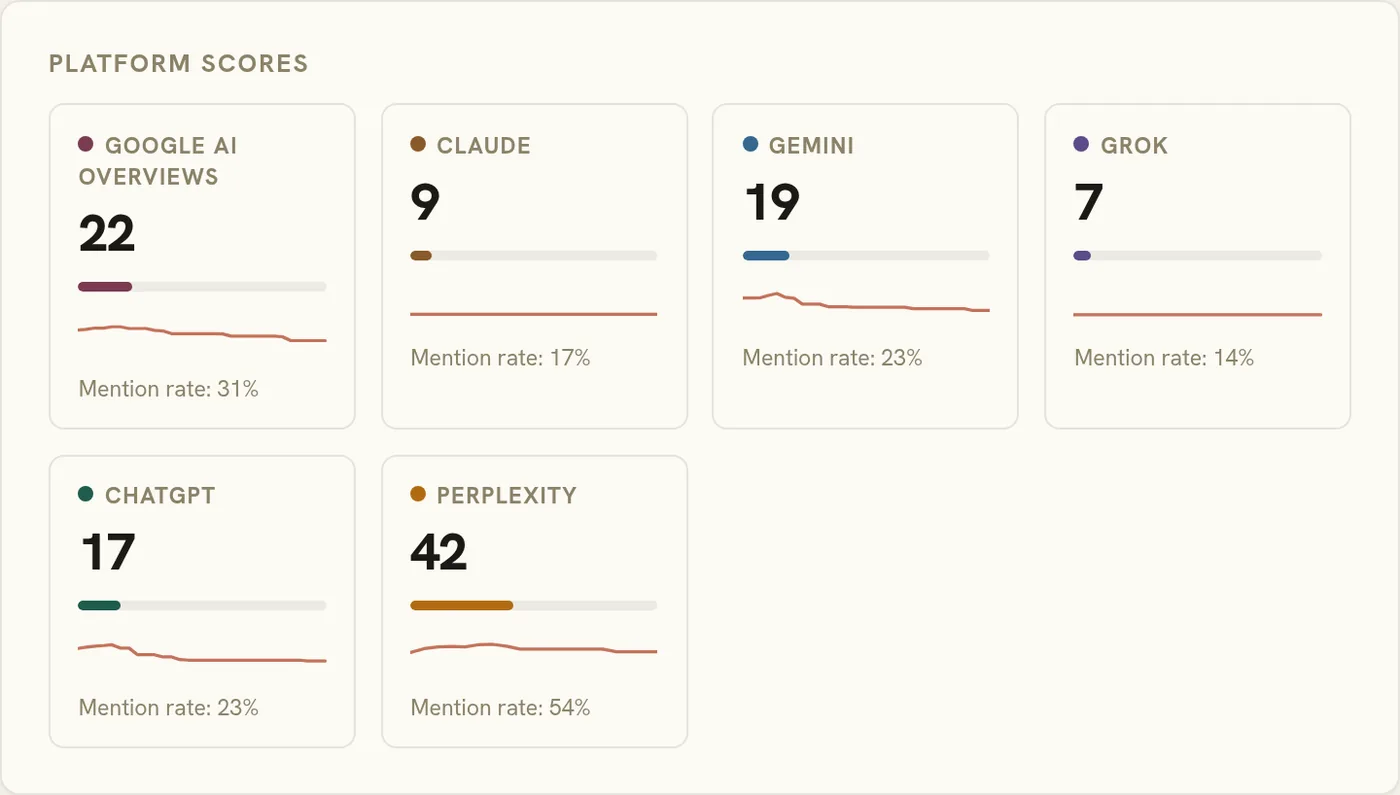
- Citation behavior. AIOs cite fairly consistently. Gemini's linking is patchier. It often names brands without linking anywhere, which is worse for your traffic but arguably better for pure brand impression. I go back and forth on whether that trade is good.
- Personalization. Gemini increasingly personalizes using account context. Two users can get meaningfully different brand recommendations for the same prompt, which makes single-query "testing" of Gemini visibility nearly useless. You need sampled, repeated measurement.
The overlap is the grounding layer. Both surfaces draw from Google Search, so strong rankings feed both. The divergence is everything after retrieval.
What I'd actually do for Gemini SEO
My short list, in priority order:
- Keep winning classic Google rankings for your money topics. This is 60% of the job and nobody wants to hear it.
- Cover topic variants, not just head terms, so query reformulations still find you.
- Fix your entity footprint: consistent naming, descriptions, and facts across your site and the third-party sources Google trusts.
- If you sell products, treat Merchant Center as a first-class channel. Complete attributes, live pricing, reviews.
- Test conversationally, repeatedly, across accounts. Never trust one chat as data; a Gemini rank tracker does this on a schedule.
The engines share more DNA than their marketing suggests, and understanding one helps with the others: the retrieval-then-recommend pattern shows up everywhere, as we covered in how ChatGPT recommends brands.
If you'd like a concrete read on how visible your brand currently is inside answer engines, generate a free AEO report and start from real data instead of guesses.