Query Fan-Out: How AI Search Rewrites Your Question
When you type a question into ChatGPT search, Google's AI Mode, or Perplexity, the engine usually doesn't search for what you typed. It rewrites your question into several different searches, sometimes many, runs them in parallel, and builds its answer from everything that comes back. Google calls this technique "query fan-out," and the name has stuck for the whole pattern across engines.
This one mechanism explains more about AI search visibility than almost anything else. It's why pages rank in AI answers for questions no human ever typed, why classic keyword thinking quietly breaks, and why some unglamorous pages get cited constantly. Worth understanding properly.
What query fan-out means in AI search
Classic search is one query, one results page. You typed it, Google matched it, done.
AI search inserts a planning step. The model looks at your question and decides what it would need to know to answer it well. Then it generates a set of sub-queries: reformulations, narrower questions and related angles. Each sub-query goes to a search backend. The retrieved pages get read, and the model synthesizes one answer from the pile, citing some of the sources.
Google described this explicitly when it introduced AI Mode in 2025: the system "issues multiple related searches concurrently across subtopics" on the user's behalf. That's the documented version. For ChatGPT search and Perplexity, the same behavior is directly observable (both show the searches they ran, and it's routinely more than one per question), even where the internals aren't published.
The key mental shift: your question is no longer the query. It's the brief. The engine writes its own queries from that brief, and those machine-written queries are what your content actually has to match.
How one question becomes eight searches
A made-up but realistic walkthrough. Suppose someone asks: "I run a 10-person design studio, should we switch from Dropbox to something else?"
No search engine on earth has good results for that literal string. So the engine decomposes it into something like:
- dropbox alternatives for small teams 2026
- dropbox business pricing
- best cloud storage for design agencies
- dropbox vs google drive for business
- large file sharing for designers
- dropbox complaints problems reddit
Six-ish searches, each hitting different pages. A comparison article wins sub-query one. A pricing page answers two. A niche blog post about design-agency file workflows takes three. A Reddit thread full of grievances covers six. The final answer stitches these together ("several teams your size switch because of X, common alternatives are A, B, C, pricing works out to...") and cites four or five of those pages.
Here's what should jump out: the Reddit complaint thread and the design-workflow blog post got into the answer for a question about switching from Dropbox, a question neither page targets or even mentions. Fan-out put them there. The engine decided complaints and agency workflows were relevant to the brief, went looking, and found them.
Whether every engine runs six sub-queries or two or twelve varies by engine, by query complexity, and by mode: deeper research modes fan out much wider. Nobody outside the labs knows the exact query-generation logic, and it changes. The pattern, though, is stable and universal.
Why you rank for questions nobody typed
This is the strategic core, so let's make it explicit.
In classic SEO, demand was legible. Keyword tools showed you what people type, you targeted the strings with volume, and zero-volume queries were ignorable by definition. Fan-out breaks that logic in both directions.
First, machine-generated sub-queries have no search volume (no human types "large file sharing for designers" in that exact framing at scale), yet pages matching them get retrieved and cited daily. Zero-volume, high-value is now a real category. Your keyword tool shows a dash; the AI engine shows your page to a purchase-ready user anyway.
Second, one human question fans into many chances to appear. You don't need to win "should we switch from Dropbox," an unwinnable, never-typed query. You need to win any one of the sub-queries it decomposes into. A brand can enter answers through the pricing angle, the comparison angle, the complaints angle, the niche use-case angle. Each is a separate door into the same answer. This is also, mechanically, how ChatGPT recommends brands: the recommendation is assembled from whatever the fanned-out retrieval dragged in.
The flip side is sobering: if your content only targets the big head terms humans type, you're competing for the one door everyone can see while the side doors go to whoever bothered to cover the narrow angles.
How to see query fan-out yourself
You don't have to take this on faith: the engines mostly show their work, which is unusual and useful.
In ChatGPT, ask a comparison or recommendation question with search enabled and expand the activity/sources panel: it lists the actual searches it ran, and you'll see your question rephrased in ways you didn't write. Perplexity displays its search steps as it works, especially in its research modes. Google's AI Mode doesn't expose its sub-queries in the interface, but Google has described the fan-out approach in its own announcements, and you can infer the spread from how disparate the cited pages are.
Do this with five of your own money questions. Ten minutes of reading the sub-queries your category generates teaches you more about what content to build than most paid tools. Look for the reformulations that recur: those are the machine keywords of your niche.
What query fan-out means for your content
Practical implications, in rough order of importance:
-
Cover angles, not just keywords. For each topic that matters commercially, ask what the engine would need to answer it:
-
Pricing
- Comparisons
- Alternatives
- Problems
- Use-case fits
- How-tos Each angle is a sub-query someone's page will win. Make some of them yours. A page per angle beats one mega-page trying to be everything, because retrieval grabs focused chunks.
- Stop dismissing zero-volume topics. "Dropbox alternatives for design agencies" with no measurable volume can be worth more than a head term you'll never crack. If a plausible sub-query has no good page on the internet, that's not a dead keyword. That's an open door.
- Answer narrow questions completely. A fan-out sub-query is specific, and the engine wants a source that nails it. Direct answer up top, specifics, numbers, dates. Pages that half-address six things lose to pages that fully address one.
- Third-party surfaces count double. Sub-queries like "X complaints reddit" or "best X for Y" resolve to pages you don't own. Your presence in those threads and roundups is content strategy now, not PR garnish.
- Expect volatility. Query generation is model behavior, and model behavior shifts with every update. The angles that get fanned to today may change next quarter, which is an argument for measuring your answer presence continuously rather than auditing once.
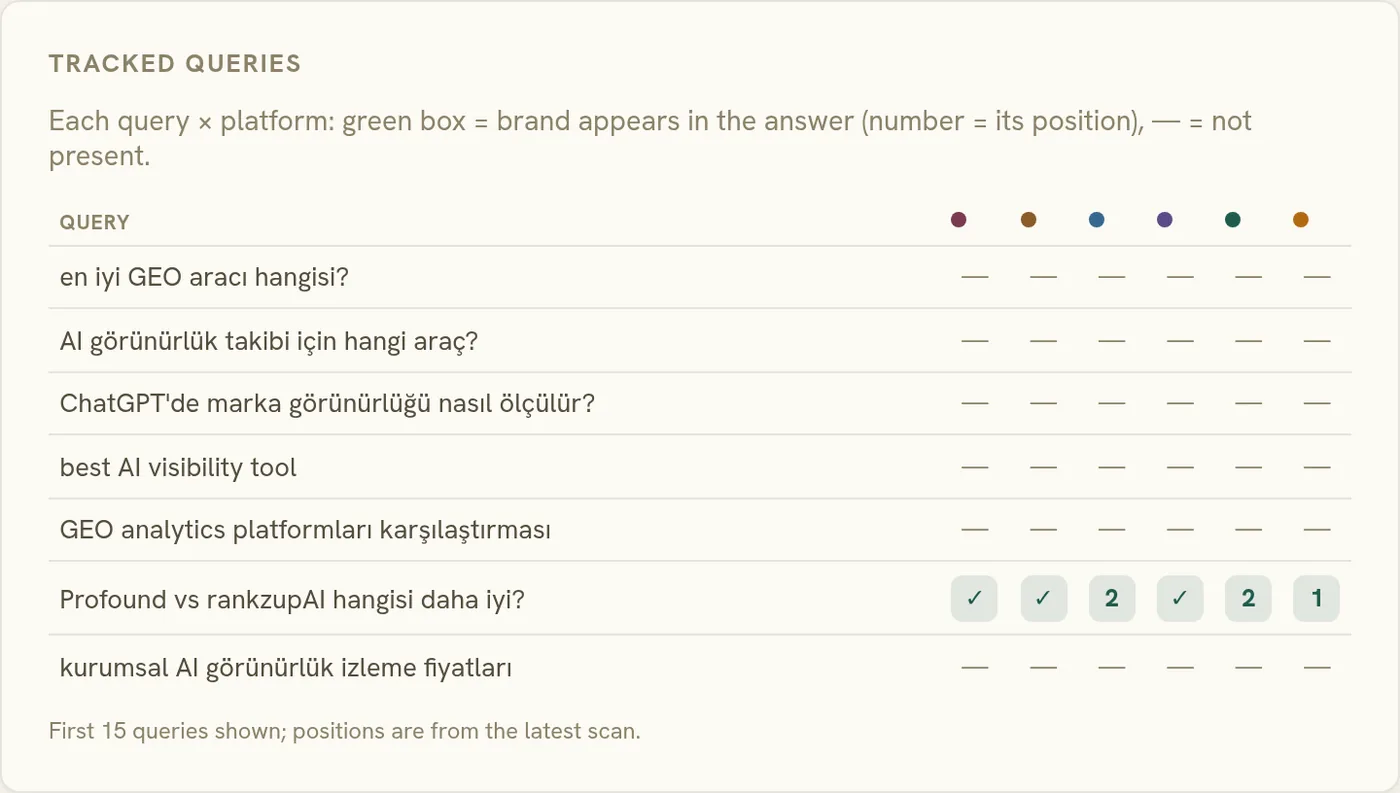
If you want to see the mechanism applied to your own topic right now, we built a free query fan-out tool that takes a question and shows the kind of sub-queries an AI engine generates from it. Run your most important buyer question through it: the gaps between those sub-queries and your existing content are your to-do list.
Fan-out is also the reason a prompt set needs angles rather than keywords. Designing a prompt set turns that into a concrete list.