What Is an AI Visibility Score?
What is an AI visibility score?
An AI visibility score is a single number (usually 0 to 100) that sums up how visible your brand is across AI answers. It rolls several signals into one figure: how often you're mentioned, where you land, how much of the answer you own, how you're framed, and how strongly you're recommended. One number you can watch move.
What goes into the score
No single signal is the whole picture, so a good score blends them: mention rate, position, share of voice, sentiment, and recommendation strength. The weighting is where the judgment lives: mention rate usually carries the most, because if you're never named, the rest is moot. A score that leans on only one signal (just mentions, say) will mislead you.
Why a score needs a confidence band
Because AI answers are noisy. A bare number pretends to a precision the underlying data doesn't have, and that false precision makes teams celebrate or panic over movement that's really just variance. An honest AI visibility score comes with a range (a confidence band) that tells you how settled the reading is. Trust a tight band; treat a wide one as provisional.
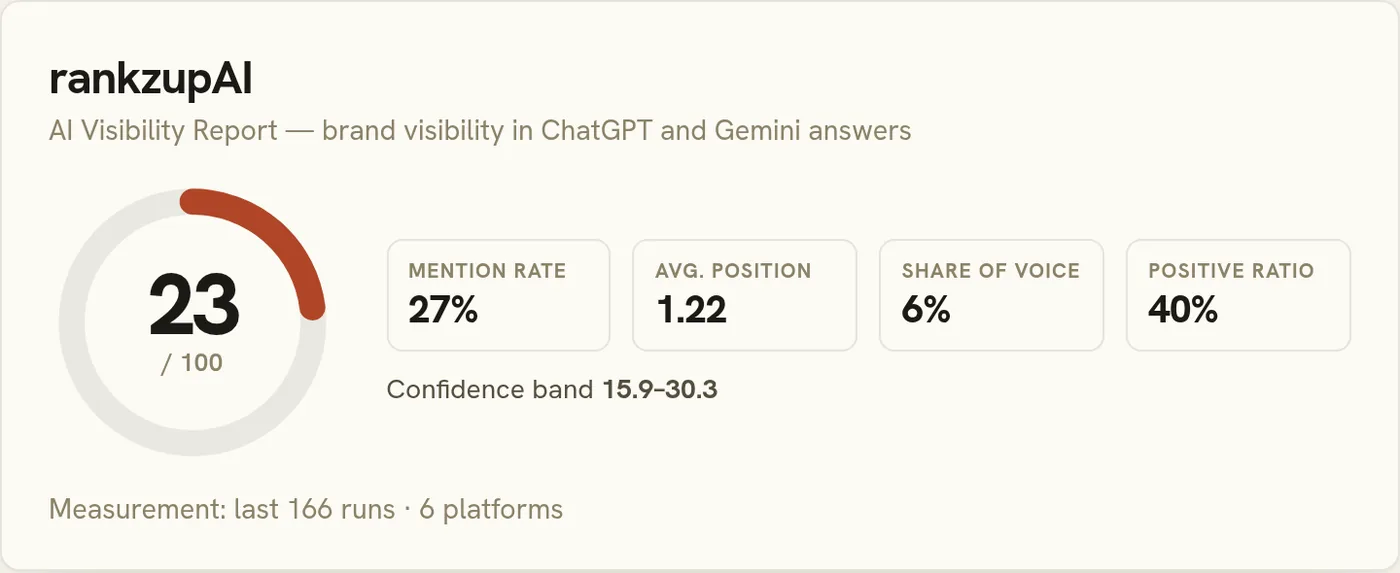
How the AI visibility score is calculated
The short version: sample a set of prompts across engines, score each answer on the signals above, and combine them into one figure with a band around it. The exact weights, the sampling window, and the honesty caveats are laid out in our methodology. And if you want the number tracked for your brand instead of computed by hand, that's what the platform is for.
What a good score looks like
Honest calibration, from measuring across markets: most brands that have never done GEO work land under 20. Category leaders typically sit between 40 and 70 on brand-free questions. Above 80 is rare and usually means the question set is too branded, worth auditing before celebrating. The score is also category-relative: 35 in a crowded category can mean leadership, while 35 in a niche with two players means trouble. That is why the score ships next to share of voice against named rivals rather than alone.
Your score dropped. Now what?
Resist the instinct to react to the number itself. The diagnostic order that works: check the confidence band first (a drop inside the band is noise), then the per-question breakdown (one lost question or many?), then the per-engine split (everywhere, or one engine?). A drop concentrated in one engine usually traces to a source change: something the engine reads shifted. The triage order in the measurement playbook in the panel automates exactly this triage.
What counts as a good AI visibility score?
There is no absolute pass mark, because the score is sampled from a market conversation your rivals are also in. Three honest readings: relative to the category leader (their score is your ceiling estimate), relative to your own last month (the trend is the KPI, not the level), and relative to the share of voice behind it. A modest score with rising share on your money questions beats a high score built on easy definitional queries. The practical rhythm: freeze a prompt set, read the score inside its band, and judge yourself on quarter-over-quarter movement.
One score vs per-engine scores
The overall score answers "how are we doing?" for an executive; the per-engine scores answer "where do we act?" for whoever does the work. Both matter, and they diverge more than teams expect: being strong on Gemini while invisible on ChatGPT is the normal case, not the exception. Reading only the composite hides the engine where you are quietly losing.