What Is AI Sentiment?
What is AI sentiment?
AI sentiment is how positively or negatively an AI answer frames your brand when it mentions you. Being named isn't the whole story. There's a wide gap between "X is a top choice for teams" and "X exists, but people complain about support." Sentiment is that framing: the tone the model attaches to your name.
Mention vs. sentiment
A mention tells you that you showed up. AI sentiment tells you how you showed up. You can be mentioned often and framed badly, which is arguably worse than not being mentioned at all: the assistant is actively steering people away from you, with your own name. Both belong on the same dashboard, because one without the other is half a picture.
Why AI sentiment matters
Because an AI answer is a recommendation, not a listing. When a model calls a brand "reliable but pricey" or "great for beginners," that framing shapes the decision more than the raw mention does. And it compounds: negative framing in the sources the model reads tends to become negative framing in the answer. The tone downstream starts upstream.
How AI sentiment is measured
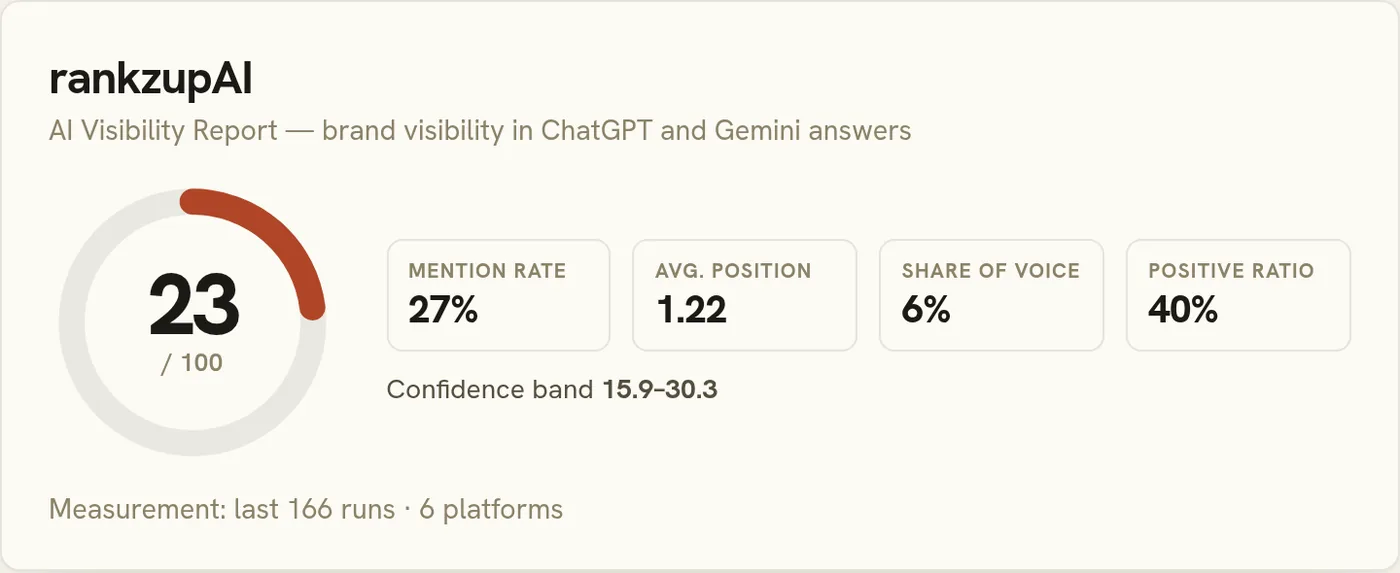
You classify each mention by tone (positive, neutral, negative) across the answers you track, then watch the ratio over time. One harsh answer is noise; a steady drift toward negative across many is a signal worth chasing down, usually a reputation or review problem upstream. Sentiment sits alongside mention rate and share of voice in the full scoring. One honest limit: sentiment is a softer, more interpretive signal than plain presence, so read it as a trend, not a verdict.
The four frames engines actually use
In practice answers fall into four framings, and seeing examples makes the metric concrete. Positive: "X is a reliable choice with strong reviews" (a recommendation). Neutral: "X is one of several options in this category" (present, not endorsed). Negative: "X has received complaints about delivery times" (mentioned as a warning). Mixed: "X offers good prices, though support quality varies" (the most common real-world frame, and the one manual checks misclassify most). A sentiment ratio counts these frames across many runs rather than judging one answer.
What actually moves AI sentiment
Engines do not form opinions; they compress sources. A negative frame almost always traces to something specific and findable: a complaint thread the engine reads, a review cluster, an old incident that ranks well. That is good news operationally: sentiment repair is source work, not persuasion. The repair sequence (measure, trace, fix at the source, wait for recrawl) lives in the sentiment repair guide.
Common traps in measuring AI sentiment
The single-answer verdict: one cautious sentence from one engine is a sample, not a diagnosis. Classify across runs before reacting. The keyword shortcut: counting words like "however" or "complaint" misreads hedged-positive answers; frames need reading, not grepping. And the missing split: sentiment averaged across engines hides exactly the finding that matters, because the engine whose sources carry the complaint is where the repair starts.
One more: the one-sided ledger. Teams measure their own sentiment and never their rivals', but "cautious about everyone" is a category trait, while "cautious about you, warm about them" is a positioning finding. Run the same classification on the two or three names that share your answers; the comparison turns a mood reading into strategy input.
Expect sentiment to disagree across engines
The same brand routinely reads positive on one engine and mixed on another, because their source pools differ. Claude might lean on older training data while Perplexity reads yesterday's reviews. Disagreement is not measurement noise. It tells you which engine's source pool contains the problem, which is exactly where to start digging. Hallucination and claim tracking pairs sentiment with the specific claims engines make about you.