What Is Mention Rate in AI Visibility?
What is mention rate?
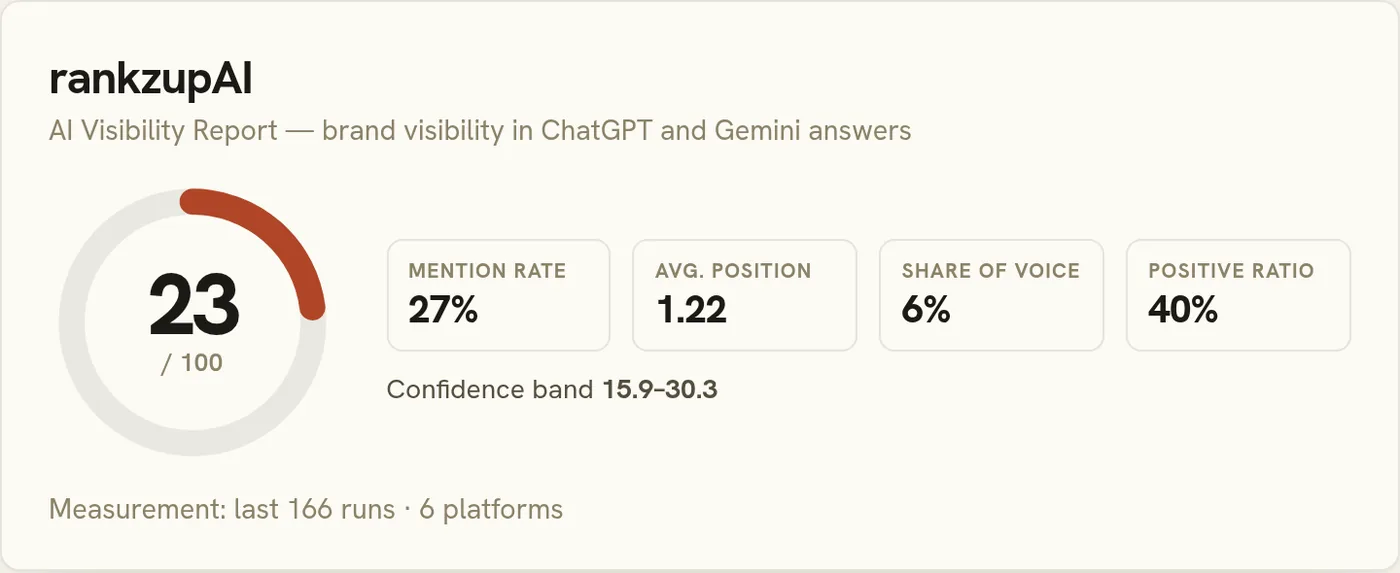
Mention rate is the share of AI answers that name your brand: track 20 questions across four engines, get named in 22 of the 80 answers, and your mention rate is 27.5%. It is the most basic AI visibility signal: before position, before sentiment, before anything else, you either exist in the answer or you do not.
How mention rate is measured
Three ingredients: a question set, an engine set, and a time window. The questions come from prompt tracking: the real things buyers ask in your category. Each question runs on each engine on a schedule, each answer is checked for your brand and its aliases, and the rate is the named answers over all answers in the window.
The alias part matters more than it sounds. Models write "Rankzup", "rankzupAI" and "rankzup.ai" for the same brand; a naive exact-match counter undercounts you and hands you a fake crisis.
Why one scan is not a mention rate
The same question, asked twice, can produce different brand lists: models sample, sources rotate, answers vary. A mention rate computed from a single run is a coin flip wearing a percentage sign. Honest measurement samples the same questions repeatedly across a window and ships the rate with a confidence band so you know how settled the number is.
Mention vs citation
Being mentioned means the answer names you. Being cited means the answer lists your site as a source, which can happen without your name ever appearing in the text. The two diverge constantly: in our own measurement across brands, roughly a third of answers that cite a brand's own site never name the brand. Mention rate tracks the first; AI citations track the second. You want both, and they respond to different work.
What moves mention rate
Mostly things outside your site. Models name brands they met in listicles, comparisons, reviews and reference pages, so off-site GEO moves mention rate more reliably than another blog post does. On brand-free questions the honest lever is becoming part of how your category is written about; on branded questions a low rate usually signals a searchability problem instead.
Reading mention rate without fooling yourself
Split it before trusting it. By question type: branded vs brand-free rates answer different questions about your business. By engine: being strong on Gemini and absent on ChatGPT is the normal case, and the average hides it. And always against rivals: a 25% mention rate is excellent or alarming depending entirely on whether your competitor sits at 10% or 60%.
Mention rate benchmarks by question type
The number only means something inside its question type. On branded questions ("is X reliable?") a healthy brand should clear 80%: the engines are being asked about you by name, and absence signals a searchability problem, not a marketing one. On brand-free category questions, the honest bands from measuring across markets: unknown brands sit near zero, working challengers land in the 10-30% range, and category leaders in 30-70%. Very few brands hold above 70% on genuinely brand-free questions, and sustained 100% almost always means the questions leak the brand name.
Comparative questions ("X vs Y") behave differently again: your mention rate there is near-guaranteed, and the informative signal moves to position and sentiment instead. Reporting one blended rate across all three types produces a number that looks precise and means nothing.
Mention rate mistakes that mislead teams
The alias undercount: engines write brand names in every casing and spelling they have seen. Counting only the exact registered name reliably understates the rate and manufactures fake declines.
The moving target: swapping questions mid-quarter resets the metric. A rate is only comparable over time while the prompt set stays frozen. Version changes deliberately and annotate them on the chart.
The quality blind spot: a mention is not an endorsement. Answers that name you with a warning attached still count toward the rate, which is why mention rate reads honestly only next to sentiment. All three mistakes get a fuller treatment in the measurement playbook.