AI Competitor Analysis: Why Do Engines Recommend Your Rival?
Classic competitor analysis watched ranking pages: who sits where for which keyword? In AI answers the stage changed: there is no results list, there is one answer, and the three to five brands in it represent the whole market. Competitor analysis now has to answer a different question: why does the engine pick my rival?
Who appears where in your category?
Step one is an inventory. Across every question you track, which brands appear in each engine's latest answer? For most brands this table delivers two surprises:
- The brands you consider rivals may be absent, while a brand you never think about appears in every answer. The engines' definition of your competition is not the one in your marketing deck.
- Different engines give different lists for the same question. You can lose a question on ChatGPT and win it on Gemini, which is why per-engine tracking is done separately.
What percent of the conversation is yours?
After individual questions, look at the aggregate: of all brand mentions across all answers, what share belongs to you? Share of voice is your real weight in the market conversation. You can have 40 percent visibility while your rival owns the conversation, appearing first and twice in every answer. We covered how share of voice is computed separately.
One critical rule when comparing: the comparison must run on brand-free questions only. We explain why in the branded vs brand-free guide. In short, everyone wins their own branded questions and the comparison breaks.
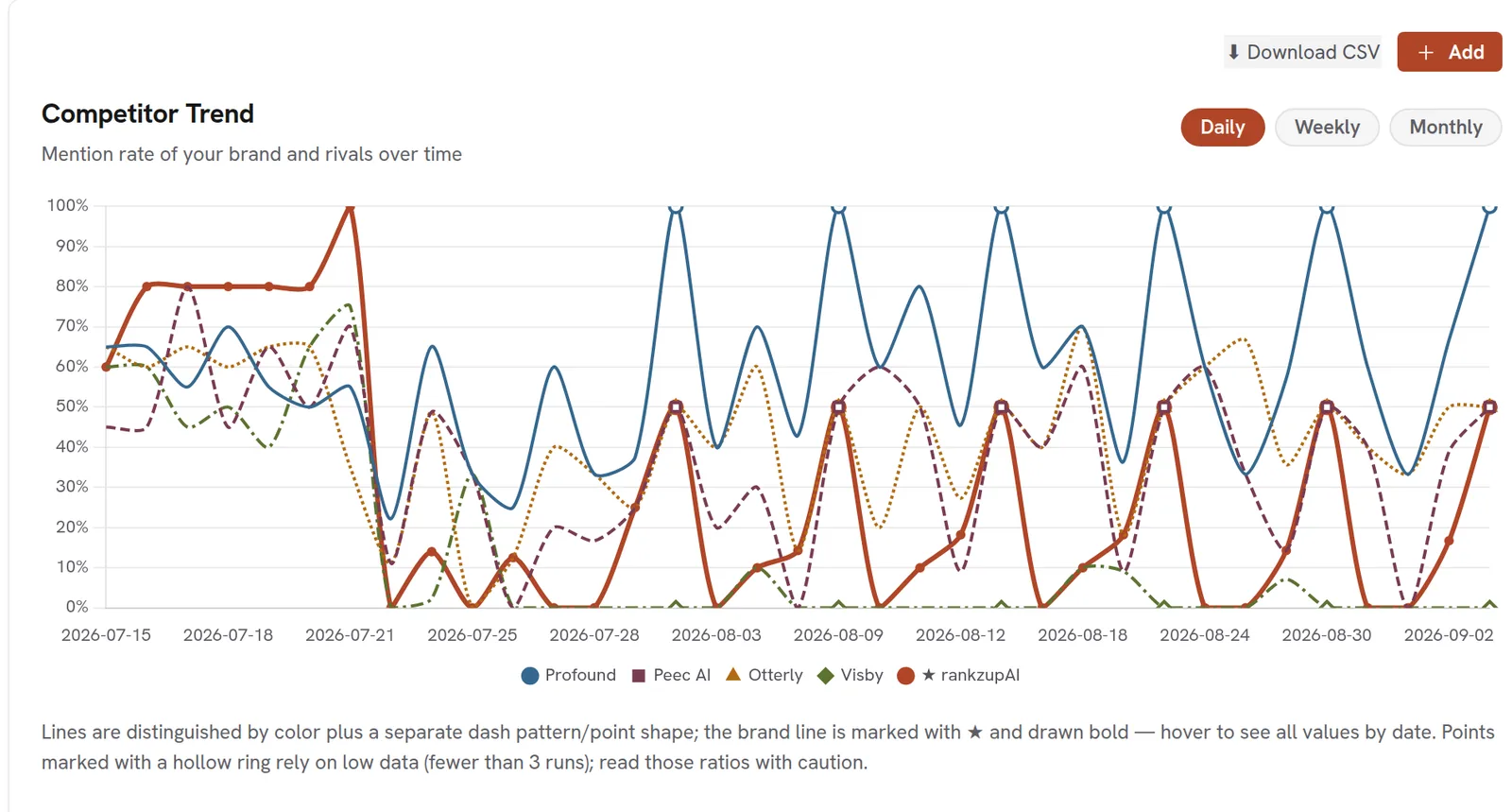
Why is the rival recommended?
The visibility table shows the state; source analysis shows the cause. Engines read specific sites while building answers: comparison sites, forums, review pages, news, and sometimes your rival's own blog. List the domains feeding the answer for every question you lose, and a pattern appears:
- The rival is listed on the two comparison sites engines cite most; you are not.
- A forum thread mentions the rival dozens of times.
- The engine cites the rival's own guide content as a source: their blog is funding your invisibility.
All three patterns convert into action: get into the same lists, build a real presence in the same communities, publish the better answer to the same question on your own site. Source classification also shows which site type dominates: in a forum-heavy category, PR budget wins; in an editorial-heavy one, content budget does.
Watch rival moves over time
A single snapshot is not enough; you need the film. If a rival's visibility has been climbing for three weeks, they are doing something: new content, new PR, new listings. Weekly scans and a change feed diff the brands entering and leaving each answer, so a rival campaign shows up in your dashboard the week it lands.
Adding a competitor in rankzupAI is one line; the rest is automatic: same questions, same engines, fair comparison and a source breakdown. Walk through a real project's competitor screen in the live demo, then try it on your own brand.
Watching rivals without obsessing
Rival-watching fails in two directions: checking daily and reacting to noise, or checking never and discovering a shift a quarter late. The workable middle is the same weekly scan that feeds your own mention rate, read with rival columns side by side, plus one alert worth interrupting your week for: a rival entering answers on a question you own. Everything else keeps until the monthly review, where share of voice trends separate real strategy shifts from answer wobble.
Reading a rival's playbook from citations
The citation trail is the closest thing to seeing a competitor's GEO strategy. If their mentions cluster around one comparison site, that placement is load-bearing, and a spot beside them is worth more than ten random listings. If their surge coincides with a review-count jump, you are watching a review program work in real time. If they are strong on Perplexity but absent on ChatGPT, they optimized for citable freshness and skipped the forums. Every one of these is visible in the source view, and each implies a specific counter-move rather than generic "do more marketing".