Branded vs Brand-Free Queries in AI Visibility Measurement
A brand's AI visibility score collapses into one number, but what that number means depends entirely on the question set beneath it. If half the questions contain the brand name, the score comes out high, and proves nothing.
What is a branded query, and what is a brand-free one?
A branded query contains the brand name: "is X trustworthy", "X reviews", "X shipping time". The engine has no choice but to mention the brand; the question already points at it.
A brand-free query asks about the category: "best protein powder", "where to buy an affordable sofa". Here the engine picks the brands ITSELF. Real competition happens in these questions, and so does new-customer acquisition.
Both types are worth tracking, but they answer different questions. Branded queries are a reputation signal: does the engine know you, and how does it talk about you? Brand-free queries are a market signal: does the engine recommend you to someone who has never heard of you?
Score inflation is the most common measurement mistake
In a hundred-question set with 40 branded questions, the score earns a 40-point floor on day one. It looks great on a dashboard and wins applause in a board deck. But compared against a competitor, the picture is distorted: everyone scores near-perfect on their own branded questions, and nobody sees anyone's real position.
A real example from our measurements: a footwear brand appeared on all four engines for "is it trustworthy" and "reviews". On category questions ("best shoe brands", "comfortable everyday shoes"), it appeared on none. Anyone looking only at branded questions would have assumed everything was fine.
Why competitor comparison must use brand-free questions only
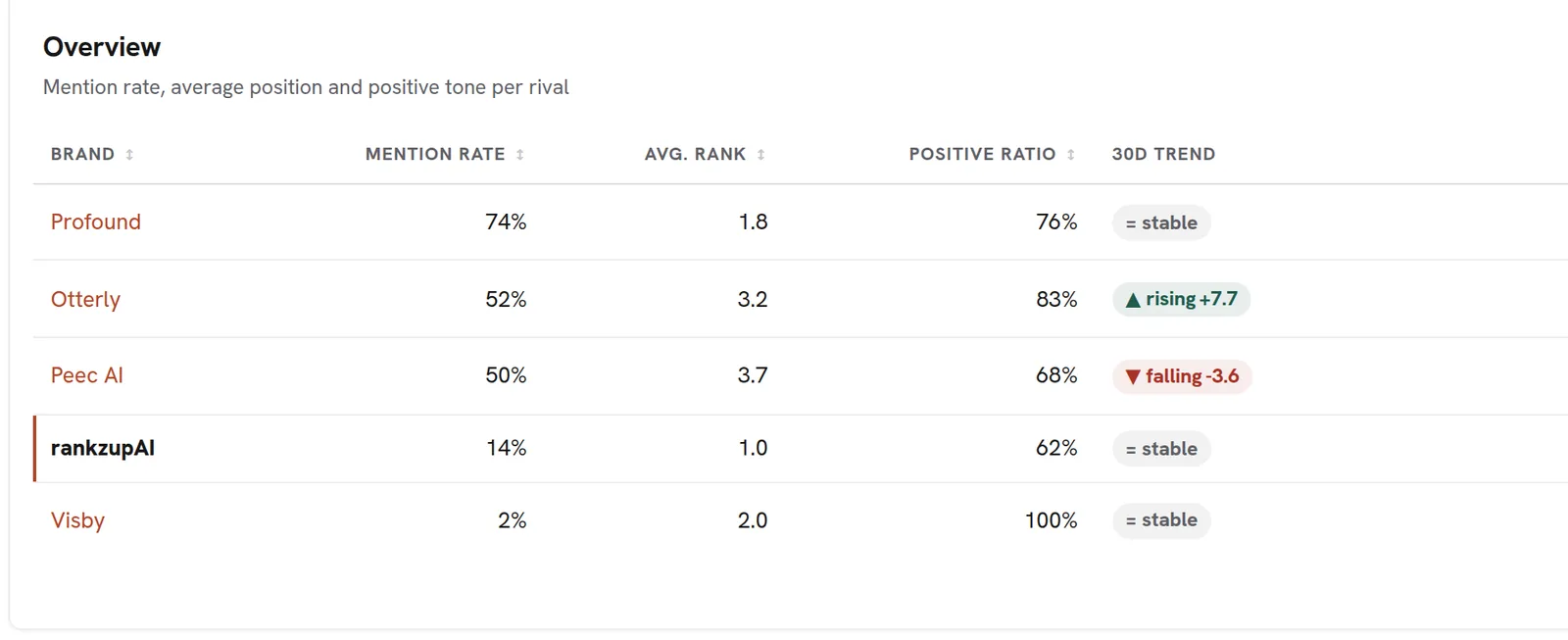
Include branded questions in a competitor comparison and every brand feeds on its own branded queries. The comparison becomes meaningless. That is why rankzupAI's competitor comparison scores only questions without any brand name in them: the owner's "is it trustworthy" does not count, and neither does the rival's. What remains is level ground.
The same rule applies to any shared report. When a report claims "we are number one", check the question set first. If the questions were chosen after seeing the results, it is marketing, not measurement.
How to build a balanced query set
A practical ratio: roughly 70% brand-free, 30% branded: say, 7 out of every 10 questions brand-free. On the brand-free side, build three layers:
- Category questions: "best X brands", "X recommendations" (the market's main stage).
- Problem questions: the pain your brand solves ("which serum for acne"), the highest purchase intent.
- Comparison questions: "X or Y". They reveal where engines build their comparison tables from.
On the branded side, the "is it trustworthy" and "reviews" pair covers most brands; it captures the reputation signal (tracked alongside, but kept out of the scoring denominator).
We cover query set design in depth in a separate guide, and the AI visibility score article shows where the ratio lands in the final number; if the jargon is new, the GEO glossary has short definitions.
How this looks in the panel
rankzupAI classifies every question as branded or brand-free, labels its intent, and computes competitor comparison on the brand-free subset. When your score is low, you see why at the question level: which category question misses you, who appears there instead, and which sources the engine built its answer from. Start a free trial and see the difference in your first scan.
The 70/30 rule in practice
The same 70/30 split, seen from the panel side. The brand-free block carries the honest scoreboard: category presence, share of voice, competitor position. The branded block does different work: reputation watch ("is X reliable?"), confusion detection with similarly named companies, and framing checks. The mistake is not having branded questions; it is letting them into the scoring denominator. Keep them tracked, keep them out of the score. The panel makes that split automatically, which is what the section above shows.