What Is Share of Voice in AI Search?
What is share of voice in AI search?
Share of voice in AI search is how much of an AI answer belongs to your brand versus everyone else's. Not whether you're mentioned, but how much of the mention space you actually own. Ask Perplexity for the best project management tools and if the answer names eight brands, being one of eight is a thin slice. If it names two and you're one of them, that's a commanding share.
That's the whole idea. Presence is binary; share of voice is the volume knob.
Share of voice vs. mention rate
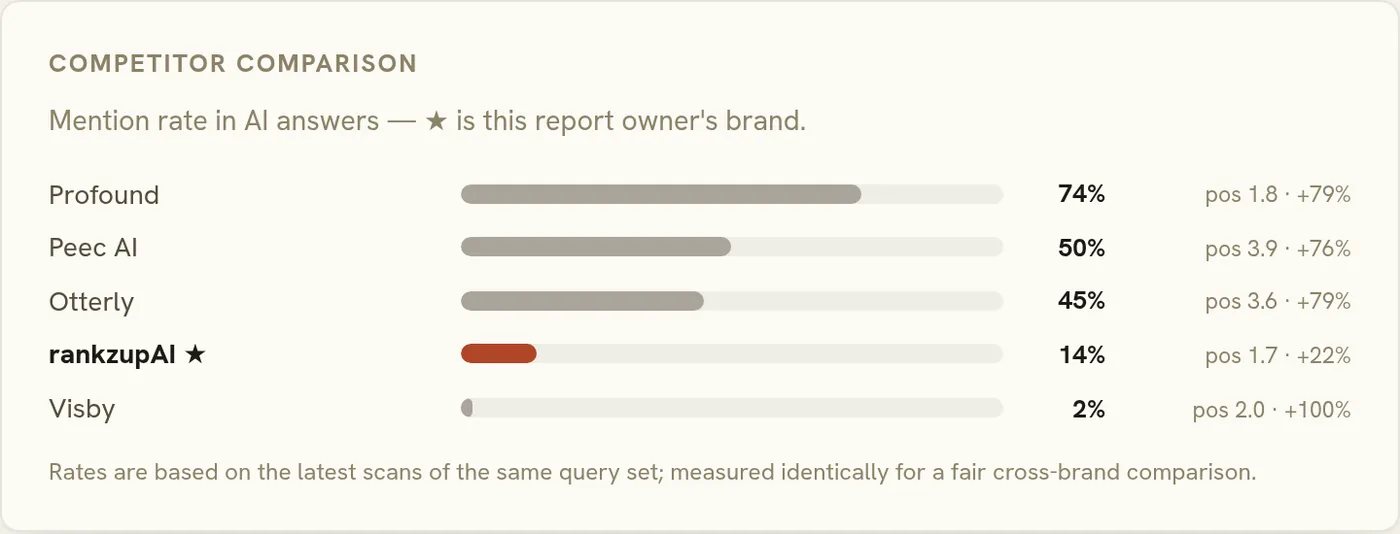
People mix these up constantly, so let's be clear. Mention rate is how often you show up at all: you're in 6 of 10 answers, that's a 60% mention rate. Share of voice is how much of each answer you own when you do show up. You can have a high mention rate and a low share of voice: named in every answer, but always buried among ten competitors. Both matter, and they tell you different things: mention rate says "am I in the conversation," share of voice says "am I dominating it."
Why AI share of voice matters
Because AI answers are winner-takes-most. A Google results page has ten organic slots; an AI answer usually names two to four brands and stops. The drop-off after those few names is total. There's no position seven getting scraps. So owning a bigger slice of a short list isn't a vanity metric. It's often the difference between being the brand the assistant effectively recommends and being background noise in a crowd.
One caveat worth saying plainly: don't compare share of voice across engines as if the numbers mean the same thing. Some models are just chattier: they name more brands per answer, which mechanically shrinks everyone's slice. Read your share of voice within one engine over time, not Gemini lined up against ChatGPT.
How AI share of voice is measured
The short version: you track a set of questions, look at every answer, and measure what fraction of the named brands is you (weighted, ideally, by position, since being named first is worth more than being named last). Do it once and it's noise; do it repeatedly over weeks and the trend is real. We go deeper on the mechanics in AI share of voice, and the full scoring sits in our methodology. If you'd rather watch it move without counting by hand, that's what an AI rank tracker is for.
A worked example
Say you track 20 brand-free questions, 4 engines, and this month's scans produce 300 total brand mentions across all answers. Your brand accounts for 45 of them; RivalA for 90, RivalB for 60, everyone else for the rest. Your share of voice is 15%, against RivalA's 30%. Now the number does its job: your mention rate could be climbing while SOV falls, which means the conversation is growing faster than your place in it. That distinction (absolute presence vs relative position) is the whole reason SOV exists alongside how AI visibility is measured.
The pitfalls that quietly corrupt SOV
- Branded questions in the denominator. "Is YourBrand good?" hands you free mentions; honest SOV uses brand-free questions only.
- A drifting rival set. If the tracked competitor list changes month to month, the trend is meaningless. Fix the set, version changes deliberately.
- Averaging across engines too early. 40% SOV on Gemini and 2% on ChatGPT does not average to "fine"; the split is the finding.
Setting a share of voice target
A useful target is relative, not absolute. In a category with a clear leader, matching the second-place brand within two quarters is ambitious but real; "beat the leader" usually is not, because incumbent citations compound. Set the target per engine (the engine where you sit closest to the leader is where a push pays fastest) and per question type, because "best X" queries concentrate the winner-takes-most effect far more than problem-first queries do. Review it quarterly, on the measurement playbook rhythm.
SOV as an early-warning system
The most useful SOV pattern is divergence: your score stable, a rival's share climbing. It usually means they entered a source you are not in (a new comparison article, a review surge), and it shows in SOV weeks before it shows in your own mention rate. The competitor comparison view tracks exactly this movement per rival, per engine.