What Does Position Mean in AI Answers?
What is position in an AI answer?
Position is where your brand appears among the names an AI answer contains. Asked for "the best project management tools", the model writes a handful of brands in some order: first, second, fifth. That order is your position for that answer, and averaged across answers it becomes one of the core AI visibility signals: average position, where lower is better.
Why order matters inside a generated answer
Because users of assistants behave like users everywhere: they anchor on the first name and skim the rest. The first brand in an answer frames the comparison: later names get evaluated against it. And when an assistant is asked to shorten or summarize, the tail gets cut first. Being fifth of five is one follow-up question away from not being mentioned at all.
Position vs classic ranking
A Google ranking is a slot in an index: stable, inspectable, position eight today and probably tomorrow. Position in an AI answer is regenerated every time the question is asked. The same question can order the same brands differently on different days. So position is measured as a distribution (an average with variance), not a fact. Tools that show you "you rank #2 on ChatGPT" from a single run are showing you one coin flip.
How average position is measured
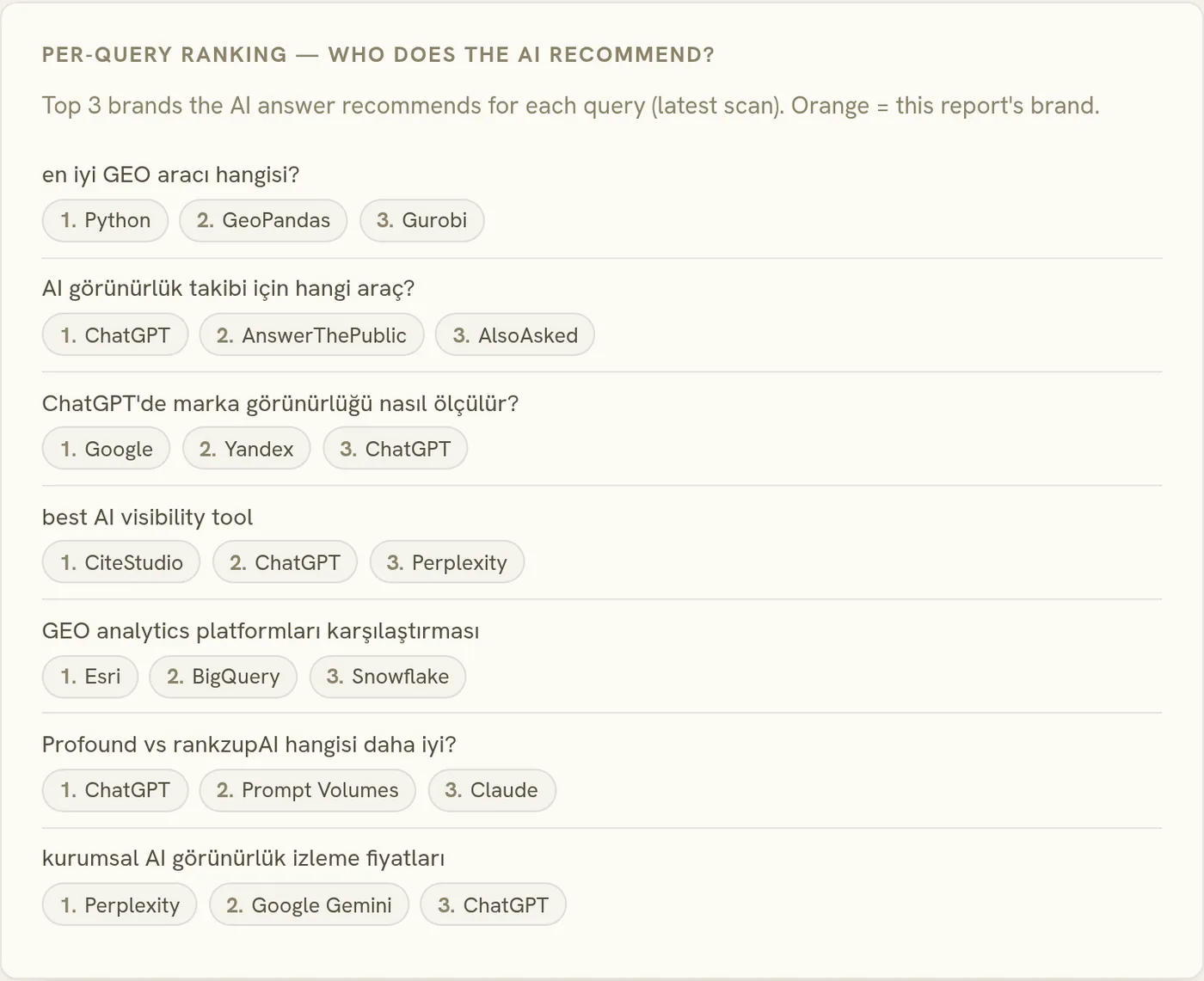
Each tracked question runs across engines on a schedule; each answer is parsed for the brands it names and their order. Your positions across the window average into one number per engine and overall. Two honesty rules make the number trustworthy: unordered mentions (prose, alphabetical lists) are excluded rather than force-ranked, and the average ships alongside mention rate. An excellent average position on the three answers you appear in is not strength.
What moves your position
Recommendation strength in the sources. Models tend to order names the way their sources do: the brand that listicles put first, that comparisons declare the winner, that reviews describe with the strongest language tends to be generated first. Getting into the listicles AI engines cite, and getting placed well in them, moves position more than anything on your own site.
Reading position with the right expectations
Track it per question and per engine, not just as one average. A worsening average usually decomposes into one or two questions where a rival started leading, which is a findable, fixable source problem, not a mysterious algorithm shift. And treat small movements inside the noise as noise: position shares the same stochasticity as every other AI answer signal, which is why it belongs inside a scoring method with a confidence band rather than on its own.
How engines decide the order of names
The order is generated, but it is not random. Three forces shape it. Source order: models loosely inherit the ordering of the pages they read: the brand that listicles and comparisons put first tends to be written first. Recommendation strength: a source saying "the best option for most teams" produces earlier, firmer placement than one saying "also worth a look"; extraction systems literally label this difference (primary versus listed versus hedged). Answer format: a "top 5" list forces explicit ranks, while a prose answer may name one brand in the opening sentence and bury the rest, placement in the first sentence being the strongest slot an answer has.
None of these can be set directly. All of them are downstream of how sources talk about you, which is the honest reason position work is listicles AI engines cite.
Why first is worth more than it looks
In voice interfaces, where answers are read aloud, the list a screen shows as five names often gets spoken as two: position decides who survives that cut. It is also why an average position drifting from 1.8 to 2.6 matters more than the decimal suggests: it usually means a rival took the anchor slot on questions you used to open. The per-question view in prompt tracking shows exactly which questions flipped, and those are the ones worth tracing back to their sources.