AI Visibility: What It Is and How to Measure It
What AI visibility actually means
AI visibility is whether your brand shows up when someone asks an AI assistant a question you'd want to be the answer to. That's it. Someone types "best accounting software for freelancers" into ChatGPT, or Google serves an AI Overview for "how to fix a leaking radiator valve": does your name appear, and in what role?
I say "in what role" because there are really three different things hiding under one term, and mixing them up is the fastest way to fool yourself:
- Mentions: your brand appears somewhere in the answer text.
- Recommendations: the answer actively suggests you as an option or the option.
- Citations: the engine links to your site as a source, whether or not your brand is discussed.
These behave differently. A mid-size SaaS can have decent citation numbers (their docs get quoted for how-to questions) while being invisible in recommendation queries, which are the ones that actually drive pipeline. If you track one number called "AI visibility" without splitting it, you'll optimize the wrong thing.
Why rank-tracking instincts fail for AI visibility
I spent over a decade in SEO, so believe me, I wanted rank-tracking logic to transfer. It doesn't, for a few structural reasons.
There's no SERP. A Google results page is a stable, inspectable artifact: ten links, positions 1 through 10, and if you're position 3 today you're probably position 3 tomorrow. An AI answer is generated fresh every time. There's no "position" to hold, because there's no page.
Worse, answers vary per run. Ask ChatGPT the same question five times in five clean sessions and you can get five different brand lists. Some overlap, sure (a dominant brand shows up in most runs), but the tail churns constantly. A single query is not a measurement. It's an anecdote. This is the single biggest mistake I see: someone asks Perplexity one question, screenshots the answer, and declares victory or panic in Slack.
Then there's context. The same question phrased slightly differently, or asked mid-conversation versus cold, pulls different answers. Model versions update silently. Retrieval sources change. What you're measuring is a probability distribution, not a ranking, and everything about your methodology has to accept that.
How to measure AI visibility honestly
Sample, don't spot-check
The fix for variance is boring: run the same prompts many times and count frequencies. If your brand appears in 14 of 50 runs for a given prompt, your visibility on that prompt is 28%, with the honest caveat that it'll wobble a few points between measurement windows. That wobble is normal. What matters is whether 28% becomes 45% over a quarter, not whether it's 26% or 31% this week.
How many runs is enough? There's no clean statistical answer because the underlying distribution shifts under you. In practice I've found 5 to 10 runs per prompt per engine, repeated weekly, is where trends become distinguishable from noise. It's the sampling floor our own scoring methodology works from too. Fewer than that and every report is a coin flip. This part is still partly guesswork across the industry, and anyone selling you a tool with a precise-looking single-run score should be treated with suspicion.
Share of voice beats absolute presence
An absolute number ("we appear 28% of the time") means little on its own. Maybe the engine only names brands in 30% of answers for that prompt, in which case 28% is near-total dominance. The metric that survives context changes is share of voice: of all brand mentions across your prompt set, what fraction are you versus each competitor? If the model gets stingier about naming brands after an update, everyone's absolute numbers drop but share of voice stays comparable. It's the closest thing to a stable currency this channel has.
Track citations separately
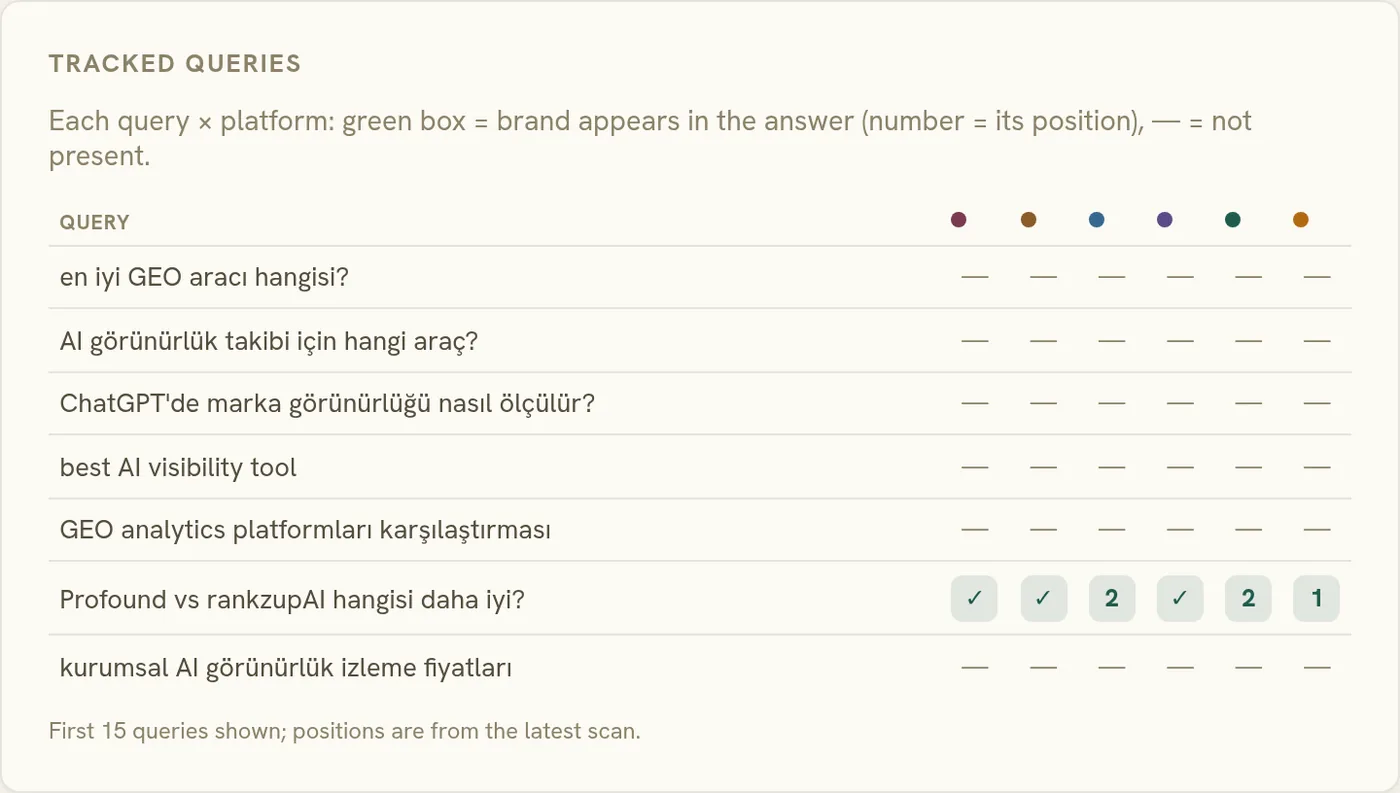
Citations (the actual source links in Perplexity, AI Overviews, and ChatGPT search answers) deserve their own tracking, because they're your only real lever. You mostly can't edit what a model "believes" about your brand this quarter, but you absolutely can influence which pages get retrieved and cited. Watch which of your URLs get cited, for which prompts, and which third-party pages get cited when discussing you. That last one is underrated: if a comparison post on some affiliate site is the model's favorite source about your category, that page matters more to you than your own homepage.
What actually moves an AI visibility score
Measuring is half the job; the other half is knowing which levers change the number. Three do most of the work.
The biggest is third-party presence. AI answers to "best" and "vs" questions pull heavily from Reddit, review platforms, and comparison roundups, not from your own site. If your brand is absent from the pages an engine cites, your visibility score has a low ceiling no matter how polished your product pages are. Getting into legitimate roundups and keeping review profiles alive is the unglamorous core of moving the number.
The second is entity clarity: a consistent, one-line description of what you are, everywhere your brand appears, so the model can confidently connect your name to your category. Ambiguous or generic names quietly lose recommendations here.
The third is retrievability: not blocking AI crawlers, keeping your key answers in raw HTML rather than behind JavaScript, and publishing pages that directly answer the questions buyers ask. We go deeper on all three in what generative engine optimization actually is; the short version is that measurement tells you where you stand, and these three levers are what you pull to change it.
Common mistakes when measuring AI visibility
Even teams that measure regularly tend to trip over the same few things.
The first is trusting a single check. One prompt on one afternoon tells you almost nothing: answers vary run to run, so a lone screenshot is noise, not signal. Track a set of prompts over weeks and read the trend, not the snapshot.
The second is comparing share of voice across engines as if the numbers meant the same thing. Some engines are simply more verbose and name more brands per answer, which mechanically lowers everyone's share. Read share of voice within an engine over time, not across engines side by side.
The third is chasing a single engine. Winning ChatGPT while ignoring Google's AI Overviews leaves half the opportunity on the table, and the two are sourced differently enough that one number won't predict the other.
The fourth is treating the absolute score as precise. The honest way to present it is with a confidence band, a range that widens when there's less data, which is why we show one instead of a single decimal pretending to a certainty the medium doesn't have. Our scoring methodology lays out exactly how that band is built.
What a good AI visibility baseline looks like
Here's a concrete shape, using a made-up example. Say you run marketing for a payroll tool aimed at small agencies. A reasonable baseline setup:
- 30 to 50 prompts, mixing recommendation queries ("best payroll software for a 10-person agency"), comparison queries ("Gusto vs [you]"), and problem queries ("how to handle contractor payments in two currencies").
- 4 engines: ChatGPT, AI Overviews, Gemini, Perplexity. They behave differently enough that averaging them hides everything interesting.
- 5+ runs per prompt per engine, weekly.
- Metrics split into mention rate, recommendation rate, share of voice against 3 to 5 named competitors, and cited URLs.
Run that for four weeks before drawing a single conclusion. In this hypothetical, our payroll brand might discover it holds 11% share of voice while the category leader holds 40%, but that its help-docs get cited constantly for contractor-payment questions. That's a real finding you can act on: the recommendation gap is a brand-authority problem, the citation strength is an asset to build on.
Where this leaves you
I'll be straight about the limits. Nobody outside the model labs knows exactly how these answers get assembled, and anyone claiming a deterministic playbook is selling something. But "we can't know everything" doesn't mean "we can't know anything." Sampled frequencies, competitive share of voice, and citation tracking give you numbers that move for reasons, and that's enough to steer content and PR decisions with.
Start with the baseline before you change anything, because you can't attribute improvement to work you did if you never measured the starting point. If you want a quick read on where you stand today, run a free GEO audit and use it as week zero.
To track a full prompt set week over week, compare plans for prompt-set tracking.