AI Visibility for Finance Brands: YMYL Rules Still Apply
Ask an AI assistant a finance question ("is this broker legitimate," "best high-yield savings account," "how does this lender compare") and watch what it cites. Regulator websites. Established financial media. Consumer protection agencies. Comparison sites with long track records. What you'll rarely see cited as an authority: the blog of the brand being asked about.
That's not an accident. If you run marketing for a bank or broker or lender or insurer or fintech, it is the single most important thing to understand about AI visibility in finance. The caution that search engines spent a decade applying to "Your Money or Your Life" content didn't disappear when the interface became a chat window. It carried over (arguably concentrated), and it changes both what works and what's worth worrying about. This piece covers how models treat finance brands differently, which trust signals actually move the needle, how to operate inside compliance constraints, and why hallucinated rates and terms make monitoring a genuine business need rather than a vanity exercise.
Why AI Visibility Works Differently for Finance Brands
YMYL (Your Money or Your Life) is Google's label for topics where bad information causes real harm, and financial topics sit at its center. For classic search this meant finance content was held to stricter standards of expertise and trustworthiness. The same conservatism shows up in AI answers, through two mechanisms.
First, training and grounding sources skew institutional. Models learned about finance disproportionately from regulators, government agencies, major financial publications, and academic material, because that's where authoritative finance text lives. When engines retrieve live sources to ground an answer, their retrieval and citation behavior shows the same skew: for anything touching money and risk, they reach for the most defensible source available, and a brand's own marketing content is nobody's idea of a defensible source on the brand's trustworthiness.
Second, models hedge harder on finance. Answers come wrapped in "consult a financial advisor," recommendations lean toward large incumbents and consensus picks, and models are visibly more reluctant to endorse a lesser-known finance brand than a lesser-known project management tool. The blast radius of a bad recommendation is different (a wrong SaaS pick wastes a subscription; a wrong broker pick can lose someone's savings), and model behavior reflects that asymmetry.
The practical consequence: a finance brand's AI visibility depends less on its own content than in almost any other industry, and more on what independent, institutional, third-party sources say. Your domain authority strategy and your GEO strategy converge on the same uncomfortable truth: you mostly can't tell your own story here. Others have to tell it for you.
YMYL Trust Signals That Move Finance AI Visibility
If models trust institutions, the play is to make your brand legible through institutions, and through the verifiable facts models can check rather than the adjectives they'll ignore.
Licensing and registration, stated plainly and everywhere. Your regulatory status (who licenses you, under what registration, in which jurisdictions) should be unambiguous on your site, consistent across every third-party profile, and correct in the registers themselves. Models cross-reference; a brand whose regulatory footprint is easy to verify is a safer thing to recommend than one whose status requires detective work. This is the finance equivalent of schema markup for trust: boring, factual, machine-checkable.
Presence in the sources models actually cite. Coverage in established financial media, listings on the major comparison and review platforms for your vertical, a clean and well-cited Wikipedia article if you're notable enough to sustain one, consistent entity data across the databases models draw from. Digital PR matters more in finance than almost anywhere, precisely because the citation bar is higher: one mention in a publication models treat as authoritative outweighs a great deal of content on your own domain.
Transparent pricing and terms. Fee schedules, rates, and conditions published clearly and kept current do double duty. They're a trust signal in themselves: models and the sources models cite both treat opacity as a red flag in finance. And they're your only defense on accuracy: a model attempting to describe your pricing will assemble its answer from whatever it can find, and if your own site is vague or stale, the assembly happens from third-party fragments of unknown age. Publish the truth clearly or the model improvises it.
Genuinely expert content, in its correct role. This doesn't mean content is useless: it means its job changes. Educational material with named, credentialed authors, honest discussion of risks and downsides, and scrupulous currency (an outdated rate on your own blog is worse than no blog) builds the expertise picture that supports everything else. But it's the supporting cast. Expect your content to shape how models describe you more than whether they recommend you; the recommendation is earned off-site.
Working Within Finance Compliance Constraints
Every finance marketer reading this has already spotted the tension: the fast-moving, opinionated, comparison-heavy content that wins AI citations in other industries is exactly what compliance review slows down or strips. You can't promise returns, comparisons must be balanced and disclaimed, and every public statement may need sign-off. That's the job; pretending otherwise isn't a strategy.
But the constraints are navigable, for three reasons. First, the highest-value GEO work in finance (accurate register entries, consistent third-party profiles, transparent published terms, earned media coverage) is factual rather than promotional, and factual accuracy is the one thing compliance teams enthusiastically approve. Second, disclaimered, carefully hedged content is not penalized in this game; models produce hedged answers about finance anyway, and sober, precise content matches the register they trust. The florid promotional voice compliance would block was never going to earn citations in YMYL territory anyway. Third, your regulated competitors sit inside the same fence. The bar isn't "outrun the internet"; it's "be more legible and better-covered than the other licensed players" (a much fairer race).
One addition worth making to the compliance conversation itself: AI answers belong on the risk register, not just the marketing plan. Which brings us to monitoring.
Hallucinated Rates and Terms Are a Monitoring Problem, Not a Hypothetical
Here's the finance-specific nightmare scenario, and it requires no exotic failure, just normal model behavior meeting high-stakes numbers. Models interpolate. Models get asked for specifics they do not reliably know:
- Your current APY
- Your fee schedule
- Your minimum deposit
- Whether you operate in a given country
Faced with those, they often produce a specific-sounding answer assembled from stale pages or third-party summaries or a similarly named competitor. In most industries a hallucinated detail is an annoyance. In finance, a confidently wrong rate or invented account term is a customer showing up with false expectations at best, and a complaint or regulatory conversation at worst, which is particularly bitter given that you would never be allowed to publish that claim, but a chatbot can put it in front of thousands of prospects without review.
A hypothetical example of the shape this takes: say a made-up digital bank, Fernbank, runs monthly checks on the factual prompts prospects actually ask: its savings rate, its fee structure, its deposit protection status. One month, a check surfaces an engine confidently quoting a promotional rate from a campaign that ended two years ago, sourced from an old comparison-site page that was never updated. Fernbank's realistic playbook: document the wrong answer with dates and screenshots, get the stale third-party page corrected, make sure its own current-rate page is unambiguous and machine-readable, then re-check on the following cycles to confirm the correction propagates into grounded answers. Slow, unglamorous, and it works far more often for grounded engines than for anything baked into training data, which is exactly why detection has to be systematic rather than occasional. Our guide on tracking AI hallucinations covers the full detect-document-correct loop.
The monitoring set for a finance brand should therefore go beyond "do we appear in best-of lists" and include factual verification prompts:
- Current rates and fees
- Product terms
- Regulatory status
- Eligibility
- Availability by market
Each one checked per engine on a schedule, with changes flagged. This is the part of AI visibility that isn't marketing at all. It's accuracy assurance for a channel that talks about your products without your involvement, and it's the piece of a GEO program that compliance and risk teams tend to fund without argument once they've seen one wrong answer.
Where a Finance Brand Should Start
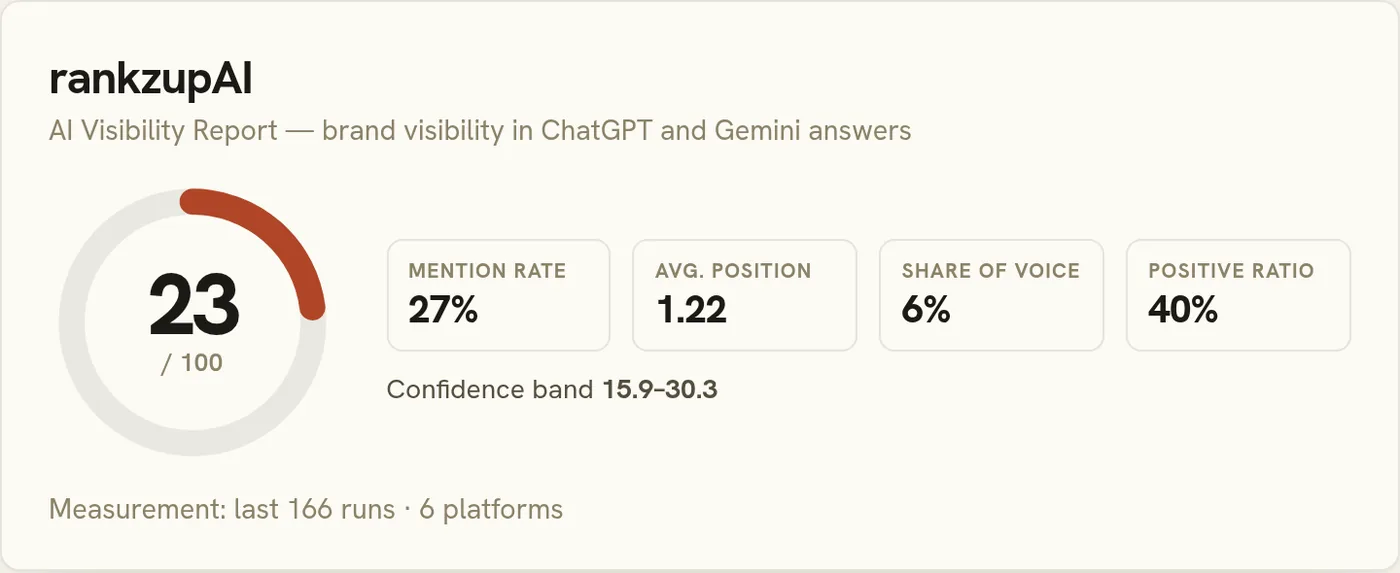
Sequenced honestly, the program looks like this. Measure first: a prompt set mixing recommendation queries ("best X for Y") with factual verification queries about your own products, run across the engines that matter, to establish both your visibility baseline and your accuracy baseline. Fix the verifiable next: regulatory registers, entity data, third-party profiles, and published terms, so that everything a model can check about you checks out. Then earn the citations (financial media coverage, comparison platform presence, review depth), accepting that in YMYL territory this is a quarters-long compounding effort, not a sprint. And keep the accuracy monitoring running throughout, because it's the workstream with the shortest path from finding to fixed to risk-avoided.
Finance is the hardest mode of this game: the highest source bar, the tightest constraints on what you can say, and the highest cost of machine-generated errors about you. It's also, for exactly those reasons, defensible ground: visibility earned through licensing legibility, institutional coverage, and verified accuracy doesn't evaporate with a model update the way a content trick does. For how these dynamics translate to other regulated and high-stakes verticals, our industry playbooks hub collects the sector-by-sector guides.
Accuracy work in finance only pays off if it is measured; how AI visibility is measured covers the sampling that makes a correction visible.