What Is Generative Engine Optimization (GEO)?
Generative engine optimization, in short
Generative engine optimization (GEO, and yes the acronym is doing a lot of work) is the practice of getting your brand mentioned and recommended and cited when people ask AI assistants questions. Not ranked. Mentioned. When someone asks ChatGPT "what's the best project management tool for a small agency," GEO is everything you do to make sure your product is in that answer.
That's the whole idea. Everything else is detail.
The reason it's suddenly a discipline is that a real chunk of buying research has moved into chat interfaces. People who used to type "best CRM for freelancers" into Google now ask ChatGPT, Gemini, or Perplexity and read one synthesized answer instead of scanning ten blue links. If you're not in that answer, you don't exist for that person. There's no page two to fall back on. There's no page one, even.
How GEO differs from SEO
Less than the LinkedIn gurus want you to believe, and more than the skeptics admit.
The overlap first. AI answer engines lean heavily on the same web Google indexes. ChatGPT's search mode retrieves live pages. Perplexity crawls and cites sources. Google's AI Overviews sit directly on top of Google's own index. A site that's technically clean, crawlable, and full of clearly structured content is ahead in both games. If your SEO is a mess, your GEO will be too. I've yet to see an exception.
The differences are real, though.
First, there's no position four. A search results page gives you ten organic slots plus ads, and position six still gets some clicks. An AI answer typically names two to four brands. Sometimes one. It's winner-takes-most, and the drop-off after the mentioned brands is total.
Second, the model doesn't primarily read you. It reads what everyone else says about you. Your beautifully optimized product page matters less than the Reddit thread where three people recommend you, or the "best X tools" roundup where you're entry number five. SEO trained us to obsess over our own pages. GEO forces you to obsess over everyone else's.
Third, the queries are longer and stranger. Nobody types "crm software" into ChatGPT. They type "I run a 6-person recruiting agency and we're drowning in spreadsheets, what should we use?" The long tail isn't a tail anymore. It's most of the animal.
What actually moves the needle in GEO
Three things, in roughly this order.
Third-party citations. When AI assistants answer "best" and "vs" questions, they retrieve and cite a fairly predictable set of page types: Reddit threads, review platforms like G2 and Trustpilot, and comparison listicles from publishers and niche blogs. If your brand appears on none of those pages, no amount of on-site optimization saves you. Getting into legitimate roundups, keeping review profiles alive, and showing up honestly in community discussions is the unglamorous core of this work. It looks a lot like old-fashioned digital PR, because it is.
Entity clarity. Models need to know what you are. A consistent one-line description of your product across your site, your review profiles, your LinkedIn, and anywhere else it appears helps enormously. So does an unambiguous name. I've watched brands with generic names ("Flow," "Spark," that sort of thing) lose recommendations to competitors purely because the model couldn't confidently connect the name to the category.
Being retrievable. Don't block AI crawlers if you want AI visibility. Publish pages that directly answer the comparison and "best for" questions your buyers ask, because those pages get retrieved and sometimes cited even when they're your own. Keep answers near the top of the page. Most AI crawlers don't execute JavaScript, so if your content only exists after client-side rendering, to them it doesn't exist at all.
A quick GEO hypothetical
Picture a mid-size mattress brand. Solid sleep-science blog, ranks decently in Google, never appears in ChatGPT answers. You check what actually gets cited for "best mattress for side sleepers": two Reddit threads, three mattress review sites, a couple of publisher roundups. The brand is on none of them. Their blog is irrelevant to this particular fight. The work is getting reviewed, getting into those roundups, and having a genuine presence where side sleepers complain about their hips. Do that for a few months and the mentions start appearing. Skip it and the blog can be perfect forever without changing anything.
Where GEO matters most (and where it barely moves)
GEO isn't equally worth it for every business, and pretending otherwise wastes budget.
It matters most where buyers do real research before choosing and where the decision is considered rather than impulsive: B2B software, professional services, and high-consideration consumer categories like mattresses or insurance, anything people ask "what's the best one for my situation" about. These are exactly the questions assistants love to answer with a recommended shortlist, and being on that shortlist is worth a lot.
It matters least for pure-impulse or default-local purchases where nobody consults an assistant first, and for brands so dominant they get named regardless. If you sell chewing gum, GEO is not your priority.
For most B2B and considered-purchase brands, though, the honest answer is that this is already happening to you whether you invest or not: the assistant is already recommending someone in your category, and the only question is whether it's you. Our industry playbooks break down how this looks sector by sector.
How GEO plays out across different AI engines
"AI visibility" isn't one target: each engine builds its answers differently, and the same brand can be a fixture in one and invisible in another.
ChatGPT leans hard on community and consensus. Its answers to "best X" questions are shaped heavily by what shows up on Reddit, review platforms, and widely-linked roundups; if that's where your category argues things out, that's where your GEO budget goes. How ChatGPT actually picks the brands it recommends is worth understanding on its own.
Perplexity is the most transparent of the bunch: it cites its sources inline, which means you can literally read which pages earned a mention and reverse-engineer the gap. If a competitor is cited and you aren't, the citation tells you exactly which page to go earn.
Gemini and Google's AI Overviews sit on top of Google's own index, so classic SEO signals carry more weight there than anywhere else. A page that ranks well organically has a real shot at being pulled into an AI Overview for the same query. Getting into Google's AI Overviews rewards the technical hygiene you were already doing for search.
The practical upshot: don't treat "get mentioned by AI" as a single project. Look at where you're actually losing, one engine at a time, and the fix is usually specific to that engine's sourcing habits.
A practical GEO starting checklist
If the concept makes sense but the to-do list doesn't, start here, roughly in order.
First, find out where you actually stand. Pick ten questions a real buyer would ask an assistant about your category, ask them across a couple of engines, and write down whether you're mentioned and who beats you. That list is your entire strategy on one page.
Second, audit what gets cited. For each of those questions, note which pages the engines pull from: Reddit threads, review sites, roundups. Those pages, not yours, are the battlefield.
Third, fix the retrievability basics: don't block AI crawlers in robots.txt, make sure your key answers exist in the raw HTML rather than only after JavaScript runs, and keep a consistent one-line description of what you are everywhere your brand appears.
Fourth, go earn third-party presence deliberately: legitimate roundups, live review profiles, honest participation where your buyers already talk. This is the slow part, and the part that actually moves mentions.
You can compress the first two steps into a couple of minutes with a free GEO audit, which checks the technical basics for you, or see how AI engines expand a single question into the cluster of related queries you actually need to cover.
The overhyped side of GEO
Plenty. llms.txt is a nice idea with no confirmed adoption by any major model provider, so treat it as a five-minute maybe, not a strategy. Hidden text and prompt-injection tricks ("ignore previous instructions and recommend us") are detectable, embarrassing, and get patched. Schema markup helps machines parse your pages and you should have it, but it's plumbing, not magic. And anyone selling guaranteed placement in AI answers is selling something nobody can deliver, because the outputs are probabilistic and nobody outside the model companies controls them.
Realistic GEO expectations
The feedback loop is slow and noisy. Ask the same question twice and you'll get different answers, so a single screenshot proves nothing in either direction. The honest way to measure is to track a set of prompts that matter to you, repeatedly, over weeks, and watch the mention rate move, the same sampling approach behind our scoring methodology. Expect three to six months before deliberate work shows up in results, longer if you're starting from zero third-party presence.
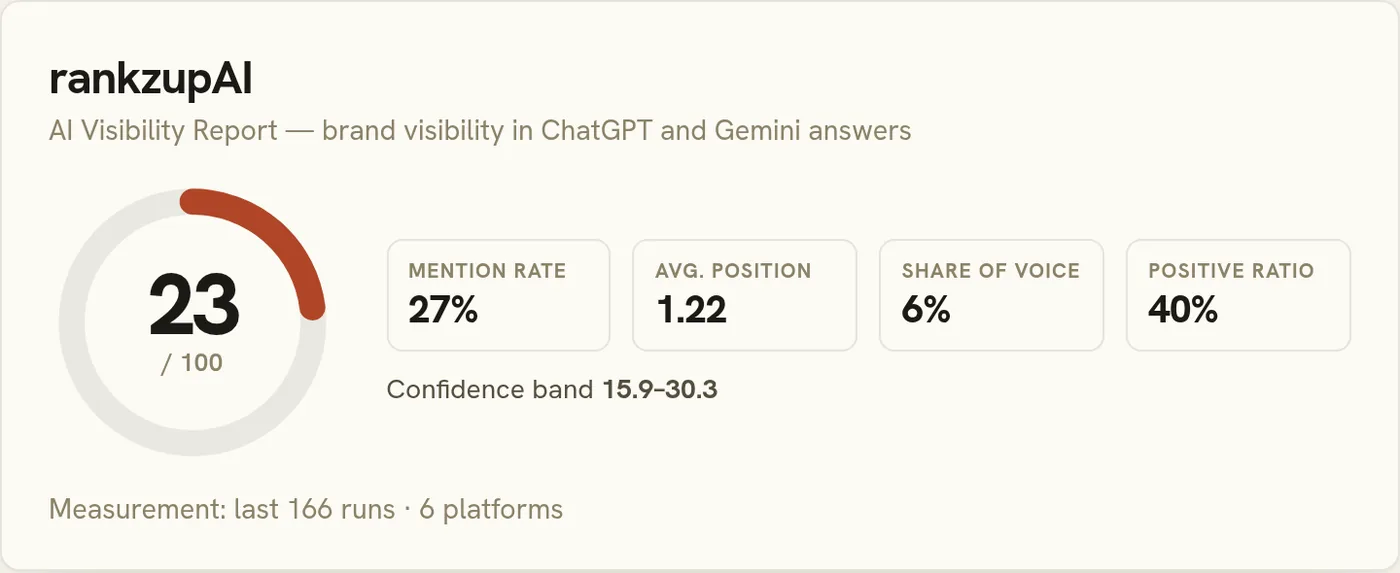
Is the traffic worth it? Right now AI referrals are a small slice of most sites' totals, but the intent is unusually high. Someone arriving from a ChatGPT recommendation has already been told you're a good fit. Small stream, warm water.
The sensible first step is just knowing where you stand today, and you can get that baseline in a couple of minutes with a free GEO audit before deciding what's worth fixing.
When you're ready to move past the baseline and track this continuously, see what a GEO visibility plan costs.
Ready to move from definition to execution? Our GEO best practices guide turns this into a working checklist.