How to Appear in Google AI Overviews (Realistic Guide)
I've watched a lot of teams panic about AI Overviews. Most of the advice they're getting is either recycled SEO basics with an "AI" sticker on it, or magic-schema snake oil. The truth sits somewhere less exciting: AI Overviews mostly reward pages that were already doing well, with a few twists worth understanding.
Let's go through what actually matters.
What triggers an AI Overview in the first place
Google doesn't show an AI Overview on every query. Not even close. They appear most often on informational queries: questions, comparisons, "how does X work," "is X safe," that kind of thing. Navigational queries almost never trigger one. Neither do most transactional queries, though Google keeps experimenting at the edges, and coverage shifts month to month.
There's also a confidence factor. If Google's systems aren't sure they can generate a reliable answer, the Overview simply doesn't render. You'll sometimes see the same query trigger an AIO one week and not the next. That's normal. It's also why "we lost our AI Overview" isn't always something you did wrong.
The practical takeaway: before optimizing for AI Overviews, check whether your target queries even produce them. If your money keywords are transactional and AIO-free, your energy belongs elsewhere.
Which content gets pulled into AI Overviews
Here's the part I find most people get backwards. AI Overviews aren't built from some separate index of "AI-friendly" content. They're grounded in Google Search results, and the citations skew heavily toward pages that already rank on page one for the query or a close variant of it. Multiple independent studies have found strong overlap between AIO citations and the organic top 10. Not perfect overlap. But strong.
What Google seems to extract is passages, not pages. A 2,500-word guide can get cited for one 40-word chunk that directly answers the question. That changes how you should write:
- Answer the actual question early, in plain declarative sentences.
- Keep one idea per paragraph. Extraction systems handle self-contained passages far better than winding ones.
- Use headings that mirror real sub-questions, because AIOs frequently synthesize across several sub-answers.
I'm genuinely unsure how much the exact phrasing matters versus semantic similarity. Google's retrieval is embedding-based, so keyword-stuffing a question verbatim probably buys you less than people think. But structuring your page so a machine can lift a clean answer? That clearly helps.
The real role of schema in AI Overviews optimization
Schema markup will not put you in an AI Overview. I want to say that plainly because a cottage industry has formed around the opposite claim.
What schema does is reduce ambiguity. FAQ, Article, Product, and Organization markup help Google's systems confirm what an entity is, who published it, and how content pieces relate. That's disambiguation, not ranking juice. Google's own representatives have said repeatedly that there's no special markup for AI features.
So use schema the boring way: accurate Organization and Author markup, Article markup with real dates, Product markup where relevant. Skip the exotic stuff. If your schema strategy takes more than an afternoon, you're probably overbuilding.
Why classic rankings still carry most of the weight
This deserves its own section because it's the uncomfortable part. If you don't rank in the top 10 for a query or its close neighbors, your odds of being cited in that query's AI Overview are slim. The grounding pipeline starts with search results. It doesn't go spelunking through page five looking for hidden gems.
That means AI Overviews optimization is roughly 70% "keep doing real SEO" (links, topical depth, crawlability, intent match) and 30% passage-level answer engineering on top. Teams that skip the first part and obsess over the second are decorating a house with no foundation.
A hypothetical to make it concrete. Imagine a project management tool (call it Flowdesk) that ranks #14 for "how to run a sprint retrospective." No AIO citation, obviously. Two paths forward: rewrite the intro into a crisp 50-word answer and pray, or fix the actual problem: thin internal linking, no author credibility signals, a page that tries to rank for six intents at once. The second path moves them to #6, and only then does the passage-level work start paying off. The order of operations matters.
A practical AI Overviews checklist
Here's what I'd actually do, in order:
- Map which target queries trigger AIOs today. Track it over time, because trigger rates drift.
- Confirm you rank top 10 for those queries. If not, that's the work. Full stop.
- Put a direct answer in the first 100 words of the relevant section. Declarative, self-contained, no throat-clearing.
- Break content into extractable passages: one sub-question per H2 or H3, answered immediately below it.
- Ship clean baseline schema: Organization, Author, Article with honest dates.
- Keep pages fresh where it's honest to do so. Updated content gets re-crawled and re-evaluated; fake date-bumping eventually backfires.
- Build entity consistency: same brand name, same descriptions, across your site, LinkedIn, Crunchbase, wherever you exist. AIOs synthesize across sources, and contradictions make you a riskier citation.
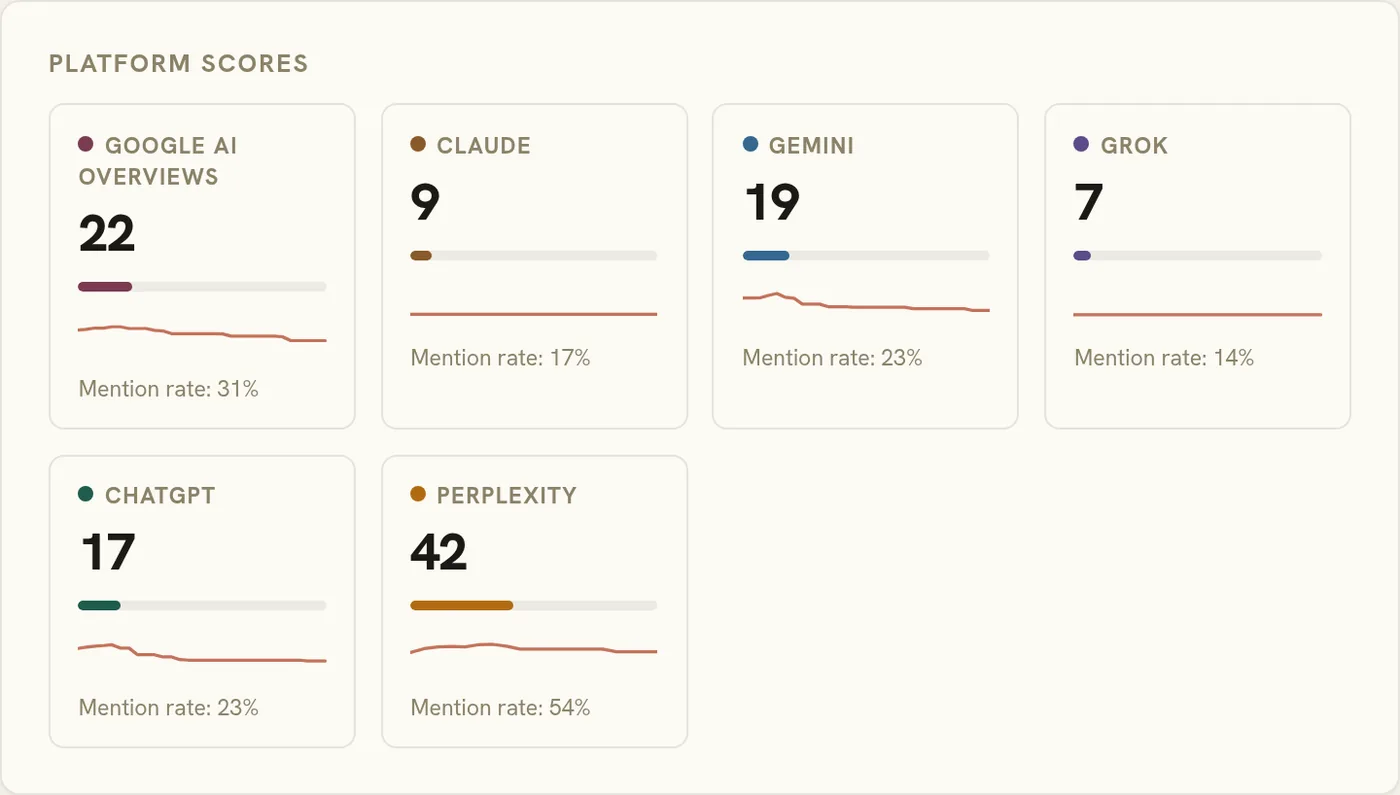
- Measure citations, not just rankings. Position 4 with an AIO citation can beat position 2 without one.
What I'd ignore
A few things not worth your time: llms.txt (no evidence Google reads it), hidden prompt-injection text (embarrassing when discovered, and it will be), and rewriting every page into Q&A format (helps some pages, wrecks others). Also ignore anyone promising guaranteed AIO placement. Nobody controls a probabilistic generation system, including Google half the time.
The honest summary is that AI Overviews are less a new channel than a new layer on the old one. Rank well, answer cleanly, be an unambiguous entity, and your citation rate follows, mostly. There's noise in the system nobody can optimize away, and I'd distrust anyone who claims otherwise. If you want the broader picture of how answer engines see your brand beyond Google, our AI visibility guide covers measurement across every major engine.
Want to know where you stand right now? Run your site through our free GEO audit and see which pages are actually built for extraction.
New to the format? See what Google AI Overviews are.