How Does ChatGPT Recommend Products and Brands?
There are two ChatGPTs, really
The short answer up front: ChatGPT recommends products by blending two sources (patterns about brands baked in during training, and live web pages retrieved through search), and for most recommendation questions today, the retrieved pages decide who makes the final list. Before anything else, you need this distinction, because it changes everything about how recommendations work.
The first ChatGPT answers from memory. The model was trained on a huge snapshot of the web, and when it recommends a brand without searching, it's drawing on patterns baked in during training. If your brand was mentioned often and positively across that training data, you're in its head. If you launched last year, you're mostly not.
The second ChatGPT searches the web. When a question smells like it needs fresh information ("best," "vs," prices, anything recent), ChatGPT fires off searches, reads live pages, and builds an answer with citations. This is the mode that matters most for product recommendations today, and it's the one you can actually influence on a reasonable timescale.
Most recommendation answers now blend both. The model's memory shapes which brands feel like plausible candidates. The retrieved pages decide who makes the final cut and who gets a citation link.
What happens when you ask ChatGPT for a recommendation
Say you ask "what's the best email tool for a small newsletter?" Roughly this happens, based on OpenAI's own documentation and a lot of observed behavior. Nobody outside OpenAI knows every detail, but the pattern is consistent.
Your question gets rewritten into one or several search queries. ChatGPT doesn't search your exact words; it generates queries like "best newsletter email platforms 2026" and sometimes fans out into several variants. Those queries hit a search index. OpenAI crawls the web itself with OAI-SearchBot and has historically used third-party search providers too; the current blend is not public. The top results get fetched and read. Then the model synthesizes an answer from what it found, filtered through its trained sense of what's credible, and attaches citations to some claims.
Here's the part people miss: the model isn't evaluating your product. It's summarizing what the retrieved pages say. If the top pages for "best newsletter platforms" all mention the same six tools, those six tools are the answer. ChatGPT is, in this mode, closer to a very fluent reader of listicles than an independent judge.
Which sources ChatGPT actually cites
Watch the citations across a few hundred commercial prompts and clear patterns show up.
Comparison articles and roundups dominate. "Best X for Y" posts from publishers, niche blogs, and yes, sometimes vendors themselves. Review platforms appear constantly for software queries: G2, Capterra, Trustpilot. Reddit shows up a lot, which is no accident; OpenAI has a licensing deal with Reddit, and community threads are exactly the kind of "real humans comparing things" content these systems favor. Wikipedia anchors factual and company-background claims. News sites cover anything recent.
What rarely gets cited for "best" queries: your homepage. Your own site gets cited when the question is about you ("does X integrate with Y?"), not when the question is about your category.
One more variable sits on top of both modes: personalization. A user with ChatGPT's memory enabled can get a different recommendation than your clean-session test shows: the model carries budget hints, industry, even brand preferences from earlier chats into its answer. You cannot optimize for any single user's memory, but it is one more reason to test in a fresh session and to read one answer as a sample, not a verdict.
Why some brands never show up in ChatGPT
Four reasons cover almost every case I've seen.
They're absent from the retrieved set. The brand isn't in the roundups, has three dusty reviews on G2, and has never been mentioned on Reddit. The model literally never reads their name while composing the answer.
They've blocked the crawlers. Sometimes deliberately, more often by accident through an aggressive CDN bot-blocking setting someone enabled and forgot. If OAI-SearchBot can't fetch your pages and ChatGPT-User gets a 403, you can't be read, so you can't be cited.
Entity confusion. The brand name is a common word, or the site never states plainly what the product is and who it's for. The model can't confidently place them in a category, so it defaults to competitors it understands.
Recency. Brands younger than the training data, with thin web coverage since, exist only in search mode, and only if the retrieval finds them.
A quick example
A hypothetical B2B SaaS with 40 solid blog posts and near-zero third-party mentions asks why ChatGPT recommends four competitors and never them. Check the citations for their money prompts: two G2 category pages, a Reddit thread, three roundups. They appear in exactly none. Their content strategy was built for Google rankings, where your own pages can carry you. In ChatGPT's world, they've written 40 posts for a conversation happening somewhere else.
How to earn ChatGPT recommendations
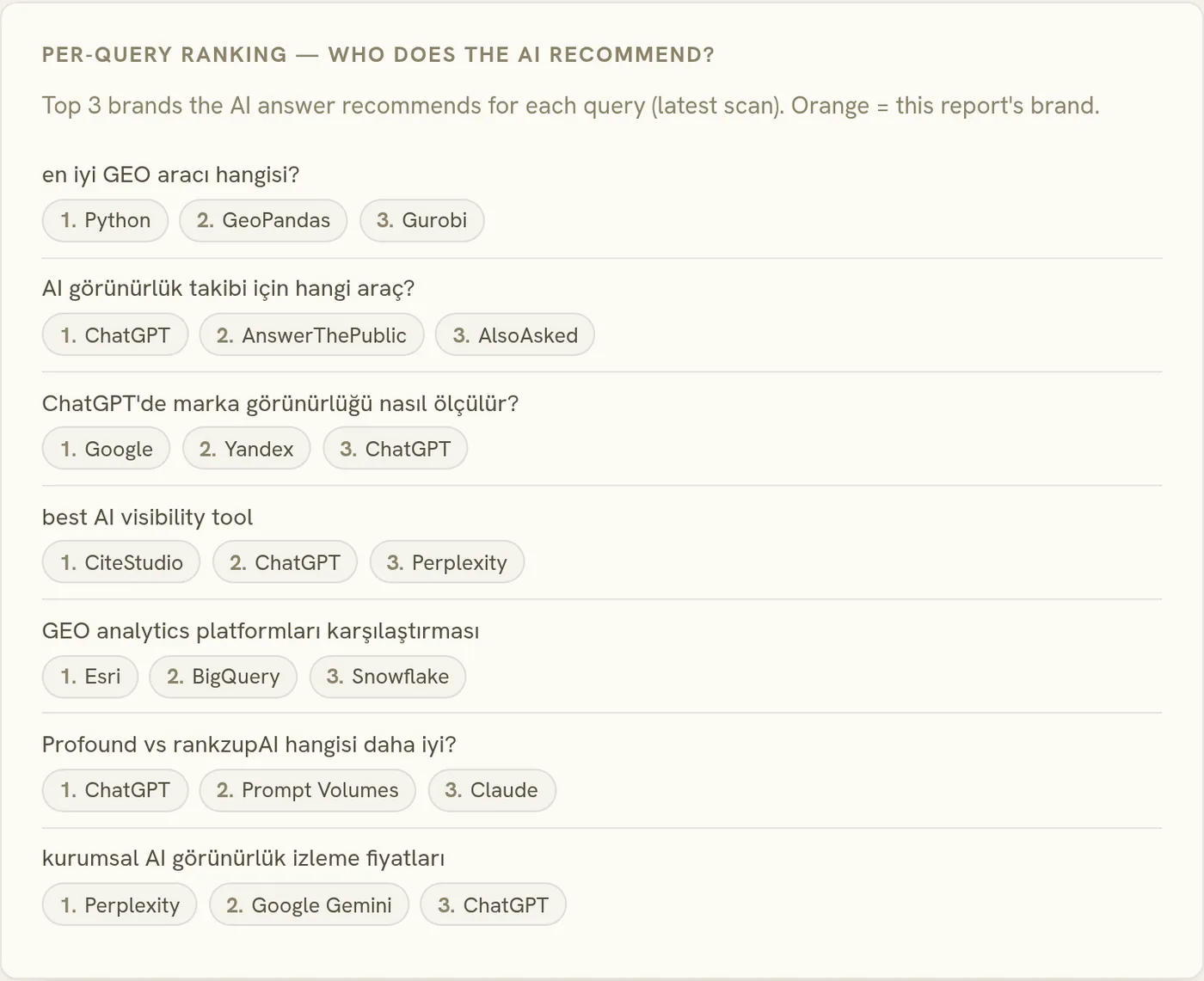
Work backwards from the citations. Run the prompts that matter for your business, note which pages ChatGPT cites, and get onto those specific pages. Pitch the roundup authors. Fix and feed your review profiles. Participate in the relevant subreddits as an actual human being; astroturfing gets sniffed out by moderators long before it fools a model.
Publish your own comparison content too. Honest "us vs them" and "best tools for" pages get retrieved, and I've seen vendor-written comparisons cited in answers when they're genuinely informative rather than a brochure.
Check your infrastructure. Confirm OAI-SearchBot and ChatGPT-User aren't blocked in robots.txt or at the CDN. Make sure your key pages render their content without JavaScript.
And state what you are, everywhere, in the same words. "X is an email platform for indie newsletter writers" repeated consistently across your site and profiles does more for entity clarity than any clever trick.
Then measure. One prompt on one afternoon tells you nothing; answers vary run to run. Track a basket of prompts weekly and watch the trend, the sampling idea our scoring methodology is built on. If you want to see how your site looks from an answer engine's side of the table right now, an AEO report will show you in a few minutes.
To see where you stand today, track your ChatGPT ranking directly, or monitor it with an AI rank tracker across every engine.
The same logic plays out differently on each engine: Gemini visibility guide, Perplexity visibility guide, Claude and Grok, appear in AI Overviews and AI Mode. To act on ChatGPT specifically, see ChatGPT SEO.
Two neighbouring reads help here: what Perplexity is explains the engine that shows its sources most openly, and Gemini versus ChatGPT sets the two largest assistants side by side.