Claude and Grok: Brand Visibility on the Quieter Engines
The quieter engines, and why they still matter
Everyone optimizing for AI visibility starts with ChatGPT, and that's the right call: it's where the users are. But two engines get skipped in almost every strategy doc I see: Claude and Grok. Both answer brand questions. Both send referral traffic. Both are growing in audiences that happen to be unusually valuable: developers and technical buyers on Claude, the terminally-online early-adopter crowd on Grok.
The case for caring isn't volume. It's that these two engines behave differently enough from ChatGPT that showing up in them takes a slightly different shape, and almost nobody is competing for the spot. If how ChatGPT recommends brands is a crowded auction, Claude and Grok are still the quiet rooms where showing up counts double.
How Claude web search works for brand questions
Claude spent its first years answering purely from training data, which made it useless for anything recent. That changed in 2025 when Anthropic added web search, and the current behavior is worth understanding precisely.
Claude decides per-question whether to search. Ask it something timeless and it answers from memory. Ask "best CRM for a 10-person agency" and it recognizes the question needs fresh information, runs searches, reads pages, and builds an answer with citations attached to specific claims. Reporting at launch pointed to Brave Search as the underlying index; Anthropic hasn't detailed the current blend, so treat that as directional rather than gospel.
Anthropic runs three relevant agents, and the distinction matters for your robots.txt. ClaudeBot collects training data. Claude-SearchBot builds the search side. Claude-User fetches a page live when a person asks Claude about it. You can block the first and allow the other two. The full breakdown is in our robots.txt for AI crawlers guide. If your CDN's one-click bot blocker catches all three, you've opted out of Claude visibility without meaning to.
What gets cited follows a familiar pattern: comparison pages, documentation, review platforms, recent articles from sources the model treats as credible. Clean, factual, well-structured pages do disproportionately well: Claude's retrieval seems to reward pages that state things plainly over pages that perform enthusiasm.
Claude's cautious tone changes what winning looks like
Here's the part that surprises people who come from ChatGPT-watching. Ask both engines the same brand question and Claude's answer is noticeably more hedged. Fewer superlatives, more "it depends on your use case," a stronger habit of listing several options with trade-offs instead of crowning one winner, and citations pinned to specific claims rather than sprinkled decoratively.
For brands, this cuts two ways. You're less likely to be declared "the best" by Claude, because Claude rarely declares anyone the best. But you're more likely to be included, because cautious answers are list-shaped answers, and lists have more seats. The optimization consequence: pages that honestly document what you're good at and where you fit ("built for teams under 20," "not ideal if you need on-prem") map beautifully onto how Claude structures answers. Chest-beating superlatives map onto nothing.
Claude's audience skews professional and technical. Anthropic's revenue base is heavily API and enterprise, and the consumer app over-indexes on developers, researchers, and people who write for a living. If those people buy what you sell, Claude punches far above its raw user numbers.
How Grok recommendations work
Grok is the odd one out among AI engines, for one structural reason: it's built by xAI and wired directly into X. That gives it two traits no competitor shares.
First, genuinely real-time sourcing. Grok pulls from live X posts alongside web search, so its picture of your brand includes what people said about you this morning: launch chatter, complaint threads, that one viral post from a customer. Other engines see the web on a crawl delay; Grok sees the timeline.
Second, X-heavy citation habits. Ask Grok about brands and its sources lean conspicuously on X posts (praise, complaints, and side-by-side comparisons from actual accounts) blended with conventional web results. Your share of voice on X is, to a first approximation, an input to your share of voice in Grok. No other engine has that property.
The tone is different too. Grok was deliberately built to be less filtered, and its brand answers are more willing to pick a lane, crack a joke, or repeat a spicy community take. That's fun when the community likes you and considerably less fun when your last outage is still getting quote-posted.
Practical consequences: an active, credible X presence is a direct Grok input in a way it isn't for any other engine. Real customer conversations on X (not your brand account posting into the void, but actual people discussing you) are the signal. And reputation problems on X surface in Grok answers faster than anywhere else, which makes it an honest early-warning system if nothing else.
Who should care about each engine
For Claude: B2B SaaS, developer tools, API-first products, professional services, anything bought by people who read documentation before purchasing. If your buyer has ever filed a pull request or written a procurement memo, Claude belongs on your tracking list.
For Grok:
- Consumer tech
- Crypto and fintech
- Gaming and media
- Creator tools
- Any category where the discourse happens on X If your customers argue about your product category in public threads, Grok is reading those arguments.
Fine to deprioritize both: local businesses, categories with older or offline buyers, and anyone who hasn't yet sorted their ChatGPT and Google visibility. Sequence matters, and these two come after the big engines, not before.
A hypothetical to make it concrete: imagine a small observability startup that gets steady, unprompted praise in developer threads on X and keeps genuinely useful public docs. Ask Grok for monitoring recommendations and those threads surface it; ask Claude and its docs earn a cited mention alongside vendors ten times its size. Meanwhile in ChatGPT it's invisible, because the listicles that dominate ChatGPT's retrieval haven't noticed it yet. Same company, three engines, three different outcomes, which is exactly why you track them separately.
An honest note on volume
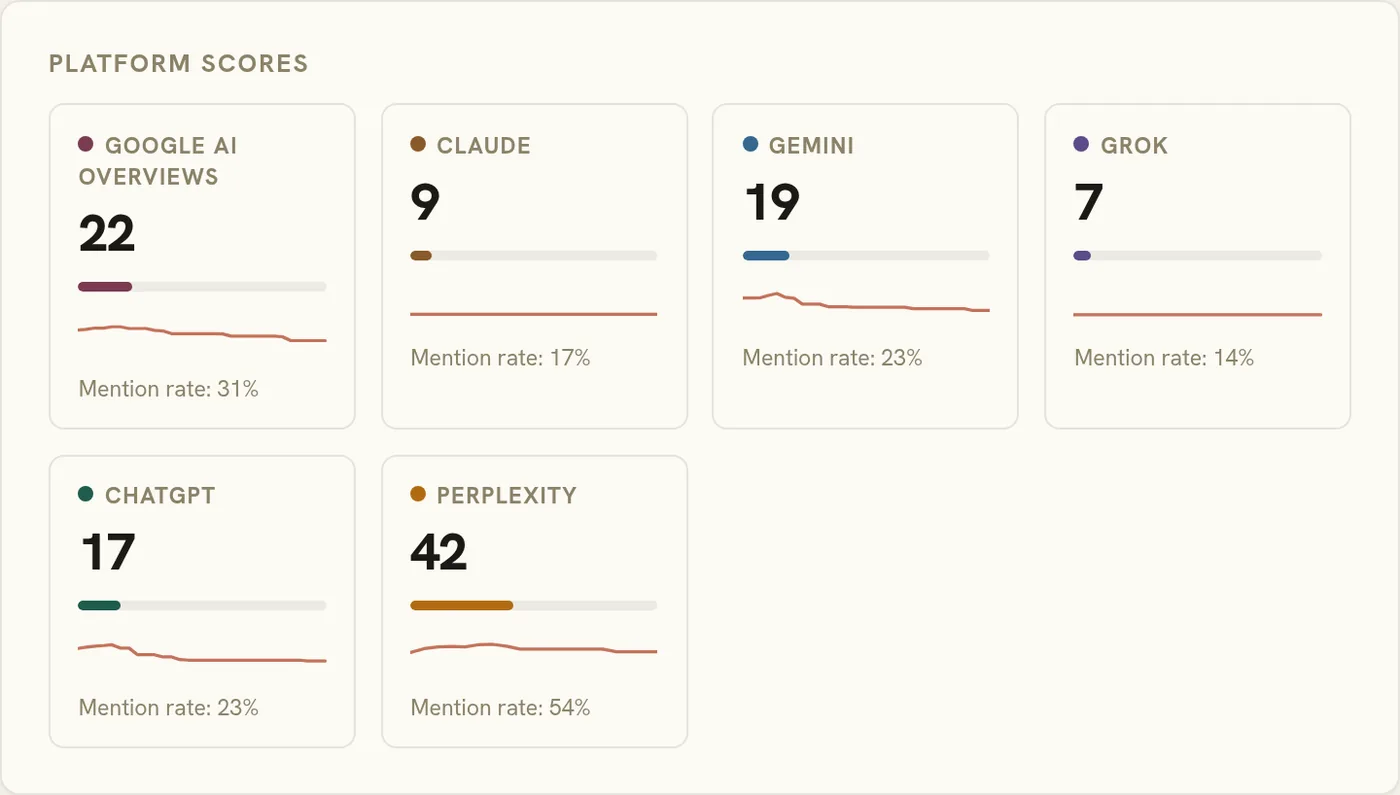
Let's not oversell this. ChatGPT's user base is measured in the high hundreds of millions weekly; Claude's consumer app and Grok are each a fraction of that, and the referral traffic they send most sites reflects it. If you're allocating effort strictly by today's volume, ChatGPT and Google's AI surfaces deserve most of it, and we'd be the first to say so.
The argument for the quieter engines is cheaper and narrower: the work is mostly shared. The robots.txt hygiene, the clean extractable pages, the honest comparison content, the third-party reputation: all of it feeds Claude and Grok too. The only genuinely incremental work is watching your X presence (for Grok) and checking that Anthropic's crawlers aren't blocked (for Claude). That's a small premium for coverage on two engines whose audiences skew heavily toward people who influence what everyone else buys.
Small volumes, cheap coverage, valuable audiences. That's the whole pitch, and for most B2B brands, it's enough.
Whether these two deserve a slot in your tracking set is a measurement question rather than a hunch. The per-engine split in measuring AI visibility answers it.