What Is Perplexity AI? How It Works and Why Brands Watch It
What is Perplexity AI?
Perplexity is an AI answer engine: you ask a question, it searches the web, reads the results and writes a direct answer with numbered citations attached to its claims. Where ChatGPT is a general assistant that sometimes searches, Perplexity is search as the entire product: every answer retrieves first and shows its sources by design. Founded in 2022, it has become the reference example of what AI search looks like when built from scratch.
How Perplexity works
The pipeline is RAG end to end. Your question is interpreted and often expanded into several searches; a web index returns candidate pages; the strongest passages are read into a language model; the model writes the answer with citations pointing back at the passages that support each claim. Follow-up questions keep the thread and re-retrieve as needed.
Two design choices define the product. Citations are not optional decoration: they are the interface, which trains users to check sources and trains the system to prefer pages it can safely quote. And the model layer is pluggable: Perplexity is not itself an LLM but a pipeline that uses various models for the writing step.
Is Perplexity free, and who owns it?
The free tier answers most questions with the full search-and-cite pipeline; a paid Pro plan adds stronger models and heavier research workloads. The company is private and venture-backed (co-founded by CEO Aravind Srinivas), and despite recurring acquisition rumors it is not owned by Google, OpenAI or Microsoft. For brand work the ownership question matters less than the behavioral one: its users skew toward research-heavy, comparison-shopping sessions.
Why brands watch Perplexity closely
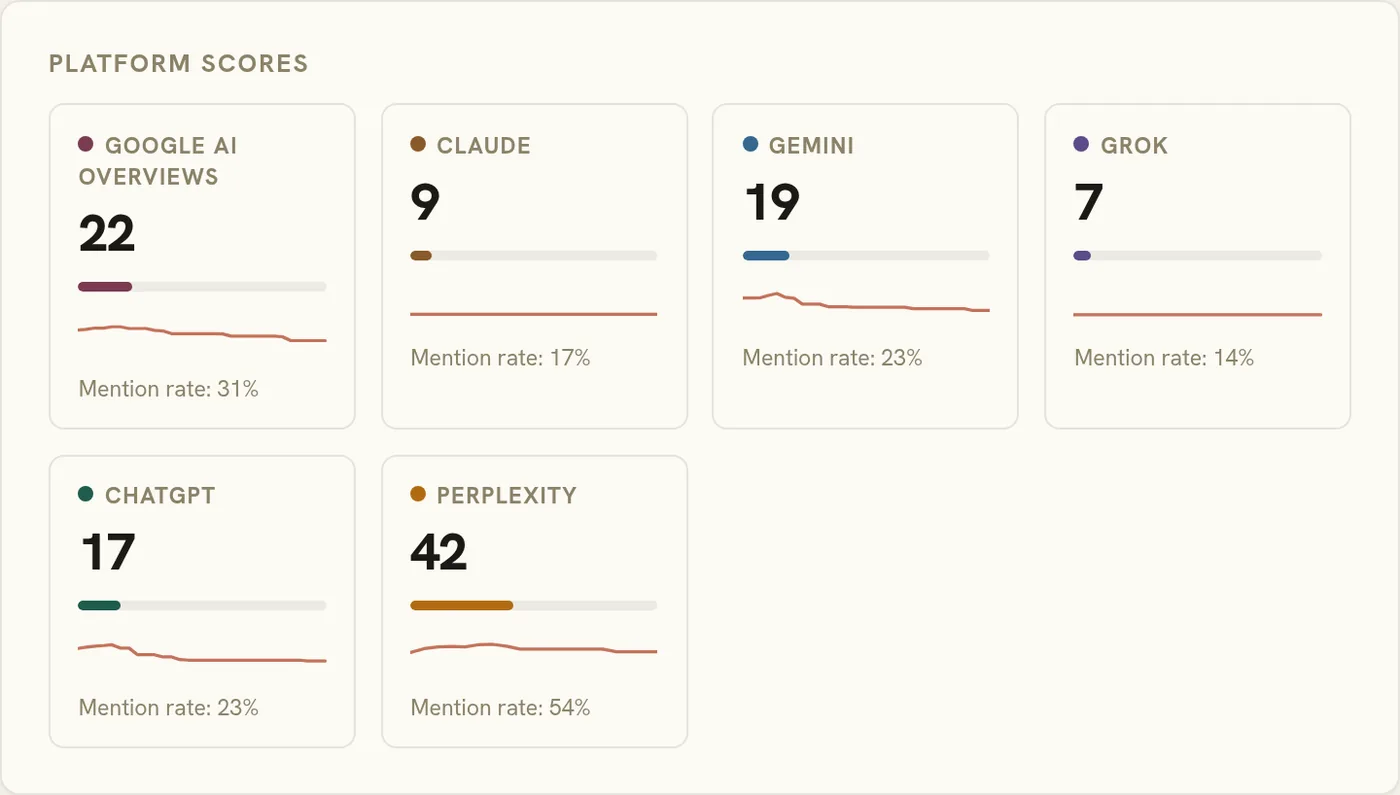
Because it is the most winnable engine. Citations are mandatory, which means every answer distributes credit to specific pages, and our measurement across engines consistently finds Perplexity the most responsive to ordinary content and technical work. A clean, extractable page that answers a buyer question can earn a citation within weeks, without the brand-weight that moving ChatGPT's memory requires. It is also transparent: the sources are printed on every answer, so you can see exactly which pages feed your category and work that list.
Getting your brand into Perplexity answers
The playbook is concrete because the citations are visible. Ask your category's buyer questions and record which domains Perplexity cites; that list is the actual competitive surface. Make your own pages retrievable: crawlable, fast, written in liftable passages. Then earn presence on the recurring third-party sources. The full step-by-step, including what moved real citations, is in the Perplexity visibility guide.
Perplexity vs ChatGPT, briefly
Different centers of gravity: ChatGPT is an assistant with search bolted on, Perplexity is search with an assistant bolted on. ChatGPT's answers vary more (search does not always fire); Perplexity retrieves every time and cites every time. For brand measurement that makes Perplexity the steadier signal and ChatGPT the bigger audience, which is an argument for tracking both, not choosing.
What Perplexity likes to cite
Watch enough Perplexity answers in one category and its source diet becomes legible. It leans on pages that commit to answers: comparison tables, spec sheets, documentation, review platforms, recent listicles, and community threads where a question got a concrete resolution. It is noticeably kinder to fresh content than model memory ever is: a well-structured page published this quarter can out-cite a stale authority page from 2022. And it punishes ambiguity: marketing pages that never state a number or a claim give the engine nothing quotable, so the citation goes to whoever did.
For a brand the diet reads as a work list: put your canonical facts on pages that state them plainly, keep comparison-relevant content current, and check which domains recur in your category's citations. Those recurring third parties are where a placement earns compounding visibility.