Local Business AI Search: Winning the Near Me Answer
What actually happens when someone asks AI for a place near them
"Best coffee near me." "Plumber who can come today." "Where should I get my watch repaired in Portland?" These used to be classic map-pack queries, and for a lot of people they still are. But a growing slice of them now goes to an AI assistant.
They get typed into ChatGPT, spoken to a phone, or answered by an AI Overview before the searcher ever sees a blue link. And when the machine answers, it doesn't show ten options and let the user sort it out. It names two or three places and moves on.
That's the whole stakes of local business AI search in one sentence: the shortlist got shorter, and it's being written by a model. If you run a single-location business, you're not competing for page one anymore. You're competing for a sentence.
The good news, and I mean this genuinely, is that local is one of the few areas where a small business can out-execute a big one. The signals that decide local AI answers are mostly things you already control: your business profile, your reviews, and whether the internet agrees with itself about your basic facts. None of it requires a content team. Most of it requires an honest afternoon of cleanup and a habit you keep up afterwards.
Google Business Profile is the backbone of local AI search
When an engine assembles a local answer it needs structured facts. What you are. Where you are. When you're open. What people think of you. For anything Google-adjacent (AI Overviews, AI Mode, Gemini), the primary source of those facts is your Google Business Profile. It isn't just one signal among many; it's the record everything else gets checked against. And in my experience, other engines lean on the same data indirectly, because the review platforms and map services they cite are themselves cross-referenced against Google's listing.
So treat your profile like a landing page, not a checkbox. That means:
- Category precision. Your primary category does more work than almost anything else. "Bakery" vs. "wholesale bakery" vs. "cafe" changes which queries you're even eligible for. Pick the most specific true one.
- Every field filled. Hours (including holidays), services, attributes, service area, photos that look like your actual business. Empty fields are ambiguity, and models handle ambiguity by picking someone else.
- Consistency with your website. Name, address, phone, hours: identical everywhere. A discrepancy doesn't just cost you a ranking point; it gives a cautious model a reason to leave you out of an answer it can't verify.
- Actual activity. Posts, Q&A answers, fresh photos. I can't prove each update moves an AI answer, but a profile that's visibly alive supports the "this place is currently operating and cared for" inference that models seem to reward.
If you do nothing else after reading this, spend an hour on your profile. It's the highest-return hour in local GEO.
Reviews decide local AI answers
Here's the thing about reviews in the AI era: the star average matters less than you think, and the sentences matter more. A language model doesn't compute your rating: it reads what people wrote. "They fixed my leak the same afternoon and the price matched the quote" is retrievable, quotable evidence. A silent 4.8 is nearly invisible.
Three review properties keep showing up as decisive:
Count sets a credibility floor. An assistant asked for the best taqueria in a neighborhood will rarely name the place with four reviews over the place with four hundred, even if the four are glowing. It's not fair, but it's how corroboration works.
Recency matters more than in classic local SEO, because generated answers try hard not to recommend somewhere that's gone downhill, or gone entirely. A business whose last review is fourteen months old reads as a question mark. A steady trickle, even two or three a month, reads as a living concern. This is why "ask happy customers to leave a review" is no longer optional politeness; it's infrastructure.
Specificity is where the text gets quoted. Reviews that mention the service, the neighborhood, and the problem solved ("best gluten-free bakery in the East End") are exactly the phrases engines match against long-tail local queries. You can't script your customers, and you shouldn't try, but you can ask at the moment of delight, and people who are asked then tend to write specifics.
One warning: never buy or fabricate reviews. Beyond the platform penalties, review authenticity is precisely the thing AI providers are tuning their systems to detect, and a purge takes your recency and your count down together. We've written more about which platforms feed which engines in our review platforms breakdown. It's worth knowing whether your vertical runs on Google, Yelp, Tripadvisor, or somewhere more specialized.
Local directories, boring but still load-bearing
Directory listings feel like 2012 SEO homework, and honestly, most of the directory-submission industry deserved its death. But a core set of listings still matters for AI answers, for a machine-shaped reason: engines cross-reference. Your name and address and phone number should agree everywhere a machine can read them. That means Google, Apple Maps, Bing Places and Yelp, plus the two or three directories that matter in your vertical (Healthgrades for clinics / Avvo for lawyers / The Knot for wedding vendors). When they agree, the model's confidence in your basic facts goes up. When they disagree (an old address from a move, a defunct phone number, two spellings of your name), you become the entry a cautious system quietly drops.
You don't need eighty listings. You need the big five or six, plus your vertical's specialist directory, all saying exactly the same thing. Do it once, calendar a check every six months, done.
Why AI Overviews handles local queries differently
Google's AI Overviews is worth understanding separately, because it doesn't treat local like it treats everything else. For most informational queries, an Overview synthesizes web pages. For local-intent queries, it draws heavily on the same infrastructure as the map pack (Business Profile data, review corpus, proximity) and often presents a small set of named businesses with profile links, sometimes alongside or instead of the classic local pack.
Two practical consequences. First, your Overview eligibility for "near me" queries runs through your profile and reviews far more than through your website's content. A gorgeous site with a neglected profile loses to a plain site with a complete one. Second, proximity is a hard input you can't optimize away: AI Overviews answers "near me" relative to the searcher, so your realistic target is dominance within your actual service radius, not your whole city. That's liberating, if anything: the competitive set is smaller than it looks. For the broader mechanics of how Overviews choose sources, our AI Overviews guide covers the non-local side.
Meanwhile, chat assistants without live map data behave differently again: they lean harder on review-site text and "best X in Y" articles from local press and bloggers. Which means a mention in your local paper's "best brunch spots" roundup can do more for your ChatGPT visibility than anything on your own site. Worth knowing before you spend another weekend rewriting your homepage.
What a single-location shop should prioritize
Let me make this concrete with a made-up example. Say Maya runs a hypothetical bike repair shop in Denver: one location, no marketing budget, a website her nephew built. If she asked me to rank her next moves for local business AI search, I'd give her this order:
- Google Business Profile, completely. One hour of work:
- Right categories ("bicycle repair shop" rather than "bicycle store")
- Full hours for every day
- Services listed individually (tune-ups / wheel builds / e-bike service)
- Twenty real photos
- A review habit, not a review blitz. A card at the register and a follow-up text after big repairs, asking happy customers to say what was fixed. Target: a few new reviews a month, forever. If a review mentions "e-bike" or her neighborhood, that's a bonus she can't buy.
- Consistency sweep. The same name and address and phone and hours everywhere:
- Apple Maps
- Bing
- Yelp
- The local chamber listing
One afternoon of work, then twice a year. 4. One genuinely useful page per service. Not blog content, but service pages. "E-bike repair in Denver: what we service, typical costs, turnaround." Factual, priced where possible, marked up with LocalBusiness schema. These are the pages engines quote when a query gets specific. 5. Two or three local mentions. The neighborhood association's business directory, a local cycling blog's shop roundup, the paper's summer guide. Earned mentions in local sources are the third-party corroboration that chat assistants in particular rely on.
Notice what's missing: no content calendar, no backlink campaign, no tooling until step five is done. Local AI visibility for a single location is mostly a hygiene game with a compounding review habit on top. The businesses that win it won't be the ones with the cleverest strategy. They'll be the ones that actually did the boring parts, then kept doing them.
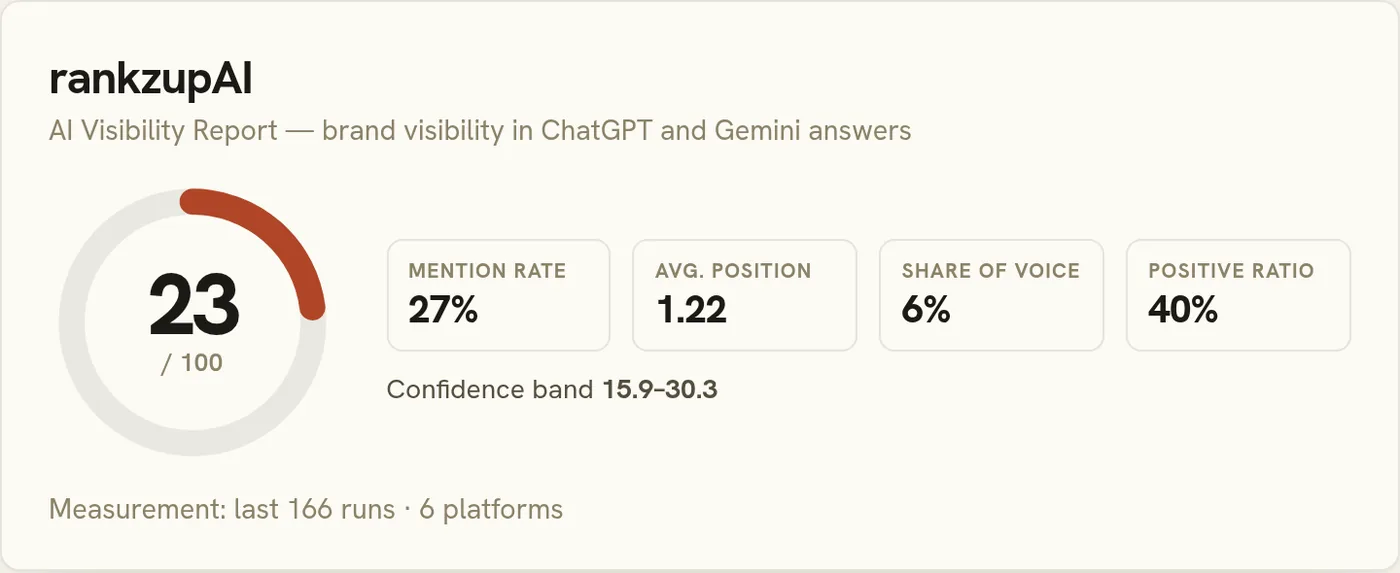
Browse other industry playbooks for sector-specific tactics. On the product side, our local business use case page shows how the tracking is set up.
Local results move with reviews and profiles, both of which change weekly. Measuring AI visibility explains the sampling that separates a real move from noise.