AI Visibility for Small Businesses (SMBs)
Picture a neighborhood cafe. Or a small boutique, a one-person design studio, a family-run spice shop. Your customers don't run everything through Google anymore. More of them open ChatGPT or Gemini and type something like "recommend a quiet cafe good for working near downtown." If your name isn't in that answer, that customer went somewhere else without ever hearing about you. And you never saw it happen.
What AI visibility means for a small business
AI visibility is simple to state. When a customer asks ChatGPT or another assistant a question about what you do, does the answer mention you? This used to be a big-brand problem. Now it's yours too. The customer making the decision no longer scrolls through ten blue links. They read one recommendation and act on it.
Being one of the three or four names in that answer is as concrete as having a storefront on the busy street. Being left out is like keeping the shutters down while you think you're open. It's tempting to file this under SEO, yet it isn't the same job. If you want the distinction, what AI SEO is lays it out plainly.
Why small businesses need to show up in AI answers
Buying habits shifted quietly. Someone who used to type "best accountant near me" now explains their situation to an assistant instead. "I run a small online shop, nothing complicated, can you suggest an affordable accountant?" The assistant hands back a short list. Being on that list means the phone rings. Being off it means you may as well not exist.
Here is a concrete case. Picture a small florist. The shop is lovely and the work is good, but the website is old. Someone asks an assistant for a reliable florist that delivers same-day in their city. The answer names three shops, and our florist isn't one of them. Yet it does same-day delivery too. The problem isn't the quality of the work. The problem is that the web doesn't know about it. AI visibility is about closing exactly that gap.
Here's the part that actually favors a small business. Your ad budget is nowhere near a national chain's. But a spot in an AI answer isn't bought with ad spend. Do the right work and you can earn it without paying. For a shop owner on a tight budget, that's a rare level playing field. In paid search the big brand outbids you every time. In an AI recommendation your small but genuine reputation can come out ahead.
There's also trust. People take a name an assistant suggests more seriously than a random ad. Getting mentioned works like word-of-mouth in digital form. It's the neighbor saying "go there, you won't regret it." That kind of trust is hard to buy. AI visibility is one honest way to earn it.
How to tell if ChatGPT recommends you to customers
The most reliable way is to just try it. Write the questions a customer would ask in their own words. Ask the assistant. Read the answer. Something like "is there a bakery that makes gluten-free desserts in this part of town?" Or "I need someone small who does web design locally." Does your name come up? If not, whose does? That's the whole test.
There's a trap here. Don't ask about your own brand directly. Ask "is my bakery any good?" and the assistant plays nice and hides the truth. Instead ask the way a customer would, with no brand name at all. Only then do you see the real picture.
The second trap is trusting a single try. AI answers wobble a little every time. Showing up once doesn't mean you'll show up tomorrow. Ask the same question on different days a few times. Watch the trend rather than one screenshot. To dig into why you're invisible, why your brand isn't showing in ChatGPT sorts the four usual causes.
How to measure AI visibility on a tight budget
You don't need to rush out and buy an expensive tool. Start by hand. Even a short list tells you a lot. Here's a plain method.
- Write down the eight to ten questions a customer would really ask.
- Ask each one across a couple of assistants like ChatGPT and Gemini.
- Note whether you were mentioned, where you ranked, and which rival got ahead of you.
- Run the same round again two or three weeks later. Watch what moved.
Let's make it concrete. Say you asked ten questions. You showed up in three and missed seven. In all three, the same rival sat ahead of you. That table tells you two things. One, that rival is doing something you aren't. Two, the seven questions you missed are your real opportunity. Now you know where to start.
That table becomes your whole strategy on one page. Where you're weak shows up. Which rival keeps leading shows up. Which question never surfaces you shows up. You start looking at numbers instead of a hunch. "I think I rarely come up" turns into "I show up in two of ten questions." To build the underlying logic first, how to become visible in AI walks a step-by-step path.
Manual tracking only carries you so far. As the question count grows, the work grows. As the engines multiply, it grows again. Repeating the same test every week gets tiring fast. Automated tracking earns its place right here. The AI visibility tool does that repetition for you while you get back to running the shop.
How a small business improves its AI visibility
The bad news first. There's no magic button. The good news is that the steps are clear and most of them are free.
Start by making sure assistants can actually read your site. If your content only appears after someone clicks a menu, bots often miss it. What you do, where you are, and your phone number should sit in plain text on the page. A slick but empty landing page is, to an assistant, mostly an empty page.
The words on the page matter too. Pages that answer a customer's question directly are the ones assistants can use. Questions like "do you deliver same-day," "do you take cards," or "are you open on weekends" should have a clear answer on your site. The assistant finds those clear answers and quotes them. Vague marketing lines don't help much.
Then get the wider web talking about you. AI assistants lean on what others write about you far more than on your own site. Local guides matter here. Industry lists matter. Honest customer reviews matter most. If you run a cafe, landing in a roundup like "quiet cafes for working" beats ten promotional pages on your own site. If you're a plumber, sitting in a local directory with good reviews pulls you forward.
Write your business name the same way everywhere. Don't let it read one way on Instagram, another on the map listing, and something else again on the invoice. Keep the assistant from getting confused. Let it recognize you as one clear business. Make the address and phone match exactly across platforms. That small consistency makes it easier for an assistant to trust you. For local tactics, the local business AI search guide goes deeper. If you sell online, the ecommerce AI visibility guide covers marketplaces and reviews.
A word on what not to spend money on. Don't buy fake reviews. Don't churn out empty pages stuffed with keywords. Don't fall for services that promise results overnight. These either do nothing or hurt you over time. A small budget is precious. Spend it on real reputation, not on tricks.
The last step is the hardest one. Patience. This doesn't happen in a week. Off-site reputation grows slowly. Keep at the right moves and over months you'll start appearing in answers more often. Whoever expects instant results quits early. Whoever stays patient gets ahead.
One asset outranks everything else for a small business with local flavor: the Google Business Profile. Gemini and AI Overviews read it directly for hours, location and reviews, and an out-of-date profile feeds wrong answers that no website fix can override. Keep it current before touching anything fancier. It is the highest-leverage 30 minutes on this list, and the local business guide goes deeper on it.
How rankzupAI helps a small business
Let's be honest. No tool can build a good business for you. What rankzupAI does is more modest, and real. It asks the questions you choose across engines like ChatGPT, Gemini, and Perplexity on a regular schedule. It sees whether the answers mention you. It measures the score you show up with. It gathers which rival is ahead into one panel.
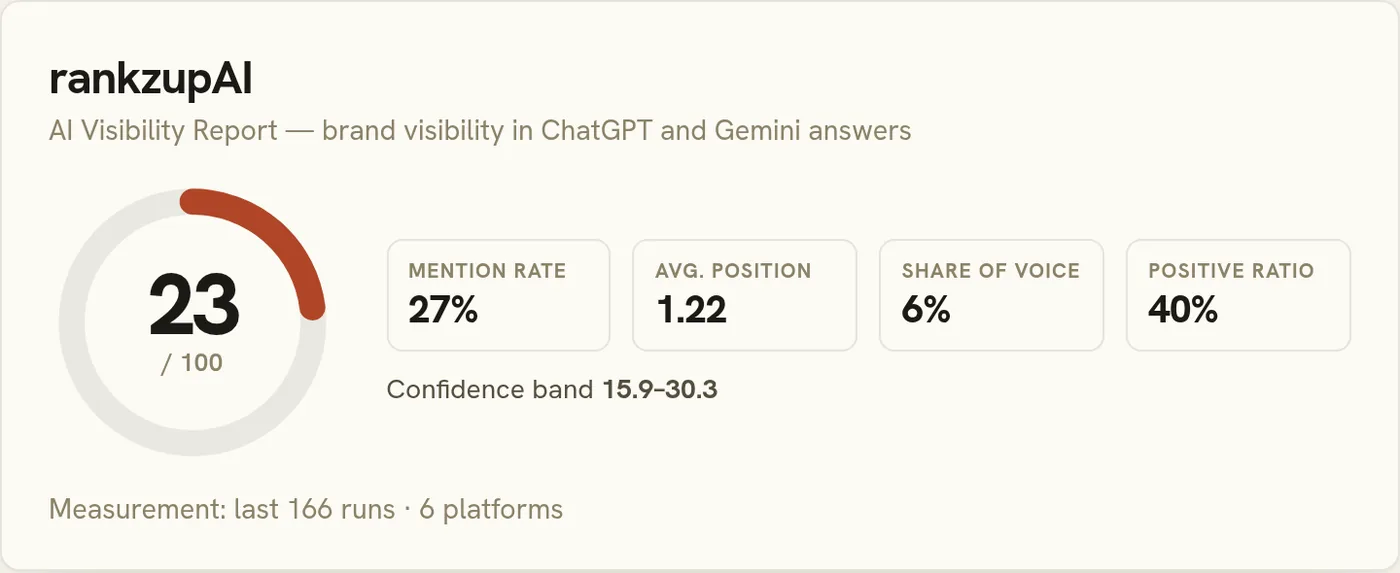
So you don't have to ask dozens of questions by hand every week and pile up screenshots. You see a trend line in the panel. If your score slips, you notice. If a rival climbs, you're told. We don't hide the uncertainty either. Instead of one exact number we show a confidence band, because AI answers are volatile and leaning on a single figure would mislead you. We spell out the method openly on the methodology page. We write down what we measure and what we can't.
If you're after a start that fits a small budget, look at the pricing page. Or without paying anything, run a free check and see where your brand stands right now. Seeing beats guessing, every time.