What Is AI SEO? (And Why the Name Confuses Everyone)
"AI SEO" is one of those phrases everyone uses and no two people mean the same thing by. Before you chase it, it's worth pinning down which one you actually want, because they're barely related.
What is AI SEO?
AI SEO is a loose umbrella covering two very different jobs: (1) optimizing so that AI assistants name your brand in their answers, and (2) using AI tools to speed up traditional SEO work. Same two letters, opposite directions. Confusing them wastes budget, so let's separate them.
Getting into AI answers
This is the one that's actually new, and it has a clearer name: generative engine optimization, or GEO. It's about being mentioned when someone asks ChatGPT, Gemini or Google's AI Overviews for a recommendation. If that's your goal, what GEO is is the real starting point, and it's a different discipline from ranking blue links.
Using AI to do SEO
The other meaning is just traditional SEO with AI assistance: using models to draft content, cluster keywords, or audit a site faster. Useful, but it's a productivity tool, not a new visibility channel. It won't get you into an AI answer on its own.
Which one matters for your brand?
If people are increasingly asking AI instead of Google, you want meaning 1: visibility inside answers. If you just want to do your existing SEO faster, that's meaning 2. Most brands asking about "AI SEO" actually want the first and don't know it has a name yet. For how it differs from classic search, see AEO vs SEO.
Two markets, one confusing name
The fastest way to sort any "AI SEO" product is a two-question test:
| Question | Camp 1: AI does your SEO | Camp 2: measures AI answers |
|---|---|---|
| What does it output? | Content, briefs, tech fixes | Mention rates, ranks, sources |
| What does success look like? | Better classic rankings | Presence in AI answers |
Both camps are legitimate; the problem is only that they share a shelf label. A tool that writes meta descriptions with GPT will not tell you whether ChatGPT recommends you, and a visibility tracker will not write your content. Buying one while needing the other is the most common purchasing mistake in this space.
Where to start if you mean answers
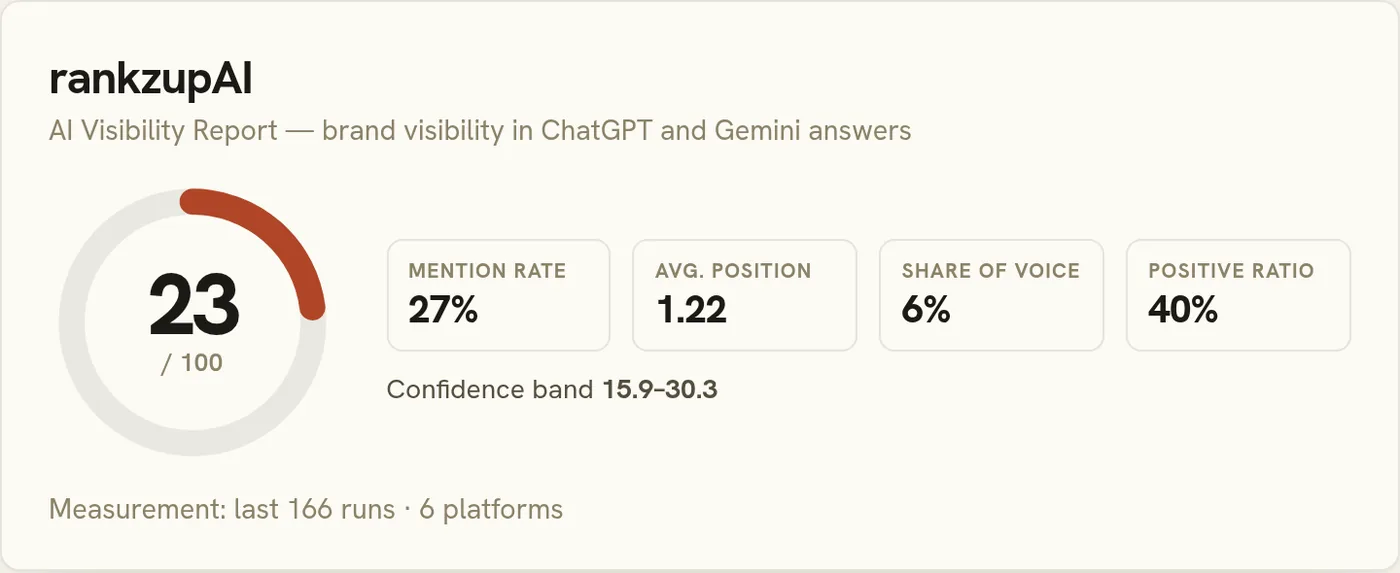
If what brought you here is "are we in AI answers?", the sequence is short: run a free check to see your baseline, read the AEO definition to name the discipline properly, then follow how to get visible in AI answers for the levers. The classic-SEO half of the name is covered by a thousand other sites; this one measures the answers.
A vocabulary map for AI SEO, GEO, AEO and LLMO
The industry produced four names before agreeing on one discipline. GEO (generative engine optimization) is the most precise label for meaning 1: visibility inside generated answers. AEO (answer engine optimization) is the same goal named from the engine's side; what AEO is covers the nuance. LLMO shows up in vendor decks and adds nothing the other two don't. And "AI SEO" is the search phrase real people type, which is why every camp claims it.
Our honest read on the naming mess is in GEO vs AEO vs LLMO: one discipline, too many names. Practical advice: pick one term for internal use and stop translating. What matters is the split above (making answers name you versus making tools write faster), not which acronym your agency prefers.
Does classic SEO still matter in AI SEO?
More than the name suggests. The engines behind meaning 1 are search systems with a language model on top: before an assistant writes an answer, a retrieval step finds candidate pages. That is RAG, and in Google's case grounding. Retrieval runs on crawling, indexing and ranking. A site that classic search cannot read is a site AI answers cannot quote; blocked bots and JavaScript-only content end the story before it starts.
So the overlap is real: technical health, entity clarity and genuinely useful pages feed both channels. The delta is real too: AI answers weigh third-party sources (listicles, reviews, comparisons) far more than your own site, and success is measured in mentions and citations rather than positions. Classic SEO is the floor of AI SEO, not the whole building.
Whichever name you settle on, the work only becomes accountable once it is measured. Measuring AI visibility is the starting point.