How to Get Your Brand Visible in AI Answers
Getting your brand into AI answers isn't a single trick: it's four moves, in order. Measure where you stand, fix the technical access that lets engines read you, earn mentions on the sources they already trust, then measure again. Here's the practical starting path, before you spend money on anything.
How do you get visible in AI answers?
You make sure AI can reach and understand your site, you get the wider web talking about you, and you measure whether it's working, repeatedly, because a single check is noise. If you want the concept behind it first, start with what AI visibility is. Otherwise, do these four things.
Find out where you stand
Pick ten questions a real buyer would ask an assistant about your category, ask them across ChatGPT, Gemini and Perplexity, and note whether you're mentioned and who beats you. That list is your entire strategy on one page. A free check does the first pass.
Make sure AI can reach you
Don't block the answer-driving crawlers, and keep your key content in raw HTML rather than behind JavaScript. Most AI bots don't run JavaScript, so anything that loads late is invisible to them. The technical GEO checklist is the five-minute version.
Earn third-party presence
This is the slow, decisive part. AI answers pull from Reddit, review sites and roundups far more than from your own pages. Getting into legitimate roundups and keeping honest reviews alive is what actually moves mentions. The off-site GEO guide covers how.
Measure and repeat
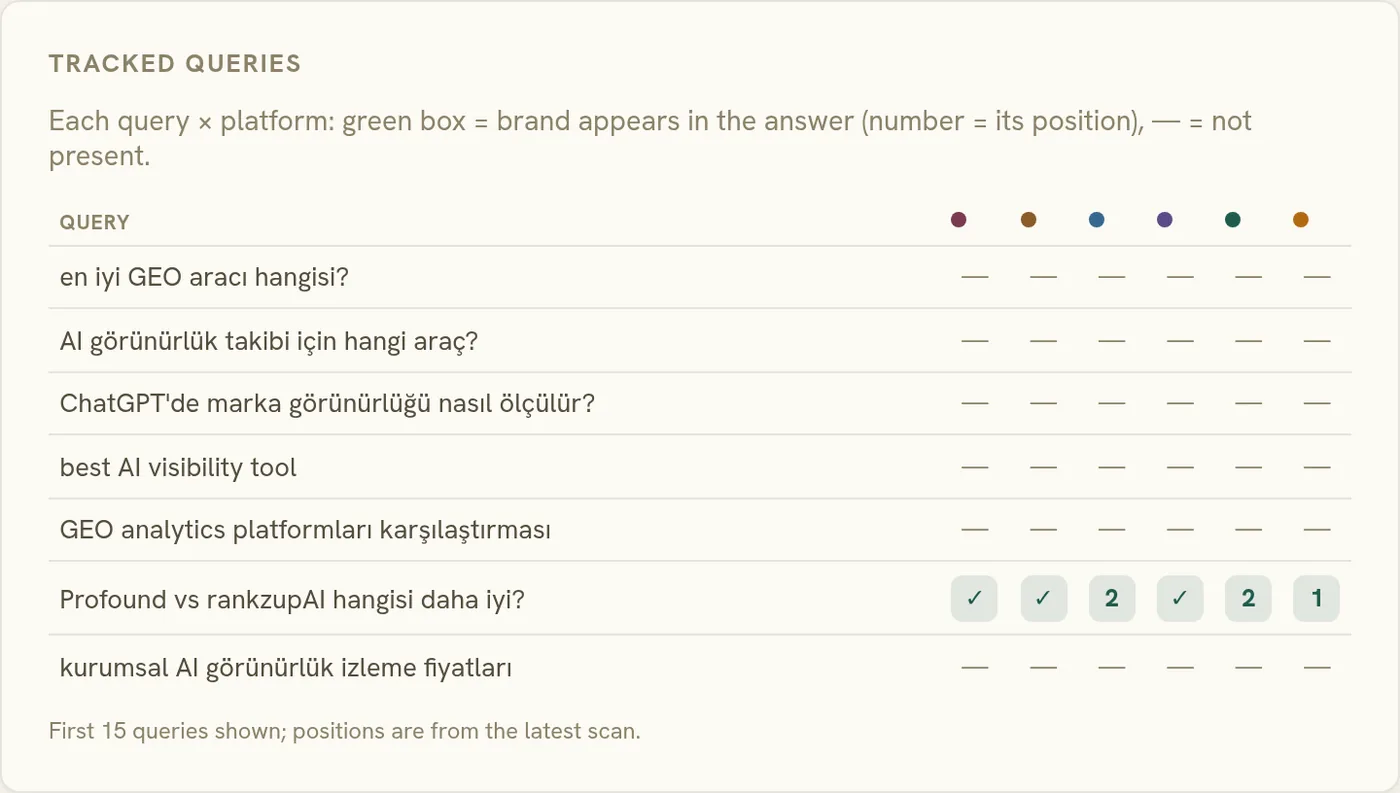
Answers change week to week, so track a set of prompts over time and watch the trend, not a lucky screenshot. That's what an AI rank tracker automates. Do steps one to three, watch step four, adjust. That's the loop.
The five levers, ranked by speed
| Lever | Typical time to show | Effort |
|---|---|---|
| Fix crawler access | Days-weeks | Low, one-time |
| Answer-first page rewrites | Weeks | Medium |
| Entering cited sources | 1-3 months | Medium-high |
| Review volume and quality | 1-3 months | Ongoing |
| Entity clarity (Wikipedia/Wikidata) | Months | High |
The order matters: access first because it is cheap and blocking, sources before entity work because they move answers faster. Teams that start with the slowest lever (entity) get discouraged before anything shows.
A 30-day starter plan
Week 1: build the question set (how to design it) and measure the baseline everywhere. Week 2: run the technical audit, fix access, rewrite the openings of your five money pages answer-first. Weeks 3-4: pull the cited-source list from your scans, pick the two sources that matter most for your questions, and start the outreach or review work there. By day 30 you have a trend line and the first movements on it.
How visibility differs by engine
The levers above work everywhere, but the mix shifts by engine. Perplexity rewards pages that answer and cite cleanly, the fastest feedback loop for citation work. Gemini leans on classic Google ranking plus grounding, so existing SEO strength transfers most directly there. ChatGPT blends model memory with its own search index, which is why crawler access and third-party coverage both matter. And appear in AI Overviews follow Google's index, making them the most SEO-like surface. Measure per engine before optimizing for any single one.
Mistakes that keep brands invisible
- Waiting for the site to be perfect while the sources that actually feed answers go unworked.
- Publishing content nobody asked: pages that answer no real question do not enter answers.
- Checking manually once a month and reacting to a single answer; variance eats that workflow (why a confidence band exists).
- Ignoring the framing. Visible but described wrong can be worse than absent: sentiment is part of visibility.