How AI Shopping Recommendations Work: Beyond Your Own Store
AI shopping recommendations are bigger than your storefront
Ask ChatGPT for a good espresso grinder under $200 and watch where the answer comes from. Some of it is the model's memory of which brands exist. Some of it is retrieved buying guides. Some of it is marketplace listings, review aggregators, and Reddit threads where people argue about burr size. What it almost never is: a single brand's product page speaking for itself.
That's the shape of the problem for ecommerce brands. Your AI visibility is a composite of every place your products live (your store, Amazon, retailer sites, comparison publishers, review platforms, community threads), and the engines weight those sources differently for every question. Optimizing your own storefront is necessary and covered ground; if you run on Shopify, start with the Shopify guide for the on-store mechanics. This article is about everything outside your checkout, because for shopping questions, outside is where most of the answer gets assembled.
One framing before we start: AI shopping answers are consensus machines. When an assistant names five grinders, it's not evaluating grinders; it's reading what the retrievable web already agrees on and summarizing the agreement. Your job, across every channel below, is to become part of that agreement: the same product name, the same claims, the same specs, repeated in enough independent places that the consensus includes you.
Amazon's role in AI shopping answers
Here's the uncomfortable dependency: even if you'd rather sell direct, Amazon is upstream of a lot of AI shopping answers. Assistants cite Amazon listings and Amazon review summaries directly. Buying guides (the listicles the engines lean on) link to Amazon and pull their "check price" data from it. And the shopping-specific experiences the AI companies keep building tend to plug into marketplace and merchant feeds, because that's where clean, structured product data at scale actually lives.
This creates a fork in strategy. If you already sell on Amazon, your listing there is an AI visibility asset, not just a sales channel, which means the title, bullets, and A+ content deserve the same "does this answer a shopper's actual question" pass you'd give your own product pages. An Amazon listing that says "durable stainless steel construction" gives a model nothing; one that says what it fits, what it replaces, and what problem it solves (phrased the way tired humans actually ask) does.
If you're direct-only, be honest about the tradeoff you've chosen. You're keeping margin and customer relationships, and you're absenting yourself from a surface the engines read constantly. That can still be the right call, but it raises the stakes on every other consensus source in this article, because the marketplace shortcut is closed to you. The brands that suffer are the ones that skip Amazon and skip the third-party work, then wonder why assistants recommend whoever the buying guides can link to.
Either way, watch what the engines say when they cite marketplace data about you. Stale listings from discontinued variants, a hijacked listing with wrong specs, or an old price on a zombie seller's page can all end up quoted as fact about your brand.
Product schema hygiene across every surface
Schema markup is table stakes, and most ecommerce sites technically have it. That's exactly why "hygiene" is the right word. The gap isn't presence, it's quality and consistency, and the engines notice the gap even when a validator doesn't.
The baseline is that every product page exposes complete Product markup:
nameanddescriptionpricewithpriceCurrencyavailabilitybrandgtinormpnwhere they existaggregateRatingmatching the reviews visible on the page The full reasoning and implementation detail lives in our guide to schema for AI search, so I'll focus on the failure patterns specific to stores.
Drift is the big one. The schema says in stock; the page says sold out. The schema price is last month's; the visible price changed in a promo. The rating in markup counts reviews from a widget you removed a year ago. Each mismatch is small, but assistants are increasingly summarizing structured data directly into answers, and a wrong availability answer costs you the sale plus a little trust.
Variant mess is the second. If your blue and green variants each generate their own URL with duplicated markup and no canonical discipline, retrieval can surface the wrong variant, the wrong price, or two conflicting versions of the same product. Pick a canonical representation and make the markup agree with it.
And the quiet one: your feed is markup too. Merchant Center and other product feeds get read straight into shopping surfaces. A clean feed with real GTINs, honest availability, and descriptions written for humans is doing schema's job in another format. Treat feed maintenance as part of the same hygiene routine, not as a paid-ads chore someone else owns.
Review velocity feeds AI recommendations
Star ratings are what humans skim; review text is what models read. A recommendation answer that says a jacket "runs small but holds up in real rain" is quoting somebody's review, laundered through a model. That has two practical implications, and both are about velocity rather than totals.
First, recency matters because retrieval favors it and shoppers ask about it. A product with 900 reviews that stopped accumulating in 2024 reads as a discontinued product. A steady drip of recent reviews (on your product pages, on the marketplace listing, on whatever platform your category trusts) keeps you legible as a living product. The mechanics are unglamorous: post-delivery email flows, review requests timed after the product has actually been used, and making the review form not miserable. None of this is new advice; what's new is that the text now gets read by machines composing answers, so specific reviews ("survived two years of daily commuting") are worth far more than "great product, fast shipping."
Second, velocity is a defense. When something goes wrong (a bad batch, a shipping meltdown), the complaints will be specific and vivid, which is exactly the content models quote. You can't delete them. What you can do is respond visibly and keep the flow of newer reviews coming, so the retrievable record shows an incident inside a longer, better pattern rather than an incident as the whole story.
Retailer aggregators and buying guides do the citing
Run your money prompts through the engines and read the citations. For most ecommerce categories you'll see the same cast: big publisher buying guides, niche enthusiast blogs, retailer category pages, price aggregators, and community threads. These are the pages assistants treat as pre-digested consensus, and getting into them is old-fashioned earned media with a new scoreboard.
The workflow is straightforward and tedious, which is why it works. Ask the engines your own category's money questions across a few phrasings. Note every source cited more than once. Sort into three piles: pages you could be added to (pitch the author, offer a sample, be genuinely reviewable), pages you can join (retailer programs, aggregator feeds, comparison sites with submission processes), and pages you can only influence indirectly (community threads: participate honestly or stay out). Then work the piles, most-cited first.
Retailer aggregators deserve a special word. When a big-box retailer or a category specialist stocks your product, their category page becomes a document that says your brand belongs in this category, published on a domain the engines already trust. Distribution decisions have always been sales decisions; they're now also visibility decisions, and that's worth putting on the scale when you weigh a retailer's terms.
Category pages should own the question, not just the product
Most stores treat category pages as furniture: a grid of products, maybe a paragraph of boilerplate written for a 2019 version of Google. That's a wasted surface, because category-level questions ("what's the difference between hybrid and innerspring," "how much should I spend on a first road bike") are exactly what people ask assistants, and the pages that answer them are the ones that get retrieved and cited.
The move is to make your category pages the best short answer to the category's real questions. Above or below the grid, in plain prose: how to choose, what the meaningful differences are, who each type suits, what things cost and why. Write it like the most patient person on your support team explains it on the phone, not like a keyword deliverable. Add FAQ markup where it genuinely fits. The goal is a page an assistant could quote a sentence from without embarrassment, because that's literally the test it will apply.
This is also where a mid-size store can outrun bigger competitors. Big retailers' category pages are auto-generated at a scale that forbids care. A store that actually knows its category can publish the explanation the machine-written pages can't, and earn citations for the deciding-stage questions where brand preference is formed.
A hypothetical cookware brand beyond its own store
Take a made-up brand: Ferrum & Pine, a direct-to-consumer carbon steel pan company with a solid Shopify store and decent search traffic, but near-zero presence in AI answers for "best carbon steel pan."
Reading the citations for their money prompts, they find the answers are built from two big publisher buying guides, one enthusiast blog, Amazon listings and review summaries for three competitors, and a long Reddit thread in a cooking community. Their beautiful product pages appear nowhere, because the question is about the category and their pages only speak about themselves.
Their next two quarters write themselves. Pitch the two buying guides and the enthusiast blog with review samples: that's three of the top citations addressable through plain outreach. Launch a minimal Amazon presence for the hero pan, tuned for question-shaped queries, accepting the margin hit as a visibility cost. Rewrite the carbon steel category page into an honest choosing-and-caring guide, since seasoning confusion dominates the community threads. Fix schema drift from a price-widget migration. And show up in the Reddit thread as a named founder answering seasoning questions without linking anything.
None of this is exotic. It's the same list most brands need, in an order set by reading citations instead of guessing.
Measure ecommerce AI visibility like a channel
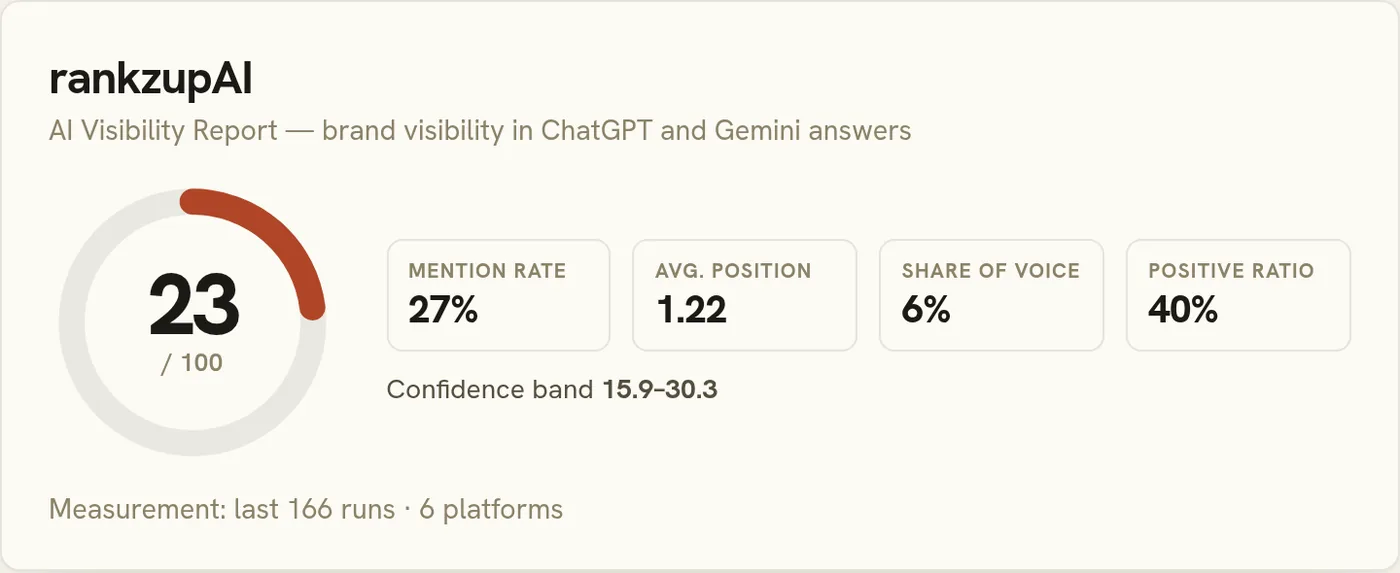
The thread running through all of this: ecommerce AI visibility is portfolio management across surfaces you mostly don't own, so measurement is what keeps you honest. Track your money prompts on a steady cadence, read which sources the engines cite for your category, and treat movement in those citations the way you'd treat a rankings shift. To see how your category behaves relative to others (some are listicle-dominated, some marketplace-heavy, some surprisingly open), the industry index shows how visibility is currently distributed across sectors, which is a useful reality check before you set expectations for yours.
See all industry AI visibility playbooks. Selling software instead? See the SaaS playbook.
Before changing anything in the catalogue, know where you stand. Measuring AI visibility sets the baseline this work gets judged against.