Schema Markup for AI Search: What It Actually Does
Schema markup has become the duct tape of AI search advice. Site not showing up in ChatGPT? "Add more schema." Perplexity ignoring your product pages? "You need JSON-LD." Some of that advice is right, some of it is cargo culting, and telling the two apart matters because schema takes real engineering time to do well.
Here's my honest read on what structured data does for AI answers, what it doesn't, and where I'd spend the effort.
How LLMs Actually Use Structured Data
First, a correction to the most common claim: language models don't "read" your JSON-LD at inference time the way Google's crawler parses it for rich results. When ChatGPT or Claude answers a question from training data, your schema markup from 2024 isn't sitting in the model as a neat key-value store. It got tokenized along with everything else, and there's no evidence models treat a @type: Product block with special reverence.
Where schema does earn its keep is in the retrieval layer. AI search products (Perplexity, ChatGPT with browsing, Google's AI Overviews) fetch and parse live pages. Structured data gives those parsers unambiguous facts: this is the price, this is the company name, this founder is this person and not the actor with the same name. Google has said its systems use structured data to understand content, and AI Overviews are built on top of that same understanding.
The second real benefit is entity disambiguation. If your brand is called "Meridian" (so are a yacht company and a health insurer and a Kentucky town), schema is one of the few machine-readable ways to say which Meridian you are and what you do and how you connect to other entities via sameAs links (the Wikipedia and Wikidata strategy is the natural next step). Knowledge graphs get built from these signals, and knowledge graphs feed AI answers. That's a slow, indirect path, but it's a real one.
The Overclaimed Parts
Let's be blunt about what schema won't do:
- It won't make a model recommend you. Recommendation comes from being mentioned across the corpus: reviews, comparisons, Reddit threads, docs. Schema doesn't manufacture reputation; it clarifies identity.
- It won't fix thin content. A FAQ block wrapped around three vague answers is still three vague answers. Parsers extract what's there; they don't upgrade it.
- "AI-first schema types" are mostly marketing. I've seen agencies pitch exotic types like
speakableas a GEO silver bullet. Adoption of that type by anything is close to nil. Stick to types with documented consumers. - More markup isn't better markup. Stuffing twelve nested types into every page adds maintenance cost and parse errors, not visibility.
If a vendor tells you schema alone will get you cited in AI answers, they're selling you the easy 10% and skipping the hard 90%.
Which Schema Types Matter for AI Visibility
Prioritize in roughly this order:
Organization. This is your entity anchor. Name, logo, URL, founding date, and, most useful, sameAs pointing to your LinkedIn, Crunchbase, Wikidata item, and GitHub. This is how machines confirm that mentions across the web refer to the same company. Put it on your homepage and about page at minimum.
Product / SoftwareApplication. For anything you sell. Price, category, operating requirements, aggregate rating if you legitimately have one. When an AI search tool fetches your pricing page to answer "how much does X cost," clean product markup is the difference between an accurate quote and a hallucinated one.
FAQPage. Not because of the old rich-result carrot (Google gutted that in 2023), but because Q&A-shaped content maps directly onto how people prompt AI assistants. The markup makes the question-answer pairing explicit to any parser. Only mark up questions you actually answer on the page.
Article. Author, date published, date modified. Freshness and authorship are things retrieval systems demonstrably care about, and this is the cleanest way to declare them. If you publish anything, use it.
Everything else (BreadcrumbList, HowTo, Review) is situational. Fine to add, but it's not where the payoff lives.
A Concrete Example
Say you run a hypothetical invoicing tool called Ledgerly. Someone asks Perplexity "what does Ledgerly cost?" Perplexity fetches your pricing page. Without markup, it's parsing a CSS grid of pricing cards and might grab the annual price and present it as monthly. I've watched exactly this class of error happen. With Product schema declaring price: 29, priceCurrency: USD, and billingDuration spelled out, the parser has an unambiguous answer. Same content, same page, materially different odds of being quoted correctly.
That's the realistic ceiling of schema: not "rank higher," but "get represented accurately when you're already being fetched."
Realistic Expectations and Where Schema Fits
Think of structured data as hygiene, not strategy. It's the technical floor: implement Organization and Product markup once, keep it validated, and move on to the work that actually drives AI mentions: being present in the sources models trust, publishing content that answers real questions, earning references on third-party sites. Schema makes those signals easier to attribute to you; it doesn't replace them. If you're new to that bigger picture, our primer on what is GEO covers how the pieces fit.
Timeline-wise: retrieval-layer benefits (accurate live citations) can show up within weeks of implementation, since AI search tools fetch pages fresh. Knowledge-graph and training-data benefits are measured in quarters. Don't ship JSON-LD on Monday and check ChatGPT on Friday.
How to Check Whether It's Working
Validate first: Google's Rich Results Test and the Schema.org validator both catch the syntax errors that make markup worthless. Then test the actual outcome: ask AI search tools factual questions about your company (pricing, category, founding year) and see whether the answers are accurate and whether your pages get cited. If you want a structured look at how AI systems currently represent your brand, run a free GEO audit. It flags missing entity markup alongside the visibility gaps that markup alone can't fix.
My bottom line: schema markup is worth an afternoon of engineering time, maybe two. It's not worth a quarter-long project, and it's definitely not worth believing it's a ranking lever for AI answers. Do it well, do it once, then go earn the mentions that actually move the needle.
This is one piece of the broader technical GEO checklist.
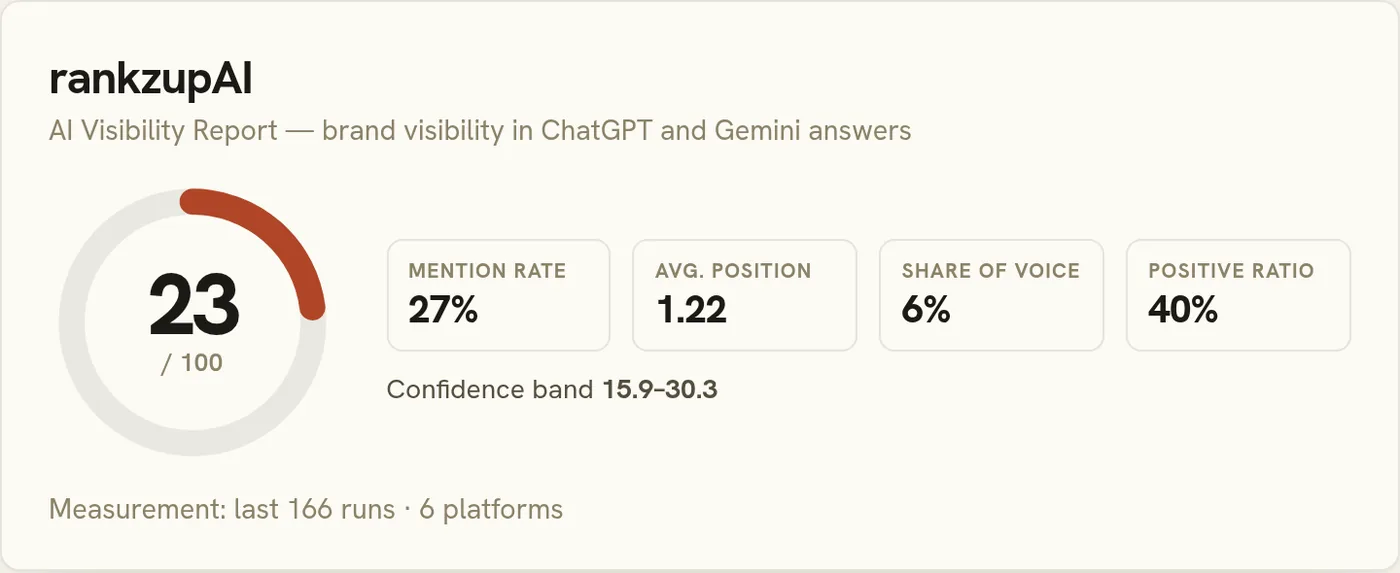
Schema is an input rather than an outcome. Decide how you will measure AI visibility before you ship markup, otherwise you will not know whether it earned you anything.