LLM SEO: What It Is and How to Do It
What is LLM SEO?
LLM SEO is the practice of optimizing so that large language models (ChatGPT, Gemini, Claude, Perplexity and the engines built on them) mention, recommend and cite your brand when people ask about your category. The name is the newest label on a discipline that already has several: GEO, AEO and LLMO all name the same job. Whatever you call it, the goal is identical: when the answer gets written, your name is in it.
What LLM SEO actually involves
Not prompt tricks, and mostly not your own website. Three workstreams carry the discipline. Source work: models learn brands from listicles, comparisons, reviews and reference pages: off-site GEO is where mentions are made. Machine readability: your own pages must be findable, fetchable and quotable by retrieval systems: AI searchability plus writing for extraction. Entity clarity: the model must know exactly who you are and not confuse you with a similar name: Wikipedia, Wikidata and consistent facts.
LLM SEO vs classic SEO
The retrieval layer is shared: search-enabled models find pages through ordinary search, so crawling, indexing and ranking still gate everything (the full comparison). What changes is the unit and the scoreboard. You optimize for mentions and citations instead of rankings; third-party sources outweigh your own site; and success is read per question and per engine, because models disagree about brands far more than search engines ever did.
How LLM ranking works, briefly
There is no index of brands with slots to climb. When a model answers "best X for Y", it generates names weighted by how its training data and its retrieved sources talk about your category. Sources that recommend you strongly and early produce earlier, firmer placement: position in AI answers is downstream of source order. That is why LLM SEO is source work wearing a technical name.
LLM SEO tools
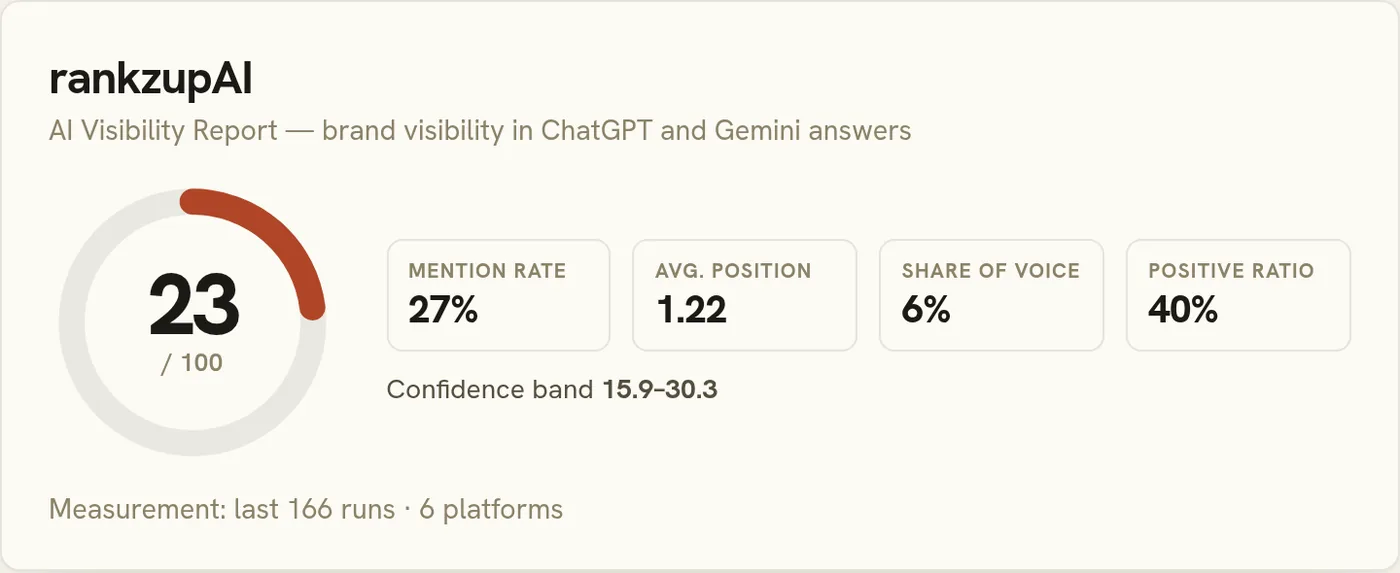
The measurement side has a young but real tool category: trackers that run your category's questions across engines on a schedule and record who gets mentioned, where, and from which sources. That is prompt tracking. The names worth knowing: rankzupAI (mention rate, position, share of voice and sentiment per engine, with confidence bands, from $32/month), Profound (enterprise-priced, agency-oriented), Peec AI and Otterly.AI (mid-market trackers), Scrunch AI and AthenaHQ (platform suites), and Semrush's AI toolkit if you already live in Semrush. On the content side, your existing SEO stack still applies; no separate "LLM content tool" category has earned its keep yet. The full landscape comparison (what to expect, what to pay, what is honest) is in the best AI visibility tools guide; the AEO-specific shortlist lives in the best AEO tools roundup.
How to start with LLM SEO
A short honest sequence. Baseline first: run your category's real buyer questions across engines and see where you stand. Most brands that never worked on this land near zero on brand-free questions. Fix searchability if branded questions fail. Then work the sources the engines already cite for your category: the listicles, the review platforms, the comparison pages. Measure on a schedule, not once: answers are stochastic and single runs mislead. The step-by-step version lives in how to get visible in AI answers.
LLM SEO mistakes that waste quarters
Four patterns burn most of the wasted budget. Prompt-hacking: trying to trick models with hidden text or stuffed phrases. Retrieval systems read rendered pages the way search engines do, and the trick that works today reads as spam in the next model revision. Single-engine tracking: optimizing and reporting on ChatGPT alone while engines disagree about brands. The quarter ends with a win on one surface and silent loss on three. Single-run reporting: screenshotting one good answer for the deck; the same prompt tomorrow says otherwise, which is why rates need windows and confidence bands. And skipping the branded check: if the model fumbles questions about you by name, that is a searchability problem no amount of off-site work fixes. Diagnose it first, not last.