AI Traffic Attribution: Finding AI-Influenced Conversions
Here's a buying journey that happens thousands of times a day and leaves almost no trace in your analytics: someone asks ChatGPT for the best tool in your category, reads a three-paragraph answer naming you and two competitors, closes the tab, and two days later types your brand name into Google and converts. Your attribution report files that as "organic search, branded." The AI answer that actually created the customer appears nowhere.
That's the core problem with AI traffic attribution today: the influence is real and growing, but the measurement plumbing was built for a click-based web, and AI answers mostly don't produce clicks. This piece walks through three things. Why AI-influenced conversions hide. The practical proxies that make them partially visible. And because this space is full of tools claiming otherwise, an honest accounting of what you cannot measure yet whatever you buy.
Why AI Traffic Attribution Breaks the Last-Click Model
Last-click attribution has always been a convenient fiction, but it was a workable fiction when every touchpoint was a page view. A user clicked an ad then a blog post then a comparison site and then converted. Even if last-click gave all the credit to the final step, the earlier steps at least left footprints you could inspect in a multi-touch view.
AI answers break this in a more fundamental way: the touchpoint often produces no visit at all. The model reads the web so your prospect doesn't have to. The research phase (the part of the journey where comparison sites, review roundups, and your own blog used to collect their attribution crumbs) increasingly happens inside a chat window, invisible to every analytics tool on earth. There's no cookie in the conversation, no referrer in the recommendation, no pixel that fires when a model says your brand name.
So the journey didn't get shorter; it got darker. The influence moved upstream into a space you can't instrument, and the only footprints left are the downstream ones: what people do after the AI answer shaped their thinking.
Where AI-Influenced Conversions Hide
Three hiding places account for most of the missing influence.
Zero-click answers. The prospect gets everything they need (the shortlist, the comparison, the pricing ballpark) without visiting anyone. If they later convert, the entry point will be whatever channel they used to act on the decision, not the channel that made the decision. The AI touch is structurally unrecordable because nothing was clicked.
Brand searches after AI exposure. This is the most common laundering path. AI answer names your brand; user googles your brand; analytics credits branded organic search or, worse, your own branded paid ads. Branded search has always partly been harvested demand created elsewhere: TV, word of mouth, PR. AI answers are the newest and fastest-growing contributor to that pile, and they're indistinguishable from the others at the session level.
Dark referrals. Even when an AI answer does produce a click, the trail is unreliable. Some clicks arrive with a usable referrer and land in your reports as chatgpt.com or perplexity.ai traffic. Others arrive stripped (copied links, app-to-browser handoffs, privacy-mediated requests) and fall into direct traffic, the junk drawer of attribution. The AI referral number you can see in GA4 is a floor, never a ceiling: real, useful, and definitely undercounting.
The combined effect is systematic: every one of these paths moves credit away from AI and toward channels you already measure. Which means the honest prior is that whatever AI influence you can see in your data, the true figure is higher. You just can't say how much higher, and anyone who claims they can is selling something.
Practical Proxies for AI Traffic Attribution
You can't measure the thing directly, but you can triangulate it. Three proxies, each individually weak, together directional:
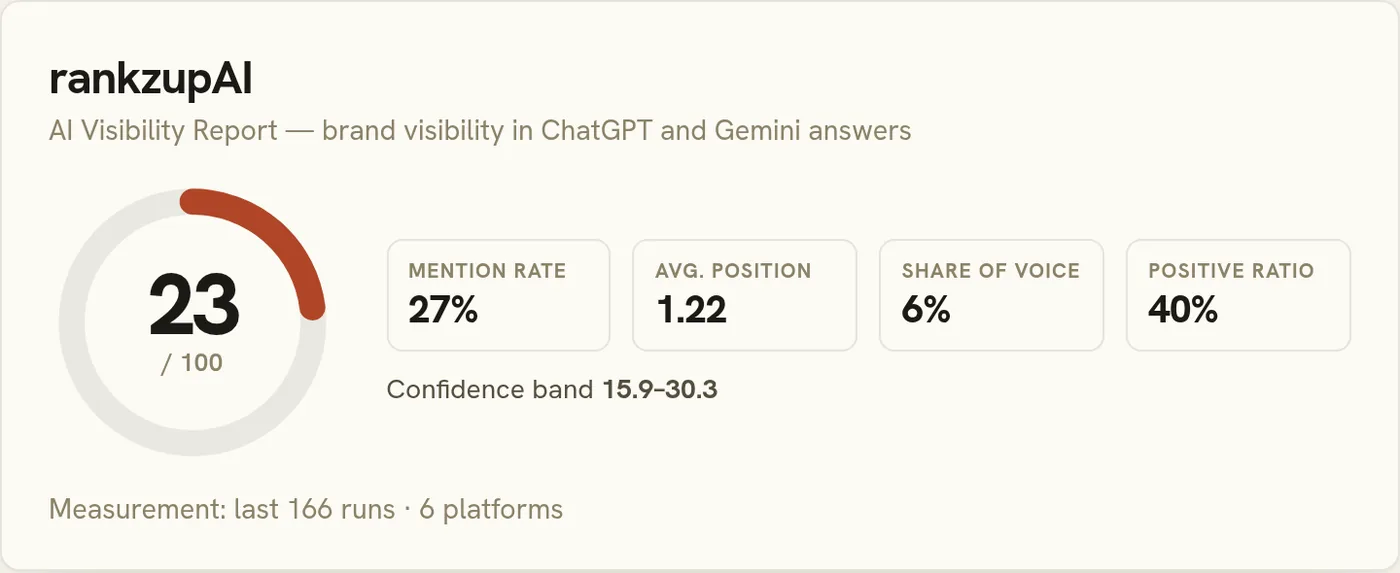
Branded search lift. Watch branded query impressions and clicks in Search Console over time, and lay that curve next to your AI visibility trend. If your mention rate and share of voice in AI answers have been climbing for two quarters and branded search is climbing too (with no TV campaign, no PR spike, no other obvious driver), AI exposure is a plausible contributor. This is correlation, not causation, and you should present it as exactly that. But sustained co-movement across quarters, checked against other explanations, is legitimate directional evidence. The discipline is doing the "what else could explain this" pass before you attribute anything.
"How did you hear about us?" The unglamorous champion. A free-text question on your signup flow or demo form, plus sales reps trained to ask and log the answer, captures what analytics never will: "ChatGPT recommended you," "I asked Perplexity for alternatives to X." Self-reported attribution is noisy (people misremember, and the first-mentioned source isn't always the first-touch source), but it's the only instrument that reaches into the chat window, because it asks the one witness who was there. Keep the field free-text (option lists prime answers), tag AI mentions consistently, and track the proportion over time rather than treating any single response as data.
AI referral trend. The measurable click-through slice, sessions arriving from AI domains, is small for most sites, but it's your one directly instrumented AI signal, so treat it with respect: segment it (the AI referral check does the first pass), watch its growth rate, and compare its conversion behavior against other channels. Many teams find these visitors convert unusually well, which makes sense: someone who clicks through from an AI answer arrived pre-sold by the recommendation. Just resist the tempting extrapolation of multiplying this segment by some assumed "dark ratio" to estimate total influence. That ratio is unknowable, and a made-up multiplier corrupts an honest measurement.
A hypothetical example of how the triangulation reads in practice: say a made-up project management tool, Taskhaven, starts GEO work in January. By June, its tracked share of voice has roughly doubled on two engines. Over the same stretch: branded search impressions up meaningfully with no campaign to explain it, AI referral sessions tripled (from tiny to small, but converting at twice the site average), and "heard about you from ChatGPT/Claude/Perplexity" mentions in the how-did-you-hear field went from occasional to a steady drumbeat. No single one of those proves anything. All three moving together, with alternative explanations checked and ruled out, is a case a reasonable executive will accept, as evidence of influence, not as a revenue attribution.
The Honest Limits of AI Attribution Today
Now the part that vendors mumble: full AI traffic attribution is not currently possible, and no tool (ours included) can give you a true end-to-end number.
What you fundamentally cannot know today: which specific conversions were influenced by an AI answer, what fraction of your branded search is AI-created demand versus word of mouth versus old-fashioned brand strength, and what happens inside conversations you can't observe. The chat window is a black box by design. Assistant platforms don't pass conversation context to your site, and there's no AI-side equivalent of search query reports. Some of this may improve (referrer conventions could standardize, platforms could expose more), but that's the future, not the present.
This has two practical consequences. First, be suspicious of precision. A dashboard claiming "AI drove $214,000 in revenue last quarter" is an estimate wearing a costume; somewhere under it sits an assumed multiplier or a model you can't audit. Directional claims honestly labeled beat precise claims that dissolve under questioning. Second, don't let the measurement gap set the strategy. The influence exists whether or not you can attribute it: buyers are demonstrably starting journeys in chat windows, and absence from those answers costs you deals no report will ever itemize. "Hard to measure" and "not worth doing" are different sentences.
The workable position: instrument everything that can be instrumented (referrals, branded search, self-reported source), track AI visibility itself as the upstream metric it is, present the combined picture as triangulated evidence with stated limits, and revisit as the measurement layer matures. That framing also happens to be exactly what senior audiences respond to. Our guide on reporting AI visibility to executives covers how to package it without overselling. The teams that win this channel won't be the ones with the prettiest attribution number. They'll be the ones who acted on honest partial evidence while competitors waited for perfect data that isn't coming.
This is one of eight metrics in the complete AI visibility measurement playbook.