Chunk Optimization for LLMs: How to Structure Content
What is chunk optimization for LLMs?
Chunk optimization is structuring your content into self-contained passages that a language model can retrieve and cite on its own. AI systems split a page into chunks and pull the single most relevant one, not the whole page. A well-optimized chunk answers one question completely without leaning on the paragraph above it. Get this right and the model can lift your passage straight into an answer.
The term does double duty. It names a thing and a practice at once. A chunk is a retrievable passage of text. Chunk optimization is the work of writing so those passages stand on their own. This page covers both.
How LLMs chunk and retrieve content
When an AI assistant answers a question, it rarely reads your page top to bottom. Behind the scenes a retrieval system has already broken your page into segments. Each segment gets turned into an embedding, a numeric fingerprint of its meaning. When someone asks a question, that question becomes an embedding too. The system compares fingerprints and fetches the closest matches. This is often called passage-level retrieval, and it is the backbone of retrieval-augmented generation (RAG) that powers tools like Perplexity, Google AI Overviews and ChatGPT's search mode.
Two things follow from this. First, the unit that competes for a citation is the chunk, not the article. Your 2,000-word guide might be excellent, yet the model only ever sees the one passage that matched. Second, the boundaries matter. If the sentence that answers the question sits in one chunk and the context that makes it meaningful sits in another, the model can retrieve a fragment that reads as incomplete or, worse, wrong.
In practice, most systems lean on the structure already in your page. Headings, paragraph breaks and list items are natural seams, and many chunkers cut on those before falling back to a fixed window of tokens. That is good news for a writer. It means the same headings and short paragraphs that help a human reader also hand the machine cleaner places to cut.
You cannot see exactly where an engine draws its chunk boundaries. Engines are not open boxes, and their segmentation shifts over time, so treat any rule of thumb as a tendency rather than a guarantee. What you can do is write so that any reasonable boundary still leaves a passage that makes sense on its own.
Why chunk optimization matters for AI visibility
A page that ranks well in classic search can still lose in AI answers. The reason is the mismatch between how you wrote the page and how the machine slices it. A chunk that only works when read after the previous three paragraphs is a chunk that fails the moment it gets pulled out alone.
Two failure modes show up again and again. A chunk gets retrieved but reads as vague, so the model uses a competitor's clearer passage instead. Or a chunk gets retrieved with a dangling reference ("as noted above", "this approach") and the model either drops it or fills the gap with a guess. Both cost you the citation, and in the second case they can put words in your mouth.
This is the on-page half of generative engine optimization. Much of GEO lives off your site, in reviews and roundups and mentions. Chunk optimization is the part you fully control. It is also the cheapest lever, because it is mostly rewriting you already know how to do.
How to optimize your content chunks
Six rules cover most of the work. Each one keeps a passage standing on its own.
One idea per section. Give every H2 or H3 a single job. When a section tries to answer three questions, no clean chunk maps to any one of them, and the retrieval system has nothing tidy to grab.
Write self-contained passages. Strip out backward references. Phrases like "as mentioned above" or "the method described earlier" break the instant a chunk travels alone. Restate the thing in one short clause instead.
Lead each chunk with the answer. Put the direct answer in the first sentence, then explain. A passage that opens with the payoff survives being quoted. A passage that buries the answer in sentence five usually gets skipped.
Use descriptive headings as chunk anchors. A heading like "How LLMs chunk content" tells the retrieval system what the passage under it is about. A heading like "Going deeper" tells it nothing. Headings often act as chunk boundaries, so make them earn their place.
Resolve pronouns and entities inside the chunk. Name the subject rather than pointing at it. Write "the chunk" instead of "it", and name your product or the tool instead of writing "the platform", at least once per passage. The model should never need the paragraph above to know who or what you mean.
Give each chunk the right length. Too short and the passage lacks the context to stand alone. Too long and it dilutes the one point that matched the query. A tight paragraph or two, one idea, fully answered, is the target.
A chunk that gets cited, before and after
Here is a passage that would retrieve badly. It is vague and it depends on everything around it.
As we saw, it can really help with this. Doing it well makes a big
difference, and most teams see better results once they get the hang
of it. The tips above should get you started.
Pulled out of context, that chunk answers nothing. There is no subject, no claim a model can quote, and three dangling references.
Now the same idea, rewritten to stand alone.
Chunk optimization improves AI visibility because language models
retrieve one passage, not the full page. A self-contained passage
that answers a question in its first sentence is far more likely to
be quoted than one that depends on the paragraphs around it.
The second version names its subject, makes a claim in the first sentence and needs no surrounding text. That is a chunk an engine can lift whole. We hold our own posts to the same test. Before publishing, we read each passage as if it appeared alone in an answer, and if it only makes sense in place, we rewrite it.
Chunking versus writing for AI extraction
These two get mixed up, so it helps to draw the line. Chunk optimization is about structure and boundaries, how you split content so each passage stands alone. Writing for AI extraction is about phrasing, how you word a claim so it is quotable and clearly attributable to you.
You need both. A perfectly bounded chunk written in mush still will not get cited. A crisp, quotable sentence buried in a section that answers four questions at once will not get retrieved in the first place. Structure gets your passage found. Phrasing gets it quoted. Fix the structure here, then handle the wording in the extraction guide.
How this relates to technical GEO and on-page work
Chunk optimization sits inside the broader on-page checklist. If your pages render key content only through JavaScript, or your headings are not crawlable, no amount of clean chunking helps, because the passage never reaches the index. The technical GEO checklist covers that groundwork.
It also connects to how AI breaks one question into many. Engines often expand a single query into several sub-questions, then retrieve a chunk for each. Well-bounded passages give them more precise targets to match. That mechanism is worth understanding on its own, and we cover it in query fan-out explained.
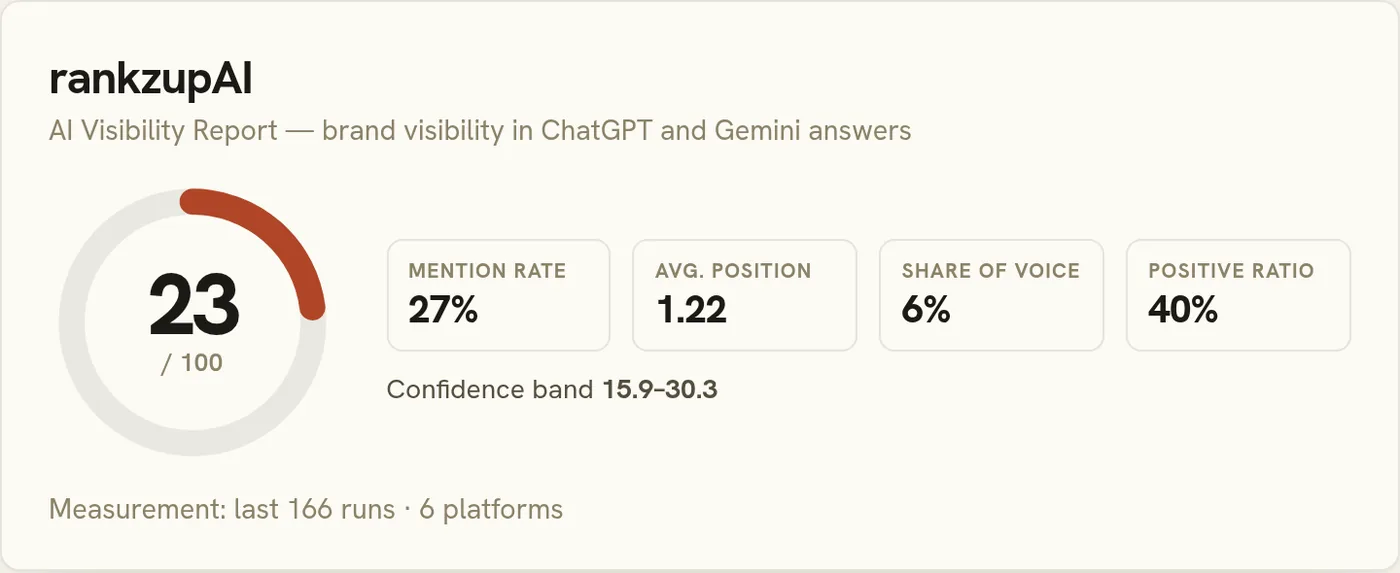
The point of all this is visibility you can measure. Structuring your chunks is only worth the effort if the passages actually start getting cited. Our methodology describes how we track that, and the RankzupAI platform is built to tell you whether your chunks show up in AI answers over time.
Common questions about chunk optimization
What's the ideal chunk size? There is no fixed number, because every engine chunks differently and you cannot see the boundaries. Aim for one idea per passage, fully answered in a short paragraph or two. That travels well across whatever segmentation an engine uses.
Do headings affect chunking? Often, yes. Headings frequently act as chunk boundaries and they signal what the passage below is about. Descriptive headings help a retrieval system understand and place your content.
Does chunk optimization help with AI Overviews? It helps anywhere content is retrieved passage by passage, and AI Overviews work that way. A self-contained passage that answers the query directly is easier for the Overview to pull and cite.
Is this the same as RAG chunking? They share the mechanism but sit on opposite sides. RAG chunking is an engineering task inside a retrieval system you build. Chunk optimization here is the publisher side, writing your content so someone else's retrieval system handles it well.